Wayground logo

Free Printable Worksheets

Font size

S
M
L
XL
Worksheets

Natural Selection

Total questions: 25

Worksheet time: 15mins

Name
Class
Date
1.

What is a mutation?

a)

When animals have extra legs

b)

When a frog changes from a tadpole

c)

When genes or DNA have been alterd or changed

d)

When RNA is upside down

2.

Are mutations ALWAYS passed down to offspring?

a)

Yes

b)

No

3.

Why do offspring share traits from both parents?

a)

offspring choose the traits they want

b)

offspring get 75 percent of the traits from their father

c)

offspring get 50 percent of each parents DNA

4.

What must organisms do when an environment changes?

a)

Adapt

b)

Camoflauge

c)

become common

d)

fight

5.

Which is NOT an example of an adaptation?
a)
A bird's beak allows it to crack open hard nuts.
b)
A zebra's stripes allow it to confuse its predators.
c)
A frog's large hind legs allow it to jump from danger.
d)
A cat sleeps on the sofa to avoid the vacuum cleaner.
6.
Which of the following is a term for a group of similar organisms that can reproduce fertile offspring?
a)
individual
b)
population
c)
species
d)
fossil
7.
What is it called when better adapted organisms survive to pass traits along to their offspring.
a)
Evolution
b)
Natural Selection
c)
Extinction
d)
Artifical Selection
8.
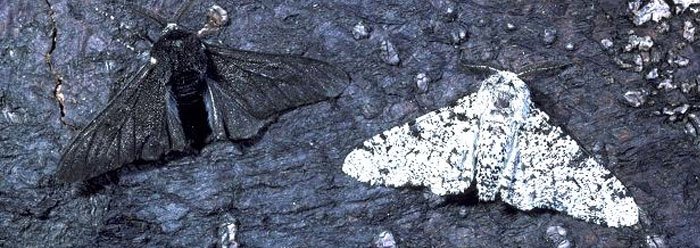
Why did the population of peppered moths in England change from light to dark after the Industrial Revolution?
a)
Light moths were easy to see against sooty trees and were eaten
b)
Light moths were killed by soot
c)
The birds that ate the dark moths were killed by soot
d)
Dark moths were produced by industrial processes
9.
Which organisms are most likely to survive?
a)
the best adapted
b)
the fastest
c)
the strongest
d)
the most domesticated (tamed)
10.
The trees these moths used to live on were white, but have been covered in soot from coal factories. Which moth will be more successful in this environment?
a)
Dark moth
b)
Light moth
c)
Both will be equally successful
d)
Neither will be successful
11.
Why are advantageous traits more likely to be passed onto offspring?
a)
Because they are more likely to survive and reproduce.
b)
Because they come from dominant alleles.
c)
Because they come from recessive alleles.
d)
Because the trait is an acquired phenotype.
12.

The adaptations brought about by natural selection happen in about a 10 year time span

a)

True

b)

False

13.

Mutations are...

a)

beneficial when it helps survival and reproduction

b)

neutral when it doesn't help or hinder survival and reproduction

c)

harmful when it lowers the chance for survival and reproduction

14.
Which statement is true of Natural Selection?
a)
It is the same process as artificial selection
b)
It is the mechanism of evolution
c)
Animal and plant breeders select desired traits to produce changes in a species
d)
It is a much shorter process than artificial selection
15.

When two or more populations no longer successfully reproduce it is called...

a)

species

b)

order

c)

speciation

d)

a shame

16.

Which are causes of speciation? Choose all that apply

a)

Isolation caused by mountains, rivers and man-made structures

b)

preference for different foods

c)

change in environment

d)

different mating behaviors

17.

Members of a species can breed with other members of the same species.

a)

True

b)

False

18.

When members of a species breed, their offspring are able to produce offspring.

a)

True

b)

False

19.

Members of the same species always live in the same geographical location.

a)

True

b)

False

20.

Members of the same species will always have a similar body appearance.

a)

true

b)

false

21.

Mutations can be...

a)

Harmful

b)

Beneficial

c)

Neutral

d)

All of the Above

22.

Mutations are...

a)

Changes in the sequence of DNA

b)

Broken chromosomes

c)

Bad genes

23.

What is a type of Mutation?

a)

Deletions

b)

Insertions

c)

Substitutions

d)

All of the Above

24.

Mutations are SOMETIMES helpful to the organism.

a)

true

b)

false

25.

Which are causes of speciation? Choose all that apply

a)

Isolation caused by mountains, rivers and man-made structures

b)

preference for different foods

c)

change in environment

d)

different mating behaviors