wayground logo

Free Printable Worksheets

NEW

Font size

S
M
L
XL
Worksheets

QA 3 Review

Total questions: 40

Worksheet time: 30mins

Name
Class
Date
1.

Which of the pictured is responsible for us being able to see objects?

a)

Transmission

b)

Reflection

c)

Refraction

d)

Scattering

e)

Absorption

2.
A wave with a large wavelength will have a ______ frequency and _____ energy
a)
high, low
b)
high, high
c)
low, high
d)
low, low
3.

An object that allows ALL light to pass through clearly and easily

a)

translucent

b)

opaque

c)

transparent

d)

reflect

4.

An object that allows NO light to pass through which creates a shadow behind the object

a)

opaque

b)

transparent

c)

translucent

d)

translated

5.

An object that allows SOME light to pass through, but not all of it. Objects appear fuzzy/blurry on the other side

a)

translucent

b)

transparent

c)

opaque

d)

optical

6.
As the frequency of an electromagnetic wave increases, the amount of energy in that wave...
a)
increases.
b)
decreases.
c)
stays the same.
7.
What happens to the energy of a photon as the frequency of the wave increases? 
a)
The energy increases
b)
The energy decreases
c)
The energy stays the same 
8.
High frequency waves have _________ wavelengths.
a)
varying
b)
long
c)
the same
d)
short
9.
What is C?
a)
Angle of incidence
b)
Angle of reflection
c)
Incident ray
d)
Reflected ray
10.
What is B?
a)
Angle of incidence
b)
Angle of reflection
c)
Incident ray
d)
Reflected ray
11.
Law of reflection state that - The angle of incidence is .................. to the angle of reflection.
a)
equal
b)
double
c)
half
12.
........... – the angle between the normal and the reflected ray.
a)
Angle of incidence
b)
Angle of reflection
c)
Angle of coincidence
d)
Angle of direction
13.
Which window is opaque?
a)
Window 1
b)
Window 2
c)
Window 3
d)
None
14.
Waves that require a medium are called 
a)
mechanical waves
b)
transverse waves
c)
light waves
d)
gamma rays
15.
What happens when you increase the amplitude of a sound?
a)
it makes the sound louder
b)
it makes the sound travel faster
c)
it increases the wavelength of the sound
d)
it increases the frequency of the sound
16.

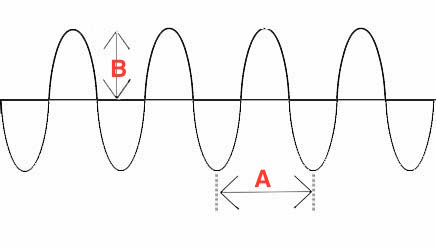
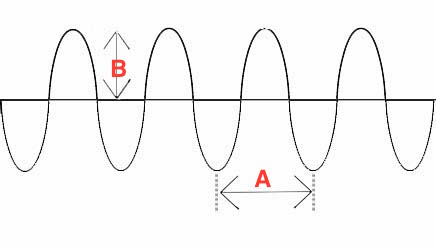
What kind of wave is pictured below?

a)

compressional wave

b)

transverse wave

c)

sound wave

d)

mechanical wave

17.
What can electromagnetic waves travel through?
a)
mediums
b)
empty space
c)
solely solids
d)
both mediums and empty space
18.
What property of this wave is represented by the letter "A"
a)
amplitude
b)
crest
c)
trough
d)
wavelength
19.
What property of the wave is represented by the letter "B"?
a)
amplitude
b)
crest
c)
trough
d)
wavelength
20.
What do waves carry from place to place?
a)
Energy, but not matter or particles
b)
Energy and matter or particles
c)
Matter or particles but not energy
d)
Neither energy nor matter or particles
21.
A wave carries...?
a)
energy only
b)
matter only
c)
energy and matter
d)
neither
22.
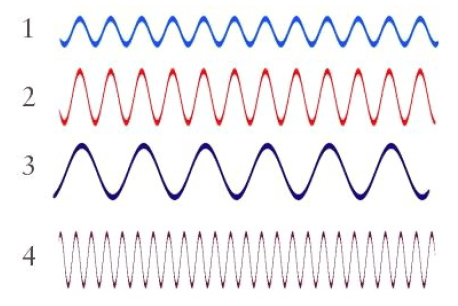
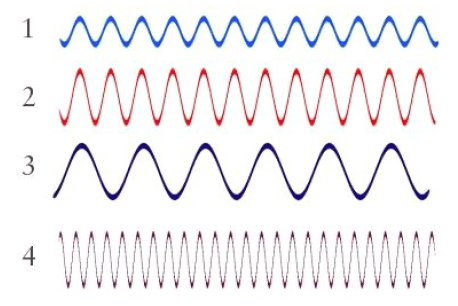
Which wave in the diagram has the greatest frequency?
a)
1
b)
2
c)
3
d)
4
23.
Which wave in the diagram has the greatest wavelength?
a)
1
b)
2
c)
3
d)
4
24.

The highest point on a wave is:

a)

the crest

b)

the trough

c)

the top

d)

the coast

25.

What is a wavelength?

a)

How many waves pass a certain point

b)

The distance from one wave crest to another

c)

The entire length of a wave

26.

What is the unit for frequency?

a)

Meters

b)

Hertz

c)

Decibels

d)

Meters/Second

27.
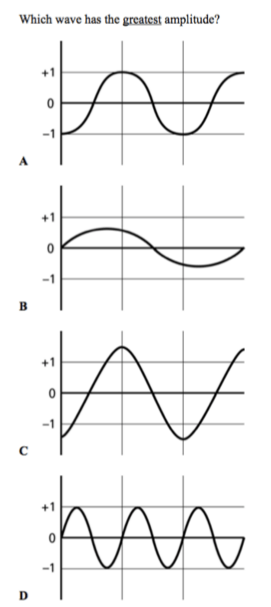
Which wave has the greatest amplitude?
a)
A
b)
B
c)
C
d)
D
28.

What is the definition reflection?

a)

The bending of waves as they enter a new medium

b)

Bouncing back of waves from a surface that it can’t pass through

c)

The bending of waves as they pass through openings or around corners

29.

What is the definition of Refraction?

a)

The bending of waves as they enter a new medium

b)

When two interfering waves have a displacement in the opposite direction, crest and trough overlap. Zero amplitude.

c)

When two interfering waves have a displacement in the same direction, two crests and two troughs overlap. Increased amplitude.

30.
The following is a picture of what type of mirror? 
a)
Convex Mirror
b)
Concave Mirror
c)
Plane Mirror
d)
Flat Mirror
31.
The following is a picture of what type of mirror? 
a)
Convex Mirror
b)
Concave Mirror
c)
Plane Mirror
d)
Flat Mirror
32.
The point where the rays meet is known as....
a)
Fire
b)
the focal point
c)
refraction
d)
Plane of the lens
33.
This is an example of a __________ mirror.
a)
Concave
b)
Convex
c)
Plane
d)
Magnifying
34.

Which of the pictured is responsible for us being able to see objects?

a)

Transmission

b)

Reflection

c)

Refraction

d)

Scattering

e)

Absorption

35.

As light travels through a lens it causes an object to appear larger, this is due to which behavior?

a)

Transmission

b)

Reflection

c)

Absorption

d)

Refraction

36.
You can see this text, your desk, and the person in front of you because light is being _______.
a)
absorbed
b)
refracted
c)
diffracted
d)
reflected
37.
When standing in the sun this behavior allows you to warm up as light and other waves hit your clothes. 
a)
Reflection
b)
Refraction
c)
Absorption
d)
Transmission
38.
Refraction occurs when _____________
a)
the wave's speed changes by entering a new medium
b)
a wave bounces off of a boundary
c)
waves parts meet each other
d)
waves bend around a barrier
39.
Which of the following represents refraction?
a)
A
b)
B
c)
C
d)
D
40.
Which of the figures represents reflection?
a)
A
b)
B
c)
C
d)
D