wayground logo

Free Printable Worksheets

NEW

Font size

S
M
L
XL
Worksheets

Covalent Review #2 (Naming, diatomic & properties)

Total questions: 25

Worksheet time: 50mins

Name
Class
Date
1.
What two types of atoms make a covalent bond?
a)
2 Nonmetals
b)
1 Nonmetal and 1 Metal
c)
2 Metals
d)
2 Noble Gases
2.
According to the octet rule most elements need _______ valence electrons.
a)
2
b)
8
c)
6
d)
18
3.

What is a valence electron?

a)

an electron that is found in the outermost shell of an atom.

b)

an electron found in the innermost shell of an atom.

c)

an electron found in the middle shell.

4.

Why do all bonds form?

a)

so the number of protons equals the number of electrons

b)

so an atom can become unstable

c)

to fill the outermost energy level

5.

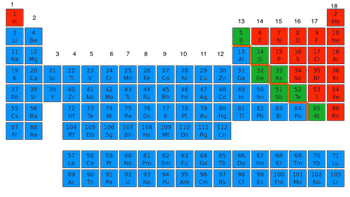
Where are the nonmetals located on the periodic table in this picture? 
a)
Blue
b)
Red
c)
Green
6.

Where are metals located on the periodic table in this picture?

a)
Blue
b)
Green
c)
Red
7.
Is hydrogen considered a metal or a non-metal?
a)
A metal
b)
Nonmetal
c)
Metalloid
8.

Covalent bonds can be found as _______?

a)

only solids

b)

solids and liquids

c)

solids, liquids and gases

9.

What is a property of covalent bonds?

a)

They cannot be dissolved in water.

b)

They have a high melting point

c)

They are orange

10.
In Cl2, the 2 is known as
a)
the subscript.
b)
the coefficient.
c)
the molecular mass.
d)
the number of protons.
11.
Bonds between two nonmetal atoms are 
a)
covalent.
b)
ionic.
c)
incomplete.
d)
complete.
12.
N2, Cl2, and O2 are all 
a)
diatomic molecules.
b)
ionic bonds.
c)
of equal mass.
d)
solids.
13.
Oxygen is commonly found as 
a)

a solid - O

b)

a gas - O2

c)
unknown
14.
In what form is Nitrogen commonly found in nature?
a)

gas - N2

b)

solid - N

c)
unknown
15.
Diatomic molecules are __________ found in nature as their single element: I, O, N, H, Br, Cl, or H.
a)
often
b)
never
c)
sometimes
d)
always
16.

What are the seven diatomic elements?

a)

H2, Cl2, Br2, O2, N2, I2, F2

b)

H2, Cl2, I2, F2, Hg2, Br2, Fe2

c)

H2, Cu2, Ni2, B2, O2, I2, Fe2

17.

Is Fe2 a diatomic element?

a)

Yes

b)

No

18.

Is K2 a diatomic element?

a)

Yes

b)

No

19.

Is O2 a diatomic element?

a)

Yes

b)

No

20.
How do covalent bonds form?
a)
Donating & receiving valence e- between atoms.
b)
Opposite slight charges attract each other between compounds.
c)
Scientists are still not sure how they form.
d)
Sharing valence e- between atoms.
21.
What is the correct name for C4H6?
a)
Carbon Hexahydride
b)
Pentacarbon Pentahydride
c)
Hexacarbon Tetrahydride
d)
Tetracarbon Hexahydride
22.
What is the correct name for NO?
a)
Mononitrogen Monoxide
b)
Nitrogen Monoxide
c)
Mononitrogen Dioxide
d)
Nitrogen Oxide
23.
What is Sulfur Trichloride?
a)
SCl3
b)
SiCl3
c)
SCl4
d)
Si3Cl
24.

The formula for triphosphorous monochloride is

a)
PCl3
b)
P3Cl
c)
P3Cl3
d)
PCL
25.
A covalent compound made of one sulfur and two oxygen atoms would be named
a)
sulfur dioxide.
b)
sulfur oxide.
c)
disulfur oxide.
d)
sulfide oxygen.