wayground logo

Free Printable Worksheets

Font size

S
M
L
XL
Worksheets

Functions vs relations

Total questions: 49

Worksheet time: 2hrs 44mins

Name
Class
Date
1.
Which graph does NOT pass the vertical line test? A vertical line should only touch one point at a time, if it is a function.
a)
Graph 1
b)
Graph 2
c)
Graph 3
d)
Graph 4
2.
Is the relation a function? Why.
a)
Yes, because the x-value 11 has two y-values pair with it.
b)
Yes, because each x-value has only one y-value paired with it.
c)
No, because the x-value 11 has two y-values pair with it.
d)
No, because each x-value has only one y-value paired with it.
3.
a)
This is a Function
b)
This is Not a Function
4.

Does the graph represent a function? Does it pass the vertical line test?

a)

Yes, because the vertical line test shows there are no repeating input values

b)

No, because the vertical line test shows there are repeating input values that have different outputs.

c)

No, because there are not enough dots to tell

d)

Yes because the dots are all red

5.

Look at the table.


Is the relation a function?

a)

Yes

b)

No

6.

Look at this set of ordered pairs: (4, 13), (1, 12), (6, 9)


Is this relation a function?

a)

Yes

b)

No

7.

Look at the graph.


Is this relation a function?

a)

Yes

b)

No

8.

Which of these relations is a function?

a)
b)
c)
d)
9.

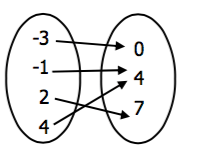
Does the mapping represent a function?

a)

It does represent a function because each input has one output.

b)

It does represent a function because each output has one input.

c)

It does not represent a function because an input has more than one output.

d)

It does not represent a function because an output has more than one input.

10.
Does this mapping diagram represent a function?
a)
No, because there are repeating input values
b)
Yes, because there are no repeating input values
11.
a)
Function
b)
Not a Function
12.
a)
Function
b)
Not a Function
13.
a)
Function
b)
Not a Function
14.
a)
Function
b)
Not a Function
15.

Which set of ordered pairs represents a function?

a)

{(3, 2), (4, 4), (6, 3), (4, 5)}

b)

{(4, –3), (4, –1), (4, 3), (4, 6)}

c)

{(–4, 4), (–2, 4), (1, 4), (5, 4)}

d)

{(–3, –3), (–2, –4), (–2, –1), (–1, –5)}

16.
For the function {(0,1), (1,-3), (2,-4), (-4,1)}, write the domain and range.
a)
D: {1, -3, -4,}
R: {0, 1, 2, -4}
b)
D: {-4, 0, 1, 2}
R:{-4, -3, 1}
c)
D: {0, 1, 2, 3, 4}
R:{1, -3, -4}
d)
D: {0, 1, 2, -4}
R: {1, -3, -4, 1}
17.
a)
{1, 2, 3, 4, 5}
b)
{-1, 1, 2, 3}
c)
{1, 2, 3, 5}
d)
[1, 5]
18.
What is the range of the following relation:
(9, -2) (4, 3)  ( 8, 10) ( -4, 8)
a)
{-4, 4, 8, 9}
b)
{-2, 3, 8, 10}
c)
{(9, -2) ( 4, 3)}
d)
{(8, 10) (-4, 8)}
19.
What is the range?
a)
{-3, -1, 2, 4}
b)
{0, 4, 7} 
c)
{0, 4, 4, 7}
d)
{7, 4, 0}
20.
Is the relation a function? Why.
a)
Yes, because the x-value 11 has two y-values pair with it.
b)
Yes, because each x-value has only one y-value paired with it.
c)
No, because the x-value 11 has two y-values pair with it.
d)
No, because each x-value has only one y-value paired with it.
21.
a)
Function
b)
Not a Function
22.
Identify the domain of the following relation:
a)
{-6, 14, 2, 28}
b)
{(-6,14), (0,32), (2,38), (4,44)}
c)
{-6, 0, 2, 4}
d)
{14, 32, 38, 44}
23.

How do you read f(x)?

a)

f x

b)

f of x

c)

f parenthesis x

d)

f with an x inside parenthesis

24.
f(x) is the same thing as ______.
a)
y
b)
x
c)
input
d)
an equation
25.

If f(x) = 2x+1, what would the function look like once you substitute in a 1 to find f(1)?

a)

f(x) = 21+1

b)

f(1) = 2 (1) + 1

c)

f(1) = 2x (1) + 1

26.

If a question asks you to find f(2), what does that mean?

a)

Let x = 2

b)

Let y = 2

27.

What is f(6) for the function f(x)=3x-8

a)

-8

b)

10

c)

-144

d)

answer not here

28.

f(x)=5x12f\left(x\right)=5x-12 What is f(4)f\left(-4\right)

a)

-32

b)

-3

c)

-12

d)

3

29.

Given h(x)=x24 what is h(6)?Given\ h\left(x\right)=x^2-4\ what\ is\ h\left(6\right)?  

a)

32

b)

0

c)

-4

d)

77

30.

What is f(5) for the function f?

f(x) = 2(x - 7)

a)

3

b)

-4

c)

-3

d)

1

31.
What is the function of the table?
a)
y=3x+1
b)
y=4x-2
c)
y=x+1
d)
y=x+7
32.
What is the function of the table?
a)
y=x*2
b)
y=x+2
c)
y=x/2
d)
y=x-2
33.
What is the function of the table?
a)
y=x*6
b)
y=x+10
c)
y=x-10
d)
y=x÷6
34.
What happened during C to D point?
a)
not moving
b)
increasing speed at a constant rate
c)
moving at a constant speed
d)
moving at 0 m/sacceleration
35.
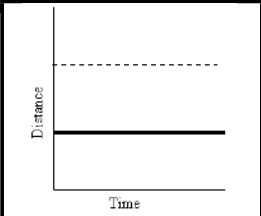
What does this graph represent?
a)
Constant speed
b)
Acceleration
c)
Not moving
36.
What happened during O to A point?
a)
not moving
b)
constant speed
c)
accelerating
d)
decelerating
37.
Which of the graphs shows that one of runners started 10 yards further ahead of the other? 
a)
Graph A
b)
Graph B
c)
Graph C
d)
Graph D
38.
Between which seconds is the line INCREASING?
a)
Between 7 and 12 seconds
b)
Between 0 and 1 seconds
c)
Between 1 and 5 seconds
d)
Between 12 and 13.5 seconds
39.
Between which seconds is the line DECREASING?
a)
Between 7 and 12 seconds
b)
Between 0 and 1 seconds
c)
Between 1 and 5 seconds
d)
Between 12 and 13.5 seconds
40.
a)
F
b)
G
c)
H
d)
J
41.
a)
F
b)
H
c)
G
d)
I
42.
a)
A
b)
B
c)
C
d)
D
43.
a)
F
b)
G
c)
H
d)
J
44.
The distance-time graphs shown represent the motion of a car. Which of the following graphs represents the car at constant speed?
a)
graph A
b)
graph B
c)
graph C
d)
graph D
45.
Which runner was faster?
a)
Runner A
b)
Runner B
46.

Which runner stopped for a rest?

a)

Albert

b)

Bob

c)

Charlie

47.
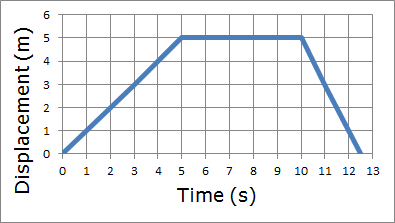
According to the graph how far does the person travel in the first 5 seconds?
a)
2 m
b)
10 m
c)
0 m
d)
5 m
48.
a)

Opposite Tom's home is a hill. Tom climbed slowly up the hill, walked across the top, and then ran quickly down the other side.

b)

Tom walked home then he stopped and waited to watch the sky. After that, he ran to get home .

c)

Tom was walking to the park. He stopped and waited so the baby chicks could pass.

49.

Which situation might this graph describe?

a)

Driving to raleigh, stopping, and coming back home.

b)

Running a mile, taking a break, running back home

c)

Running part way across a football field, picking up a football, running back to the start

d)

Biking to a friends house, stay the night, bike back home.