
 Worksheets
Light Test
Total questions: 41
Worksheet time: 10hrs 15mins
Which color has the longest waves?
red
orange
yellow
green
The frequency of light is 7.14 x 10¹⁴ Hz. What is the wavelength?
3.00 x 10⁸ m
4.20 x 10⁻⁷ m
2.25 x 10²³ m
3.90 x 10⁻⁹ m
The frequency of light is 7.14 x 10¹⁴ Hz. What is the energy?
4.73 x 10⁻¹⁹ J
1.20 x 10-48 J
1.13 x 10⁻¹⁷ J
4.97 x 10-49 J
Calculate the energy of light with a frequency of 5.10 x 10¹⁴ Hz.
3.38 x 10⁻¹⁹ J
5.88 x 10⁻⁷ J
9.62 x 10¹² J
1.04 x 10⁻¹³ J
What is the frequency of ultraviolet light with a wavelength of 1.24 x 10⁻⁷ m?
2.42 x 10¹⁵ Hz
8.22 x 10⁻³⁴ Hz
3.00 x 10⁸ Hz
1.04 x 10¹³ Hz
What is the frequency of infrared light with a wavelength of 1.05 x 10⁻⁶ m?
6.96 x 10-40 Hz
2.86 x 10¹⁴ Hz
9.62 x 10⁻¹³ Hz
2.55 x 10⁻¹⁹ Hz
Which term describes a 3D region where the electron are most likely found?
Ground state
Orbital
Quantum
Excited State
Which term describes a packet, or certain amount, of energy?
Ground state
Orbital
Quantum
Excited State
In order to become excited, an electron must....
absorb a constant stream of energy
absorb a quantum or a several quanta of energy
release a constant stream of energy
release a quantum or a several quanta of energy
In order to emit light, an electron must....
absorb a constant stream of energy
absorb a quantum or a several quanta of energy
release a constant stream of energy
release a quantum or a several quanta of energy
Why is the Bohr Model not the currently accepted model for the atom?
Because it only explains atomic emission spectra, not any other chemical properties of elements
Because it conflicts with the Periodic Table
Because it only explains the chemical properties of hydrogen
Because it doesn't explain time travel

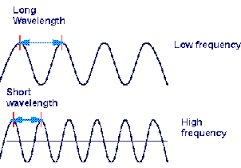
Wavelength and Frequency are related in that...
they are always the same
when one increases, the other decreases (inversely proportional)
there is no correlation
they both vary in an irregular pattern

Which of the following is the correct unit for frequency?
Hz
m
J
J⋅s
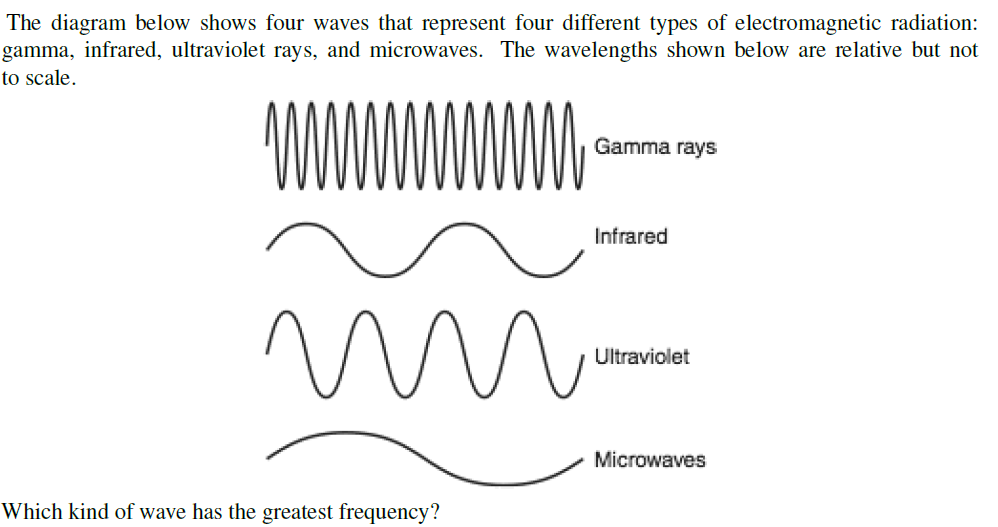
The speed of a wave is its wavelength multiplied by its ___________
Or the formula
C = λ x ν
amplitude
vibration
frequency
reflection
Who decided that the position & momentum of the electron cannot be known at the same time?

wavelength and distance
position and momentum
the Hulk and time travel
atomic radius and frequency
What is an orbital?
Chewing gum
The path the sun takes around the moon
A 3D area outside the nucleus where electrons are found
The electron cloud
Photons are....
a packet of electromagnetic energy
an excited state
the ground state
frequency of time travel

Which of the following has the lowest frequency?
The color blue
The color green
The color yellow
The color violet
Which of the following has the lowest frequency?
The color blue
The color green
The color red
The color yellow


Shorter Wavelengths have ____Energy,Longer Wavelengths___Energy?
Lower,Higher
Higher,Lower

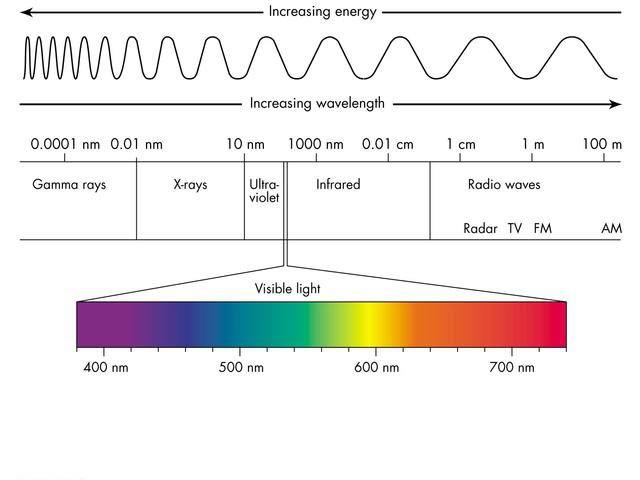
What is the correct order of the visible light spectrum starting with the lowest frequency?
Red, yellow, orange, blue, violet, indigo
Violet, indigo, blue, green, yellow, orange, red
Green, yellow, blue, indigo, red, orange
Red, orange, yellow, green, blue, indigo, violet

Scientists observed a celestial object emitting a wavelength of 3 x 10⁻¹⁰m. What type of telescope did the scientists have to use to view this?
Radio wave
Infrared ray
X-ray
Gamma Ray
Scientists observed a celestial object emitting waves with a frequency of 1.41 x 10⁸ Hz. What type of telescope did the scientists have to use to view this object?
Radio wave
Microwave
X-ray
Ultraviolet wave
Scientists observed a celestial object emitting a wavelength of 10−12 m. What type of telescope did the scientists have to use to view this?
Radio wave
Infrared ray
X-ray
Gamma Ray

If an electron moves from n=4 to n=2 it ____
absorbs energy
emits electromagnetic radiation

b is showing...
excited state to ground state
ground state to excited state
emitting energy
Planck's constant
a is showing...
excited state to ground state
ground state to excited state
absorbing energy
Planck's constant
e is showing...
excited state to ground state
absorbing energy
emitting energy
Planck's constant
Which electrons are moving from lower energy level to a higher energy level?
a
b & e
a & f
c
Which electron is moving from n=2 to n=4
a
b
f
c
Which electron is emitting light?
a
b
e
None of them
A radiation has a wavelength of 750 nm. What color would this be?
Red
Violet
Green
Orange

