
NEW
Font size
 Worksheets
Higher Chemistry - Proteins
Total questions: 20
Worksheet time: 14mins
The rate of hydrolysis of protein, using an enzyme, was studied at different temperatures. Which of the following graphs would be obtained?


Essential amino acids are defined as the amino acids which
are necessary for building proteins
humans must acquire through their diet
plants cannot synthesise for themselves
are produced when any protein is hydrolysed.

Molecule X has the structure shown.
Which of the following could be produced by partial hydrolysis of X?


Uncooked egg white is mainly composed of dissolved proteins. During cooking processes, the proteins become denatured as the protein chains unwind, and the egg white solidifies. Why do the protein chains unwind?
the protein is hydrolysed
the molecules do not collide with the correct geometry
the protein becomes an emulsifier
Heat breaks hydrogen bonds
Once cooked and eaten, the digestive system breaks protein chains into amino acids with the help of enzymes.
State the name of the digestion process where enzymes break down proteins into amino acids.
condensation
hydrolysis
hydrogenation
reduction

State how many amino acid molecules joined to form this section of protein?
4
5
6
7
What type of chemical structure does a protein have?
ester
polymer
fatty acid
hydrocarbon
Which of the following is an example of a protein?
oils
fats
soap
enzymes
Which of these does not apply to proteins?
They form major structural materials of animal tissue
They help with the maintenance and regulation of life processes
The provide a rich energy source
They can form spirals, sheets, or other complex shapes
Amino acids contain
an amine group and a carbonyl group
an amine group and a carboxyl group
an amide group and a carbonyl group
an amide group and a carboxyl group
The link that forms in a protein is known as
ester link
protein link
peptide link
amine link
When proteins in foods are denatured, what effect does this have?
the are able to dissolve which make it easier to cook with
the texture of food is changed
the food goes off
no effect
Enzymes are commonly added to dishwasher tablets. These are used to break down proteins.
The proteins are broken down into small, water-soluble molecules. Name the small, water-soluble molecules made when proteins are broken down completely.
carboxylic acids
amino acids
fatty acids
glycerol
State the term used to describe the change in shape of enzyme molecules.
deactivate
oxidation
reduction
denature
Suggest a change in conditions which would cause an enzyme molecule to change shape.
increase concentration
increased pressure
increased temperature
addition of a catalyst
Amino acids are the building blocks of proteins. When they join up together to make a protein, what type of reaction is this?
hydrolysis
addition
condensation
hydrogenation
When a protein is denatured...
it is broken into amino acids
hydrogen bonds are broken
peptide links are hydrolysed
water molecules are eliminated
When two amino acids react in a condensation reaction, water is eliminated and a peptide link is formed. Which of the following represents this process?
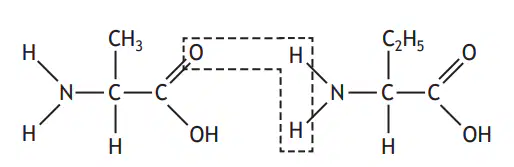
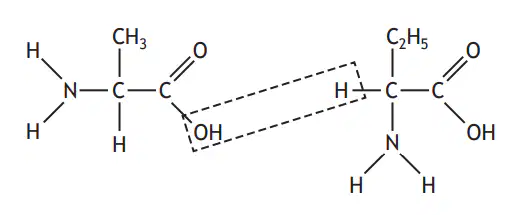

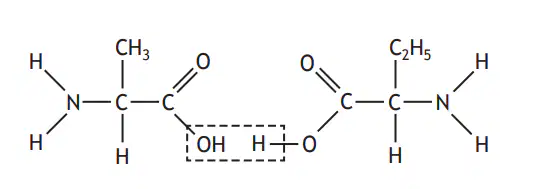
What else is produced when amino acids join up to form proteins?
Nothing Else
Carboxylic Acid
Water
Hydrogen
What is an enzyme?
An environmental catalyst
A biological catalyst
A non-biological catalyst
A substance that slows down chemical reactions in a biological environment

