
NEW
Font size
 Worksheets
Bonding and Nomenclature Practice
Total questions: 36
Worksheet time: 26mins
Why do all bonds form?
to fill the outermost energy level
so an atom can be unstable
so the number of protons and electrons can equal.
so they can gain neutrons.
Valence electrons are found
outermost energy level
innermost energy level
some where in the electron cloud
An atom with 1 valence electron 'needs' a full shell, so it can either gain 7 electrons or lose 1. Which is more likely to occur?
nothing
gain 7
lose 1
How do covalent bonds form?
by sharing electrons between atoms
by donating or receiving electrons
What two types of atoms make a covalent bond?
2 nonmetals
2 metals
1 metal and 1 nonmetal`
How many valence electrons does Boron have?
1
2
3
4
Ionic bonds are between
metals and nonmetals
2 metals
2 nonmetals
Atoms are most stable when their outer shell is full or complete.
true
false
How are ionic bonds formed?
transfer of electrons
sharing of electrons
Group numbers on the periodic table help us determine
number of valence electrons
state of the element (solid, liquid, gas)
Electrons are involved in chemical reactions, not protons or neutrons.
true
false
Water is an example of what?
covalent compound
ionic compound
Salt (NaCl) is an example of what?
ionic compound
covalent compound
Atoms involved in a covalent bond are not charged, while atoms involved in an ionic bond are charged (negative or positive)
true
false


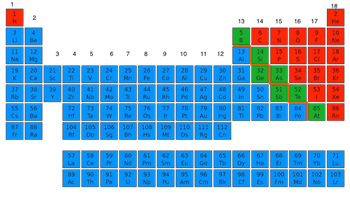

What is the correct formula for a compound formed from Na + and S -2
Na2S
NaS2
Na2S2
NaS
What is the correct formula for a compound formed from the ions K + and N-3
KN
KN3
K3N3
K3N
What is the oxidation number of magnesium in magnesium chloride (MgCl2)?
+2
-2
12
0
Zinc fluoride
ZnF2
Zn2F
ZnF
Zn2F4
How many Aluminum atoms are in Al2O3?
3
5
2
1
When naming ionic compounds, the metal is always named first and the nonmetal is always named second.
True
False
Write the correct formula for Sodium Chloride.
SC
SCl
NaCl
NaCl2
What is the proper name for CH4?
Monocarbon hydride
Carbon tetrahydride
Monocarbon tetrahydride
What is the proper name for S2O2?
Sulfur oxide
Sulfur dioxide
Sulfur (II) oxide
Disulfur dioxide

