
NEW
Font size
 Worksheets
Universal Gravitation
Total questions: 40
Worksheet time: 38mins
Law of Conservation of Energy
If I double the mass of one object, but don't change anything else... What happens to the gravitational force between two objects?
What would the force between them be if the distance between them were doubled?
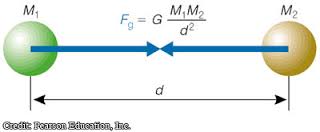
Calculate the gravitational force between two objects when they are 0.750m apart. Each object has a mass of 5.00kg.
2.96x10⁻⁹N
3.00x10⁻⁶N
2.22x10⁻⁹N
2.23x10⁻⁸N

How is the gravitational force between to objects related to their mass
They are directly proportional
They are inversely proportional
They do not affect each other
They are equal

If the distance between 2 masses is increased then the force of gravitation between them will...
increase
decrease
stay the same

If the mass of either m1 or m2 is increased then the force of gravitation between them will...
increase
decrease
stay the same

Which of the following formulas is the correct equation for the law of Universal gravitation?
F=r2GM1M2
F=mg
F=m1m2Gd2
F=d2KQ1Q2
Find the distance between two objects whose masses are m1 = 4,500 kg, and m2 = 8,700 kg; if the gravitational force between them is F = 2.0 x 10⁻⁸ N.
130565.25 m
361.34 m
0.19575 m
0.783 m
If I double the mass of one object without changing anything else, What would happen to the gravitational force between that object and any other object?
Doubles
Quadruples
Cut in Half
41 as much
A man who weighs 1000N on the surface of the earth will weigh how much at twice the distance in the atmosphere.
500 N
250 N
2000 N
4000N
At what point is the force of gravity on an object greatest
At the center of the earth (Core of the earth)
At twice the distance from the surface of the earth
At the surface of the earth
The force of gravity ios the same irrespective of distance from the center of the earth
If Earth's mass was cut in half, what would happen to your weight?
Compared to the gravitational field of Earth at its surface, Earth’s gravitational field at Earth’s center is
zero
.half as much
twice as much
.three times as much
The surface planetary gravity is?
The graphical relationship between Fg of Earth on a man and distance between Earth and man is:


The graphical relationship between Fg of Earth on another planet and the mass of the planet is:


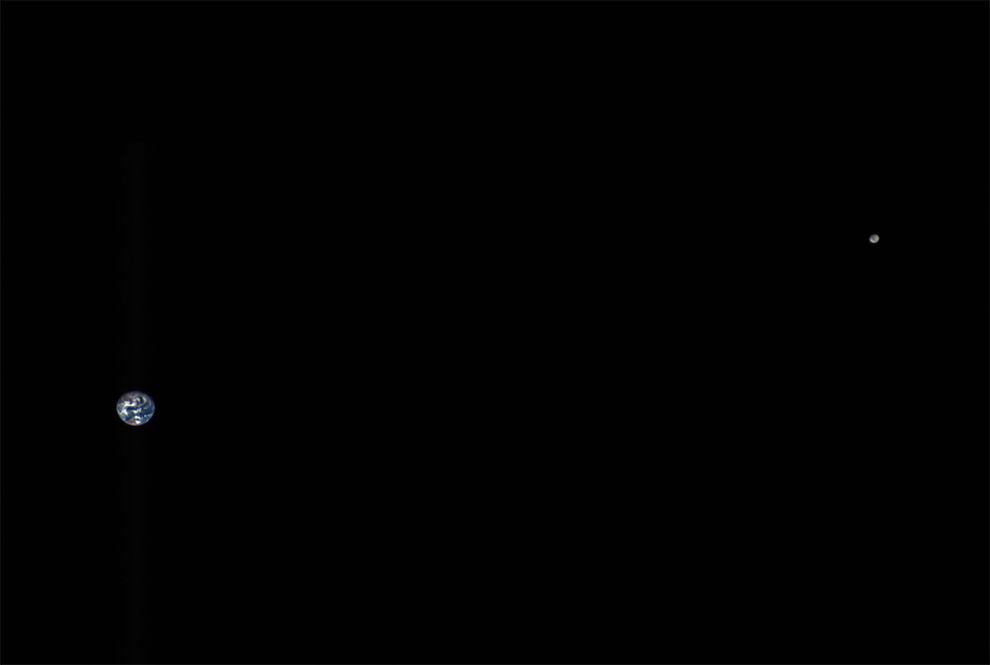
According to Newton's law of gravitation, the Earth and the Moon are gravitationally attracted to each other. The more massive Earth attracts the Moon with...
a stronger force than the Moon attracts the Earth.
a weaker force than the Moon attracts the Earth.
the same force as the Moon attracts the Earth.
a force that is sometimes stronger and other times weaker than the Moon attracts the Earth.
What is T?
period
mass
velocity
frequency
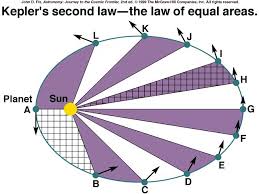

The diagram below shows a moon revolving around a planet in an elliptical orbit. At which position is the moon traveling fastest?
location 1
location 2
location 3
location 4
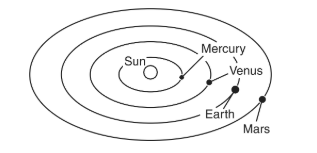
Which planet will take the least amount of time to revolve around the Sun?
Mercury
Venus
Earth
Mars

The period of Jupiter is 4,344 days. This tells you how long it takes _?_.
Jupiter to orbit the sun.
Jupiter to rotate one time on its axis.
the sun to orbit Jupiter.
Earth to orbit Jupiter.
Newton’s law states that for every action, there is an ________ reaction.
unequal and opposite
equal and similar
stronger and opposite
equal and opposite

When a small car pushes a big truck, the truck applies an equal and opposite force on the car.
False
True

When a heavy football player and a light one run into each other, who exerts more force
The light one
Their force are equal
The heavy one
What is the nature of gravity according to Newton's Law of Universal Gravitation?
Repulsive force
Attractive force
Electromagnetic force
Nuclear force
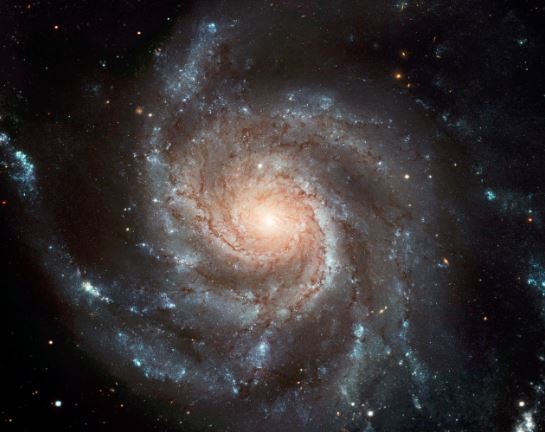
Without gravity, the stars, planets and all objects in the universe would _______.
continue to orbit each other
move in a random direction
move in a straight line
stop moving

