wayground logo

Free Printable Worksheets

Font size

S
M
L
XL
Worksheets

Fundamental Particles

Total questions: 40

Worksheet time: 33mins

Name
Class
Date
1.

Atoms or elements consist of _____ and _____ in their nuclei

a)

protons and neutrons

b)

protons and electrons

c)

electrons and neutrons

d)

nucleus

2.

Is most of the atom empty space?

a)

True

b)

False

3.

Which statement below is correct?

a)

Stable because the p:n is stable.

b)

Stable because the number of protons and neutrons are the same.

c)

Unstable because the number of protons and electrons are the same

d)

Unstable because the number of protons and electrons are not the same.
4.
How many protons are in Zirconium (Zr) ?
a)
40
b)
91
c)
30
d)
65
5.
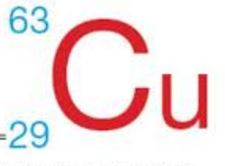
What is the atomic mass of Copper?
a)
63
b)
29
c)
34
d)
92
6.
How many electrons does Cu4+ have?
a)
29
b)
33
c)
25
d)
30
7.
How many electrons does S2- have?
a)
16
b)
18
c)
14
d)
12
8.
A proton is....
a)
A negatively charged subatomic particle
b)
A positively charged subatomic particle
c)
A neutrally charged subatomic particle
d)
The only subatomic particle located in the nucleus
9.
A neutron has a charge of
a)
+2
b)
No charge
c)
-1
d)
+1
10.
What does the atomic mass tell you?
a)
Basically,the number of electrons and protons
b)
The number of neutrons
c)
Basically, the number of protons and neutrons
d)
The number of protons.
11.
An element's identity is determined by the number of
a)
electrons.
b)
protons.
c)
neutrons.
d)
valence.
12.
Elements can have the same number of protons?
a)
True
b)
False
13.
When an atom loses a valence electron, it becomes a(n) _____________ ion.
a)
positive
b)
negative
c)
neutral
d)
polyatomic
14.
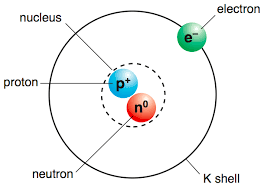
How many valence electrons in this structure?
a)
6
b)
5
c)
4
d)
7
15.
Which subatomic particles contribute the most to the mass of an atom?
a)
Protons, Neutrons, Electrons
b)
Protons only
c)
Protons and Electrons
d)
Protons and Neutrons
16.
The first energy level can hold up to how many electrons?
a)
8
b)
4
c)
2
d)
5
17.

Do electrons contribute to the atomic mass of an atom?

a)

YES of course, they are there for a reason

b)

NO, they are useless to the atom

c)

No, their mass is too small to contribute to the mass

d)

YES, silly, they are the superstars of the atom

18.
The number of protons is equal to 
a)
the atomic number
b)
the number of neutrons
c)
the energy levels
d)
the periodic table groups
19.

The nucleus of an atom contains which subatomic particles?

a)

protons and electrons

b)

protons and neutrons

c)

electrons and neutrons

d)

protons, electrons, and neutrons

20.
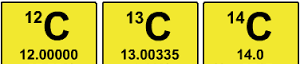
What do these isotopes of carbon all have in common?
a)
neutrons & mass number
b)
atomic number and neutrons
c)
atomic number and electrons
d)
protons, atomic number, and mass number
21.
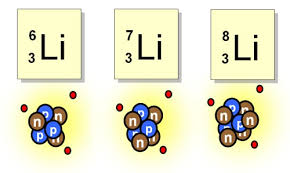
How many neutrons does the isotope of lithium have?
a)
8
b)
3
c)
4
d)
5
22.
In a correctly written symbol what would be located in the "A" position?
a)
number of neutrons
b)
atomic number
c)
number of electrons 
d)
mass number
23.
What quantities vary between isotopes of an element?
a)
protons, electrons, and atomic mass
b)
protons, electrons, and atomic number
c)
neutrons and electrons
d)
neutrons and atomic mass
24.
which atom has  4 neutrons?
a)
Li-6
b)
Li-7
c)
Li-8
d)
they have the same # of neutrons
25.
Isotopes are atoms of the same element with different #’s of __________ & therefore different __________.
a)
n0 ;  atomic #’s
b)
p+ ; atomic #’s
c)
e- ; atomic masses
d)
n0 ; atomic masses
26.
How many neutrons does the isotope below have?     89 36Kr
a)
53
b)
36
c)
89
d)
125
27.
How many neutrons does an atom of the isotope Neon-22 have?
a)
12
b)
10
c)
22
d)
20
28.
Four isotopes of lead include lead-204, lead-206, lead-207, and lead-208.  The average atomic mass of lead is 207.2.  Which isotope of lead is likely to be the most abundant.
a)
204
b)
206
c)
207
d)
208
29.
An atom is electrically neutral when
a)
protons and neutrons are the same
b)
protons and electrons are the same
c)
neutrons and electrons are the same
d)
neutrons balance the protons and electrons
30.
Two isotopes of carbon are carbon-12 and carbon-14.  These isotopes differ from one another by two protons.
a)
true
b)
false
31.
Ions are: 
a)
atoms with a positive or negative charge
b)
atoms with no charge
c)
atoms with ONLY a positive charge
d)
atoms with ONLY a negative charge
32.
How many electrons are in an atom that has an atomic number of 34, an atomic mass of 74 and a charge of -2?
a)
34
b)
36
c)
2
d)
40
33.
Cations are
a)
positive
b)
negative
c)
neutral
d)
nonmetals
34.
If an atom gains an electron to become an ion, it is a(n)....
a)
cation
b)
anion
c)
noble gas
d)
metal
35.
Name the ion...  P3-
a)
Phosphorous
b)
Phosphide
c)
Phosphorous (III)
d)
Potassium 
36.
Will Magnesium gain or lose electrons to become stable?
a)
gain
b)
lose
c)
neither
37.
Name the ion....  Ca2+
a)
Calcium
b)
Calcide
c)
Calcium (II)
d)
Calciumide
38.
Nitrogen will ____ valence electrons when forming an ionic bond.
a)
gain 1
b)
lose 1
c)
gain 3
d)
lose 3
39.

When electrons are shared a(an) ________ bond is formed

a)

ionic

b)

covalent

c)

metallic

40.

All elements are made up of tiny particles called _____________

a)

cells

b)

matter

c)

atoms

d)

elements