
 Worksheets
Unit 3 SAC2 Chemistry Revision
Total questions: 43
Worksheet time: 33mins
What is collision theory?
Molecules must collide in the correct orientation with enough energy to bond.
Molecules need enough energy to collide and react.
Atoms constantly collide and react.
The minimum energy needed for atoms to react
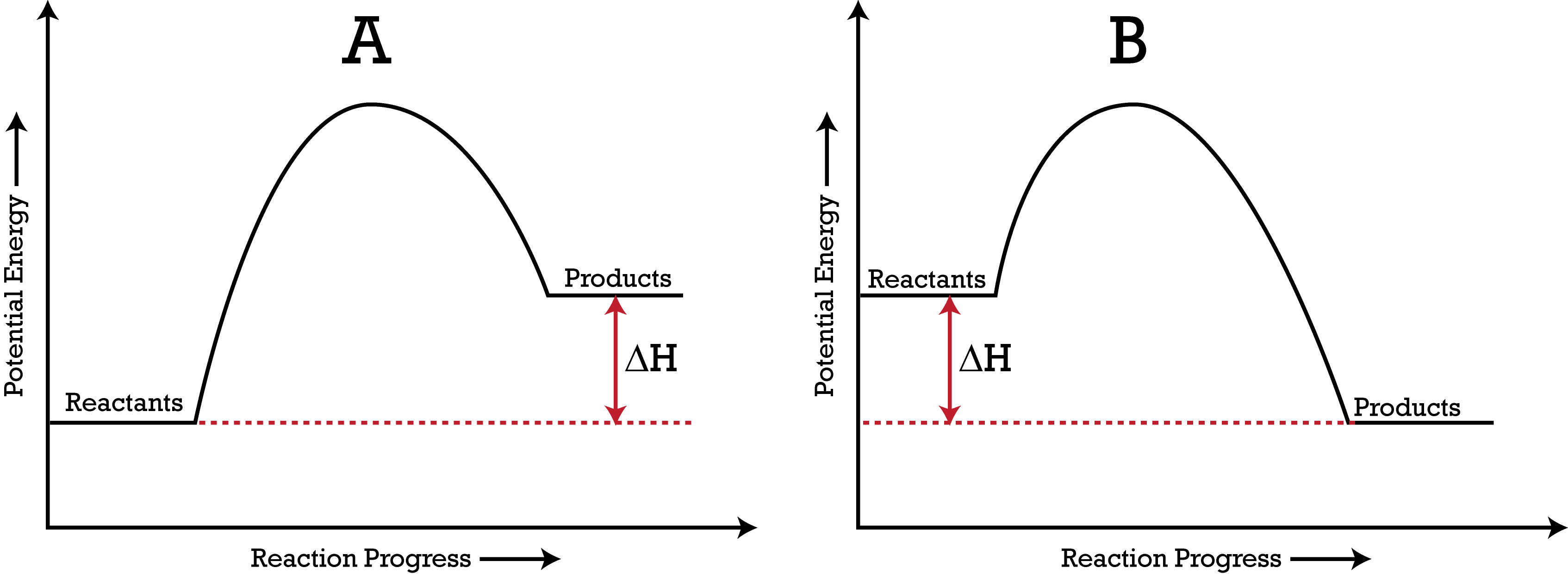
Which PE Diagram represents an endothermic reaction?
A
B
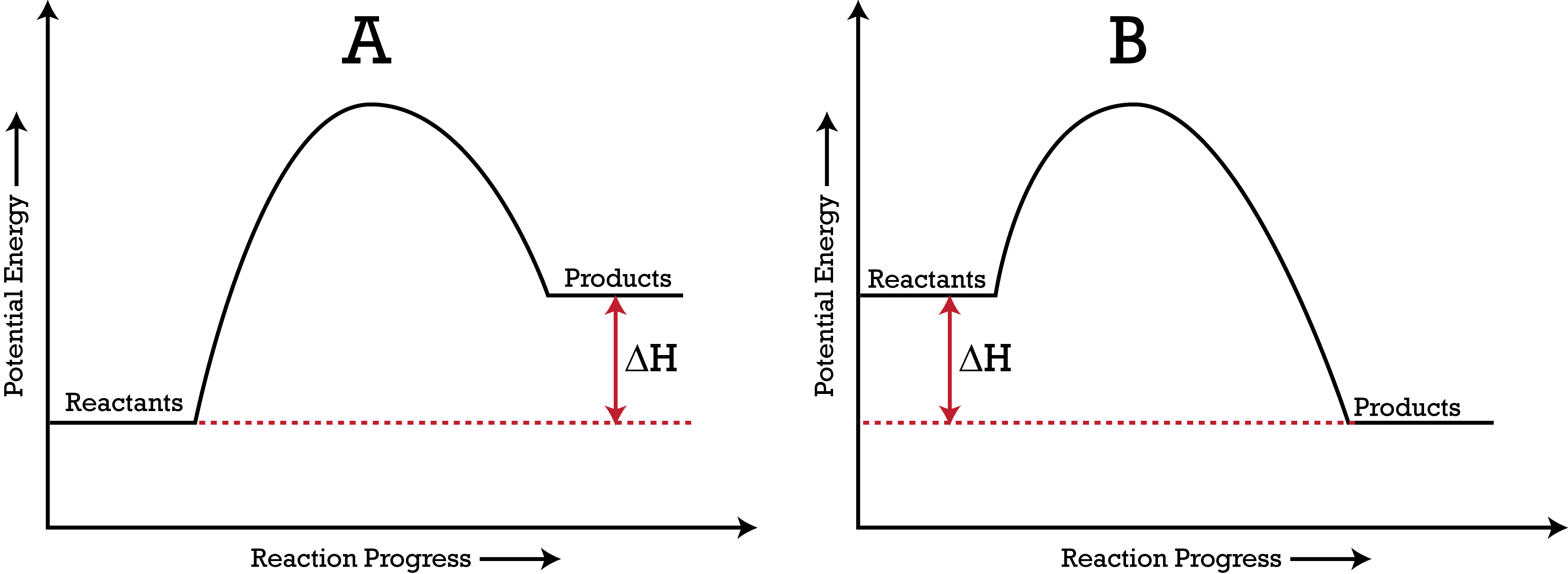
Which PE Diagram represents an exothermic reaction?
A
B
What is the purpose of a catalyst?
Helps to slow down a reaction
Raises the activation energy
Lowers the activation energy
Is consumed by the reaction
What factors effect rate of reaction?
Temperature, Concentration, Pressure and Energy
Surface Area, Concentration, Energy and Pressure
Temperature, Pressure, Concentration and Surface area
Pressure, Surface area, Density and Energy
Increasing the temperature of your solution will.......
Not affect the rate of reaction.
Speed up the rate of reaction
Slow down the rate of reaction
Decreasing the concentration of a substance will usually........
Slow down the reaction
Speed up the reaction
Have no affect on the reaction
Which has more surface area?
Large chunks of chalk
Cube of sugar
Powdered sugar
Small chunks of sugar
If you shrink the container size that your gas substance is in what will happen?
The reaction rate will stay the same
The reaction rate will speed up
The reaction rate will slow down
The collisions which bring about a chemical reaction are called:
Consistent collisions
Normal collisions
Successful collisions
None of the above
What criteria must be met for reactant collisions to result in a successful product?
The reactants must collide with each other
The reactants must collide with enough energy and be in the right positions
The reactants must have enough energy to form the activated complex


SO2 + O2 <=> SO3
If the concentration of SO2 is increased, the equilibrium position of the reaction will shift ___________.
SO2 + O2 <=> SO3
If the equilibrium position shifts to the right, the concentration of O2 will ___________.
N2 + O2 <=> 2NO
If O2 is removed, the concentration of N2 will _______.
N2 + O2 <=> 2NO: Δ H = +182 kJ mol-1.
If the temperature is increased the equilibrium position will shift _______.
2 NO(g) + O2(g) ⇌ 2 NO2(g)
2SO2(g) + O2(g) <=> 2SO3(g): ΔΗ = - 197 kJ mol -1
Which of the following will NOT shift the equilibrium position to the right?
If a (dynamic) equilibrium is disturbed by changing the conditions, the position of equilibrium................

SO2 (g) + NO2 (g) <=> SO3 (g) + NO (g)
had reached a state of equilibrium, was found to contain
0.40 mol L-1 SO3 , and 0.30 mol L-1 NO,
0.15 mol L-1NO2 , and 0.20 mol L-1 SO2.
Calculate the equilibrium constant for this reaction.
Fe3O4(s) + 4H2(g) <=> 3Fe(s) + 4H2O(g)
Kc =
H2 (g) + Cl2 (g) <=> 2HCl (g) + heat
If the pressure in the system is increased, the equilibrium position will _______.
At elevated temperatures ammonium carbonate, NH2COONH4, is in equilibrium with NH3 and CO2 according to the equation;
NH2COONH4(s) ↔ 2 NH3(g) + CO2(g)
What is the equilibrium expression for this reaction?
K = 2 [NH3][CO2]
[NH2COONH4]
K = [NH3]2[CO2]
[NH2COONH4]
K = 2 [NH3][CO2]
K = [NH3]2[CO2]

1N2 + 3H2 →2NH3
When the pressure on the system is increased, the equilibrium position shifts to the right. Why?
To increase the amount of products
To reduce the pressure, as the right side has fewer molecules of gas
Keq will increase when it is shifted to the right
To increase the pressure, as the right side has more molecules of gas

Hydrogen is produced by the reaction of methane with steam. The reaction mixture reaches a state of dynamic equilibrium.
CH4(g) + H2O(g) ⇌ CO(g) + 3H2(g) ∆H = +206 kJ mol−1
Which of the following shows how the equilibrium yield of hydrogen and the value of the equilibrium constant are affected by the changes shown?
A
B
C
D
Phosphorus(V) chloride decomposes at high temperatures into phosphorus(III) chloride and chlorine according to the equation.
PCl5(g) ⇌ PCl3(g) + Cl2(g)
Which one of the graphs best represents the variation with pressure of the yield of chlorine at equilibrium?


What kind of equilibrium does the reaction below show?
H2(g) +I2(g) ↔ 2HI(g)
Heterogeneous equilibrium, all the reactants and products are in the same physical state.
Homogeneous equilibrium, all the reactants and products are in the same physical state.
Heterogeneous equilibrium, the reactants and products are present in more than one physical state
Homogeneous equilibrium, the reactants and products are present in more than one physical state

Why does this graph show equilibrium occurring at T1?
reaction rates are equal
reaction rates are constant
concentrations are equal
concentrations are constant
A certain reaction is found to have a Keq value of 0.0560. What can you tell me about the Keq value for the reverse reaction?
Nothing - I don't know the reaction equation
It is going to be 0.0560 if it is at equilibrium
It is going to be 17.9
It is going to be 0.9440
Find the equilibrium expression for this reaction.
Fe(OH)3(aq) ↔ Fe3+(aq) + 3OH-(aq)


At t = 4 minutes, the temperature of the system was increased to 60 °C.
Is the REVERSE reaction EXOTHERMIC or ENDOTHERMIC?
Endothermic
Exothermic

6,75
6
7

At equilibrium it is found that 1.12 g CO(g) is present in the container.
Calculate the equilibrium concentration of the
2.11 × 10⁻³ M
0.19 M
0.02 M
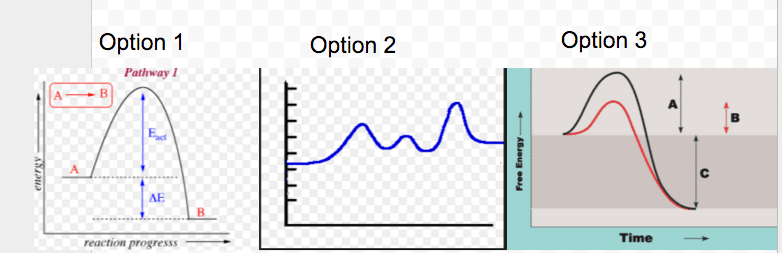

H2 gas and N2 gas were placed in a rigid vessel and allowed to reach equilibrium in the presence of a catalyst according to the following equation.
3 H2(g) + N2(g) ⇄ 2 NH3(g) ΔHo = -92 kJ/molrxn
The diagram above shows how the concentrations of H2 , N2 , and NH3 in this system changed over time.
More NH3 gas is added to the system at time t2 while the temperature is held constant. Which of the following will most likely occur?
The value of the equilibrium constant will increase
The value of the equilibrium constant will decrease.
The total pressure in the container will decrease.
The amount of N2 will increase.
The amount of H2 will decrease.

H2 gas and N2 gas were placed in a rigid vessel and allowed to reach equilibrium in the presence of a catalyst according to the following equation.
3 H2(g) + N2(g) ⇄ 2 NH3(g) ΔHo = -92 kJ/molrxn
The diagram above shows how the concentrations of H2 , N2 , and NH3 in this system changed over time.
Which of the following was true for the system between time t1 and time t2?
The concentration of N2 decreased.
The temperature of the system decreased.
The number of effective collisions between H2 and N2 was zero.
The rates of the forward and reverse reactions were equal.
The rate of formation of NH3 molecules was equal to the rate of disappearance of H2 molecules.

A sample of N2O4 (g) is placed into an evacuated container at 373 K and allowed to undergo the reversible reaction N2O4 (g) ↔ 2 NO2 (g). The concentration of each species is measured over time, and the data are used to make the graph shown above. Which of the following identifies when equilibrium is first reached and provides a correct explanation?
At 14 seconds, because [N2O4] is twice [NO2], which implies that the forward and reverse reaction rates are equal.
At 23 seconds, because [NO2] equals [N2O4], which shows that equal concentrations are present at equilibrium.
At 40 seconds, because [NO2] is twice [N2O4], which matches the stoichiometry of the balanced chemical equation.
At 60 seconds, because [NO2] and [N2O4] remain constant, indicating that the forward and reverse reaction rates are equal.

