
 Worksheets
Rome Review
Total questions: 162
Worksheet time: 5hrs 24mins
Members of the Roman landholding upper class were called
consuls
plebeians
patricians
tyrants
Roman farmers, merchants, artisans, and traders were known as
plebeians
patricians
tribunes
consuls
In what form of government do people choose some of the officials?
a republic
an oligarchy
a nation
a monarchy
Roman gods and goddesses were adapted from those of which people?
Mesopotamians
Egyptians
Greeks
Persians
Which two people supervised the business of government and commanded the Roman armies?
the dictators
the consuls
the plebeians
the tribunes
Res Republica means
That which belongs to the consul
That which belongs to elders
That which belongs to the people
That which belongs to all
Who made up the sentae?
Patricians
Etruscans
Greeks
Consul
A form of government in which the leader is not a monarch and certain citizens can vote is a . . .
Dictator
Pax Romana
Oligarchy
Republic
The ancestors of the Romans were the
Greeks
Sardinians
Latins
Corsicans
How was the power of Roman consuls limited?
They were elected by the general population and served a King.
Their decisions were voted upon by the Senate.
Their decisions could be reversed by a court of law.
They served only one term and approved each other's decisions.
In times of war, a dictator might be put in power for a period of
6 months
1 year
2 years
4 years

Romulus and Remus were raised by a
Wolf
Bear
Lioness
Eagle
What was the main job of the Senate in the Roman Republic?
Command the military.
Make laws.
Elect Tribunes.
Choose Consuls.
The lengthy period of Roman peace, expansion, and stability was known as...
the Pax Romana.
the SPQR.
the Roman Golden Age.
the Roman Revolution.
Which religion did the Romans at first try to stop and then later adopted it as its official religion?
Islam
Polytheism
Judaism
Christianity
peninsula.
He persecuted and killed many Christians who he blamed for starting the Great Fire in the city of Rome.
Nero
Caligula
Vespian
Domitian

What philosophy did Marcus Aurelius practice?
Stoicism
Cynicism
Romanticism
Hellenism


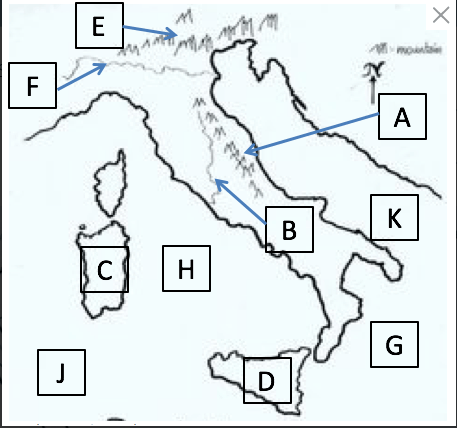
Identify the item on the map labeled E.
Italian Mountains
Rocky Mountains
Alps Mountains
Apennines Mountains
What was the first triumvirate?
An alliance between Marc Antony, Lepidus, and Octavian
An alliance between Caesar, Crassus, and Pompey
An alliance between Rome and Greece
All of the above
What was the second triumvirate?
An alliance between Marc Antony, Lepidus, and Octavian
An alliance between Caesar, Crassus, and Pompey
An alliance between Greece and Rome
All of the above


Which best describes Rome's republic?
All men and women elect their leaders.
Only the wealthy can vote.
Citizens have the right to vote and choose their leaders.
A king rules over the people.
Which of the following did the Romans borrow from the Greeks or Etruscans?
Maniples, democracy, philosophy
Mythology, maniples, monotheism
An alphabet, religious ideas, building styles
Religious ideas, tyranny, building styles
The reign of Caesar Augustus signaled the end of what?
The Roman monarchy
The Roman Republic
The Roman Parliament
free bread for Roman citizens
What was a province of the Roman Republic?
An independent state of Rome.
A part of Rome left for slaves.
A farm where all food is grown.
A division or part of the Republic
What is an Empire?
A large country ruled by a king.
A large country usually ruled by an emperor.
A city-state ruled by an Oligarch.
A country ruled by a dictator.
Which of the following was Julius Caesar NOT known for?
Reorganized government.
Lowered taxes.
Made citizenship easier.
Made Rome an Empire.
What was Augustus known for?
Restoring order to Rome.
Giving land to the people.
Starting war for Rome.
Being part of the First Triumvirate.
Why was Julius Caesar named "dictator for life" ?
He won rocks, paper, scissors.
He was the richest person.
He killed Pompey and Crassus,.
Popularity and the power he held.
What was the biggest contribution of the Gracchi brothers?
Redistributing land.
Allowing all people to join the Army.
Giving citizenship to all.
Marching Roman Legions to Rome.
Why did violence become a social tool?
Blood was shed intentionally to maintain power.
The people were looking to gain more power.
The military was looking to take over Rome.
The death of Julius Caesar was a mistake.
What made Julius Caesar popular with the people?
The reforms he made.
Giving away free money.
Giving away bread and wine.
Giving them grand art and buildings.
What is symbolic of Augustus?
The end of the Republic and rise of the Empire.
The gaining of surrounding territory of Rome.
The end of the Roman Pax Romana.
The changing of Roman culture to be greek like.
How many wars did Rome fight with Carthage?
One
Two
Three
Four
The First Punic War was fought over control of
Greece.
Sicily.
Rome.
Carthage.
Who was the Roman general who defeated Hannibal?
Scipio
Augustus
Julius Caesar
Crassus
Where did Christianity originate?
Greece
Judea
Egypt
Rome
Which of the following achievements is similar to Virgil's Aeneid?
Homer's Iliad
Athen's Parthenon
The Gupta's decimal system
The Han's invention of paper
Ptolemy and the Gupta Golden Age had achievements in which field:
Which of the following Greek achievements is similar to Rome's colosseum?
Athens' Parthenon
Homer's Odyssey
Sophocles' Oedipus Rex
Greece's Temple at Delphi
Virgil and Aeschylus both had achievements in the field of:
Medicine
Literature
Science
Architecture
How are both the Persian Royal Road and the Roman roads similar?
Both were all-weather roads
Both were stone-cut roads that replaced dirt roads
Both were used by couriers to relay messages
Both were built by slave labor
The Roman free-standing dome:
was a new breakthrough in architecture
was a cultural diffusion from Greece
was based on Persian designs of architecture
was a combination of Greek and Persian designs

The father or head of the Christian church.
Priest
Pope
Bishop
Patriarch


come from?


How was Jesus put to death?
Killed in the Colosseum
Crucifixion
Beheaded
Burned alive
What did Jesus teach?
Loving God and loving others
Encouraging people to convert to Christianity
Convincing authorities not to persecute christians
Eliminating all other religion

The four accounts of Jesus's life are called as
Parables
Revelation
Laws
Gospels

What did Jesus call his follwers ?
Children
Prople
Disciples
Followers
Why was Christianity so attractive to people?
it offered an opportunity to become a Roman of high social class
it offered many gods to choose from
it offered the poor and weak a reward in heaven
it offered riches on earth

What is the central or main idea of Christianity?
moral righteousness (being good) and social justice (kindness to others)
being rich and powerful is most important
conquering the largest territory in the world
following Roman laws and customs

The gospels are part of ...
the New testament
The Edict of Milan
The writings of Paul
The City of God
What is a 'messiah'?
Saviour
Enlightened one
Everyone's favourite person
Richest man in the world

Roman Emperor who made Christianity the official religion of the Roman Empire
Hadrian
Theodosius
Constantine
Moses

What made it easier for Apostle Paul to spread the message of Christianity?
Common languages of English and German
Period of Pax Romana that made travel and exchange of ideas fairly safe
The low cost of maintaining horses
Limited his message to only poor Jewish people
What were some of the ways Roman leaders tried to punish Christians?
some were put to death at the hands of Romans.
Some were killed by wild animals in arenas and coliseums.
Both answers are true.
None of the above.
Which word describes the treatment of early Christians in the Roman Empire until about 300 CE?
Welcoming
Ambivalence
Persecution
Conversion
Where did the religion of Christianity begin?
the city of Rome on the Italian Peninsula
in a kingdom near the Himalayan Mountains in India
in Judea a province of Rome in present day Israel
in Mesopotamia
Why did some leaders fear Jesus Christ?
They did not like his hair
Jesus was from Egypt, not their local area
They feared his followers would rebel against Rome
A person who is not a Jew is called a _______________.
Gentile
Democrat
Muslim
In what year did Constantine make Christianity an accepted religion?
305
333
313
323
Because of which people did the Goths have to move south into the Roman Empire?
Hungarians
Huns
Avars
Alans

The decline of the Roman Empire was
accelerated (happened faster) because?
Rome waged war against a single
powerful trade rival.
Rome allowed Christianity to spread.
Rome was conquered by the Islamic
Empire.
Rome faced invasions from many
"Barbarian" tribes.

How did Roman leadership from the
200s - 400s CE contribute to the fall of
the Roman Empire?
Roman leaders during this time were
focused on hurting their own people.
Roman leaders during this time worked
together to transition power peacefully.
Roman leaders during this time were
weak and fought over who had power.
Roman Leaders during this time made
peace with other Empires to conquer
Rome.
Which Barbarian tribe set off a domino effect which pushed many other tribes into Roman territory?
A) The Goths
B) The Huns
C) The Vandals
D) The Franks

What does this diagram illustrate?
events that led to corruption in ancient Rome
effects of the collapse of the Roman Empire
patterns that develop when a government collects taxes
causes of the fall of the Roman Empire

How did the lack of new conquests hurt the Roman Empire?
It put an end to new sources of wealth.
It made Roman leaders appear weak.
It weakened Rome's prominence in the world.
It left the Roman army with little to do.
When Rome divided it split into?
Northern and Southern Empire
New Rome and Ancient Rome
Eastern and Western Empire

The most straightforward theory for Western Rome’s collapse pins the fall on a string of military losses sustained against outside forces. Rome had tangled with Germanic tribes for centuries, but by the 300s “barbarian” groups like the Goths had encroached beyond the Empire’s borders. The Romans weathered a Germanic uprising in the late fourth century, but in 410 the Visigoth King Alaric successfully sacked the city of Rome.
Based on the text above, the author's point of view best supports the claim that:
Rome tangled with Germanic forces while being able to keep the Germanic tribes away from Rome's borders
The most immediate cause for the fall of Rome were the invasions of Germanic forces
In 410, the Romans weathered a Germanic uprising
Barbarian groups like the Goths attacked beyond Rome's borders, while causing minimal damage

Finally, in 476, the Germanic leader Odoacer staged a revolt and deposed the Emperor Romulus Augustulus. From then on, no Roman emperor would ever again rule from a post in Italy, leading many to cite 476 as the year the Western Empire suffered its deathblow.
The purpose of the text above is to describe:
The rise of power of the last Roman emperor in the year 476
The last year a Roman emperor gained power in Rome
The final fall of the Roman Empire in the year 476 as no Roman emperor held power again
The significance of events that led to the fall of Rome

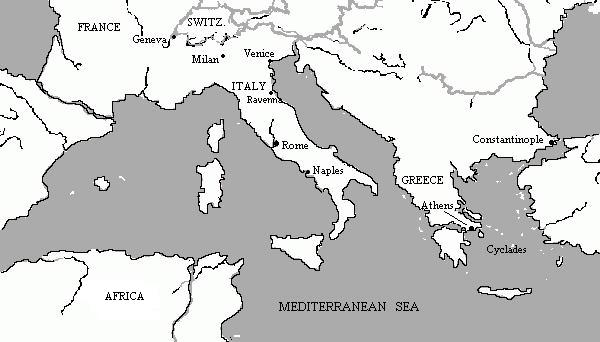
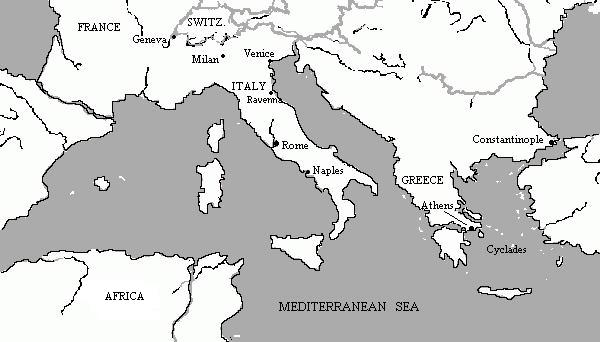
The purpose of the map above is to describe:
An economic cause for the fall of Rome
A social cause for the fall of Rome
A military cause for the fall of Rome
A political cause for the fall of Rome
The empire was not always governed efficiently. There were many rulers who weakened the empire by their dishonesty, corruption, or stupidity.
Political
Social
Economic
Technological
Farms were not properly operated, as people moved to the cities and left the slaves to work the land. Trade decreased. Many city workers lived in poverty.
Political
Social
Economic
Religious
The people lost their rights to participate in the government. Lacking democratic rights, they soon ceased to take any serious interest in the welfare of the state.
Social
Economic
Political
Technology
This document legalized Christianity
The Edict of Milan
The Magna Carta
The Code of Hammurabi
The Edict of Mulan
Which social change resulted from the adoption of the Edict of Milan?
Common culture developed between German invaders and Roman citizens.
Political rights were granted to the plebian social class in Rome.
Rome became the center of the Christian Church.
Roman social classes were divided resulting in a civil war.

What Roman legal concept is evident in legal proceedings in the United States today?
The state uses religious leaders as judges.
The accused has a right to legal counsel.
The accused is innocent until proven guilty.
The burden of proof is on the accused.
How did the early Christian Paul contribute to the spread of Christianity?
As a missionary, he traveled around the Roman Empire converting people to Christianity.
As a Roman senator, he pushed for the toleration of Christianity within the Empire.
As a powerful priest in Rome, he persuaded Roman leaders to adopt Christianity.
As leader of the Christian Church in Jerusalem, he established the first structure of Christianity.
What law did Tiberius try to revive?
distribution of corn at subsidised rate
one individual only permitted to hold 500 acres of public land
public land to be redistributed for colonies
transferral of law courts from senate to the equites

How are the fall of Rome and the rise of Christianity related?
It was a frightening time and people turned to Christianity for comfort
The fall of Rome started the persecution of Christianity
The fall of Rome meant the rise of a Christian kingdom
The fall of Rome actually almost destroyed Christianity
(Helpful Hint: The 3rd century is after the Pax Romana ended.)

Corruption is
dishonest or illegal behavior
a part of the desert that has water and plants
when a volcano explodes
Many emperors died this way due to corruption.
Assassination
Disease
Old age
Died in battle
Over time, Rome's army...
had fewer men join
brought in outside warriors not loyal to Rome
wore less armor and became weaker
All of the above

Using ____ the Romans developed the ________dome to roof large spaces.
Mud, Arched
Concrete, Rounded
Wood, Curved
Bricks, Square
A city state on the northern coast of Africa.
Sardiania
Corsica
Carthage
Rome
What reforms did Julius Caesar introduce in Rome?
Public works, gave land to poor, citizenship to more people, the Julian Calendar
More Taxes, Public Buildings, Bigger military, Better government
New Roads, Better Housing, Lower Taxes, Reformed Government
Better Healthcare, More Military Power, Aquaducts, Taxes
Who was the grand-nephew of Caesar?
Gaius
Julius
Tiberius
Octavian
The senate gave Octavian the title of?
Augustus
King
Peace Maker
Dictator
Octavian laid the foundation for a stable__________.
Kingdom
Empire
Government
Country
How did Julius Caesar die?
During War
Assassination
Heart Attack
Disease
This Emperor was a TOTAL JERK and killed all in his way, "played the fiddle while Rome burned."
Nero
Caligula
Diocletian
Antony
The greatest military barrier of the Western world is:
The Great Wall of China
Hadrian's Wall
The Berlin Wall
The Great Barrier Reef

Which title best describes this list?
Greek gods and goddesses
Greek leaders
Roman gods and goddesses
Roman leaders
Which geographic feature did Hannibal cross to invade the Italian peninsula?
The Atlantic Ocean
The Alps
The Himalayas
The Sahara Desert
As a result of the Punic Wars, Rome controlled...
All of Africa
The area from the Red Sea to the Persian Gulf
The Italian Peninsula
The West Mediterranean Sea
How did Rome's military conquests affect the economic and social structures of the Roman Republic?
Slavery became important to Rome's agricultural production
Soldiers deserted to join enemy armies attacking Rome
Trade routes fell into disuse throughout the Republic
The Republic adopted a monotheistic religion

Which effect best completes the graphic?
Julius Caesar establishes a representative democracy
Unemployment declines throughout the Roman Republic
Carthage is destroyed by the Romans
The Roman Republic begins to fall apart

Which list places these events in the correct chronological order?
1, 2, 3, 4
2, 4, 3, 1
3, 1, 2, 4
4, 3, 1, 2

Which of the following best completes the shaded part of the graphic?
Defeated by Marc Anthony
Came to power by force
Referred to as First Citizen
Attempted to bring stability to Rome

How did the form of technology seen in the picture impact ancient Rome?
It provided a place for Romans to worship all of the pagan gods of Roman mythology
It provided a place for citizens to trade and meet with people for official business
It provided a central location for spectators to observe the gladiators fight to their death
It provided clean water to public paths and other water systems in the empire

Which cause best completes the graphic?
Devaluation of Roman currency
Development of a uniform law code
Denial of non-Romans in the military
Continued growth of Christianity

Which title below best completes the graphic organizer?
Features of Roman democracy
Social structure in the Roman Republic
Contributions of Ancient Rome
Roman citizenship
Which statement is consistent with the cultural influence of Ancient Rome on other civilizations?
Ancient Roman Cultural Achievements:
Roman architectural styles are found throughout the world.
Roman law is the basis for legal practice in Europe, former European Colonies, and Latin America.
Roman roads, called the greatest engineering accomplishment of their time, are still used in some places today.
Roman art was the inspiration for many works during the Renaissance period.
Rome has had a lasting impact on the modern art period.
Rome has had an enduring impact on modern civilizations.
The Romans greatly influenced early African societies.
The Romans greatly influenced Greek society.
What language did the Romans use to write poetry, philosophy , and to record history?
English
Roman
Spanish
Latin
How were Hammurabi's Code and the Roman Twelve Tables similar?
Both were written on bronze tablets
Both were displayed in public places for all to see
Both had extremely harsh consequences for breaking the law
Both were created to promote equality between social classes
In the beginning, the early Romans shared the Italian peninsula with the:
Spanish and Portugese
Greeks and Etruscans
Germans and Asians
Africans and English
Romans conquered many territories and people, but they allowed those conquered people to:
Practice their own customs and beliefs
become political leaders
move away to other lands
own property and slaves
The 12 tables were placed here
Forum
Assembly
Senate
Mosaics

