
 Worksheets
Rome Test Questions
Total questions: 160
Worksheet time: 5hrs 20mins
Members of the Roman landholding upper class were called
consuls
plebeians
patricians
tyrants
Roman farmers, merchants, artisans, and traders were known as
plebeians
patricians
tribunes
consuls
Roman gods and goddesses were adapted from those of which people?
Mesopotamians
Egyptians
Greeks
Persians
Which two people supervised the business of government and commanded the Roman armies?
the dictators
the consuls
the plebeians
the tribunes
Res Republica means
That which belongs to the consul
That which belongs to elders
That which belongs to the people
That which belongs to all
Who made up the sentae?
Patricians
Etruscans
Greeks
Consul
The ancestors of the Romans were the
Greeks
Sardinians
Latins
Corsicans
Which elements of Etruscan civilization were adopted by the Romans?
philosophy and weapons
education and religion
the column and democracy
the alphabet and the arch
How was the power of Roman consuls limited?
They were elected by the general population and served a King.
Their decisions were voted upon by the Senate.
Their decisions could be reversed by a court of law.
They served only one term and approved each other's decisions.
In times of war, a dictator might be put in power for a period of
6 months
1 year
2 years
4 years

Why were these Twelve Tables placed in the Roman marketplace?
They were a written code of laws placed in a central location for everyone to see.
They applied only to plebeians and the plebeians worked in the marketplace.
They provided a list of slaves available for work in a central location for everyone to see.
They contained the current prices of goods being sold in the marketplace.
What was the result of the Punic Wars?
Rome won two and Carthage won one.
Hannibal almost defeated the Romans.
Rome gained control of land around the Mediterranean Sea.
Rome lost control of the Mediterranean shipping routes.
What was the name of the mountain range to the north of Italy that provided some protection from invading forces.
Alps
Andes
Himalayas
Zagros
Which group did NOT gain citizenship in the Rome?
Patricians
Plebeians
Select Foreigners
Women
How long did each Consul serve as chief executive of the Roman Republic?
1 Year
4 Years
8 Years
For Life

Romulus and Remus were raised by a
Wolf
Bear
Lioness
Eagle

The first Punic War was fought over
control of the sea
control of Sicily
control of Africa
control of Spain


How was the Roman Republic different from the Roman Empire?
The Republic was very large; the Empire was fairly small.
The Republic was ruled by elected representatives; the Empire was not.
The Republic had no army; the Empire had a massive army.
The Republic
The basic unit of the Roman military was the __________ and consisted of approximately __________ men.
Legion, 1000
Platoon, 5000
Brigade, 2500
Legion, 5000

The art of persuading someone through the word choice and style
logos
rhetoric
suffrage
inevitable
Who were the legendary founders of Rome?
Klingons & Romulans
Romulus & Remes
Achilles & Hector
Hercules & Ares
What was the result of the Punic Wars?
Rome won two wars and Carthage won one war
Hannibal almost defeated the Greeks.
Rome salted Carthage and controlled the land around the Med. Sea
Rome lost control of the Mediterranean shipping routes.
Carthage was located on the tip of what continent?
Africa
Europe
Asia
Australia


Which peoples founded the city of Carthage
The Athenians
The Babylonians
The Hebrews
The Phoenicians
A major reason for the decline of the Roman Empire was what?
a series of military defeats in Africa
political corruption and the instability of the government
the abolition of slavery throughout the entire empire
continued acceptance of traditional religions

Was the greatest Roman scientist, developed the earth centered theory
Ptolemy
Plutarch
Archimedes
Horace
The first and last leaders of the Pax Romana time period were
Caesar – Constantine
Octavian – Augustus
Augustus – Aurelius
Caesar – Aurelius
Christian leaders and their roles:
People willing to die for their beliefs.
Bishops
Constantine
Martyrs
Patriarchs
Jesus
The first four books of the New Testament, the Gospels, tell us most of what we know about the life and teachings of __.
Cicero
Jesus
Paul
Clarence
After the death of Jesus, the disciples ___ the ideas of Christianity around the Roman Empire.
decoded
denounced
spread
hid
As the Roman Republic conquered more territory outside of its' natural borders it became __ __.
a continent
an empire
a democracy
a colony
Pax Romana means __ of Rome.
Peace
Piece
Agreement
University
Explain how Rome's treatment of conquered people furthered unity in their vast empire.
Ordering Latin as the official language.
Automatic citizenship for educated civilians.
Conquered people were completely eradicated and replaced with Romans.
Conquered people could retain their local customs by paying taxes.

What made Christianity legal in the Roman Empire in AD 313
Theodosius
Edict of Milan
Paul's Rock Edicts
Nicene Creed
When Rome was a Republic, how did the Roman Army provide enough soldiers to be successful?
Superior strength and tactics over enemies
Slaves were used to provide reinforcements
All citizens were required to serve in the military
Citizenship was offered to foreigners who enlisted
To communicate his ideas, Jesus often used short stories with moral lessons called _______.
myths
satires
parables
lyres
From around what sea did the Roman Empire expand?
Black
Red
Caspian
Mediterranean
How did the Gracchus brothers try to reform Roman society?
Gaius Gracchus attempted to seize power
Tiberius Gracchus reduced the size of the senate
They tried to change the military recruitment method
They wanted to redistribute land to small farmers
The political and military reforms of Diocletian and Constantine
enabled the Roman Empire to withstand the invasions of the Aryan tribes
strengthened the economy, which had been weakened by several recent wars.
greatly enhanced the army and civil service institutions, but drained most of the public funds
were the direct result of the Roman Empire adopting Islam as its official religion
The reforms of Gaius and Tiberius Gracchus ended in
violence and instability
Sulla's election as consul
Julius Caesar's empire
Marius' control of the senate
Which city was the capital of the Eastern Roman Empire after 330 C.E.?
Rome
Athens
Alexandria
Constantinope
Who is associated with the following events:
100 B.C. - Born
61 B.C. - Formed triumvirate with Pompey and Crassus
58 B.C. to 50 B. C. - Conquered Gaul
48 B.C. - Gained victory in civil war over Pompey
46 B.C. - Named as dictator of Rome
44 B.C. - Assassinated on the Ides of March (15th of March)
Augustus Caesar
Marcus Aurelius
Julius Caesar
Marc Antony

What Roman legal concept is evident in legal proceedings in the United States today?
The state uses religious leaders as judges.
The accused has a right to legal counsel.
The accused is innocent until proven guilty.
The burden of proof is on the accused.
Which of the following shows how Rome's government progressed over time?
empire, republic, dictatorship, monarchy
dictatorship, empie, republic, monarchy
monarchy, republic, dictatorship, empire
republic, monarchy, dictatorship, empire
How was Jesus put to death?
Killed in the Colosseum
Crucifixion
Beheaded
Burned alive
Why was Christianity so attractive to people?
it offered an opportunity to become a Roman of high social class
it offered many gods to choose from
it offered the poor and weak a reward in heaven
it offered riches on earth
What was the main job of the Senate in the Roman Republic?
Command the military.
Make laws.
Elect Tribunes.
Choose Consuls.
He persecuted and killed many Christians who he blamed for starting the Great Fire in the city of Rome.
Nero
Caligula
Vespian
Domitian
What philosophy did Marcus Aurelius practice?
Stoicism
Cynicism
Romanticism
Hellenism

What was the first triumvirate?
An alliance between Marc Antony, Lepidus, and Octavian
An alliance between Caesar, Crassus, and Pompey
An alliance between Rome and Greece
All of the above
What was the second triumvirate?
An alliance between Marc Antony, Lepidus, and Octavian
An alliance between Caesar, Crassus, and Pompey
An alliance between Greece and Rome
All of the above
What is an Empire?
A large country ruled by a king.
A large country usually ruled by an emperor.
A city-state ruled by an Oligarch.
A country ruled by a dictator.
What was a province of the Roman Republic?
An independent state of Rome.
A part of Rome left for slaves.
A farm where all food is grown.
A division or part of the Republic
What is symbolic of Augustus?
The end of the Republic and rise of the Empire.
The gaining of surrounding territory of Rome.
The end of the Roman Pax Romana.
The changing of Roman culture to be greek like.
Where did Christianity originate?
Greece
Judea
Egypt
Rome
Which of the following achievements is similar to Virgil's Aeneid?
Homer's Iliad
Athen's Parthenon
The Gupta's decimal system
The Han's invention of paper
Which of the following Greek achievements is similar to Rome's colosseum?
Athens' Parthenon
Homer's Odyssey
Sophocles' Oedipus Rex
Greece's Temple at Delphi

The father or head of the Christian church.
Priest
Pope
Bishop
Patriarch

The four accounts of Jesus's life are called as
Parables
Revelation
Laws
Gospels

What did Jesus call his follwers ?
Children
Prople
Disciples
Followers
Why was Christianity so attractive to people?
it offered an opportunity to become a Roman of high social class
it offered many gods to choose from
it offered the poor and weak a reward in heaven
it offered riches on earth

The gospels are part of ...
the New testament
The Edict of Milan
The writings of Paul
The City of God
What is a 'messiah'?
Saviour
Enlightened one
Everyone's favourite person
Richest man in the world

Roman Emperor who made Christianity the official religion of the Roman Empire
Hadrian
Theodosius
Constantine
Moses

What made it easier for Apostle Paul to spread the message of Christianity?
Common languages of English and German
Period of Pax Romana that made travel and exchange of ideas fairly safe
The low cost of maintaining horses
Limited his message to only poor Jewish people
What were some of the ways Roman leaders tried to punish Christians?
some were put to death at the hands of Romans.
Some were killed by wild animals in arenas and coliseums.
Both answers are true.
None of the above.
Which word describes the treatment of early Christians in the Roman Empire until about 300 CE?
Welcoming
Ambivalence
Persecution
Conversion
A person who is not a Jew is called a _______________.
Gentile
Democrat
Muslim
Because of which people did the Goths have to move south into the Roman Empire?
Hungarians
Huns
Avars
Alans

The decline of the Roman Empire was
accelerated (happened faster) because?
Rome waged war against a single
powerful trade rival.
Rome allowed Christianity to spread.
Rome was conquered by the Islamic
Empire.
Rome faced invasions from many
"Barbarian" tribes.

How did the lack of new conquests hurt the Roman Empire?
It put an end to new sources of wealth.
It made Roman leaders appear weak.
It weakened Rome's prominence in the world.
It left the Roman army with little to do.

The most straightforward theory for Western Rome’s collapse pins the fall on a string of military losses sustained against outside forces. Rome had tangled with Germanic tribes for centuries, but by the 300s “barbarian” groups like the Goths had encroached beyond the Empire’s borders. The Romans weathered a Germanic uprising in the late fourth century, but in 410 the Visigoth King Alaric successfully sacked the city of Rome.
Based on the text above, the author's point of view best supports the claim that:
Rome tangled with Germanic forces while being able to keep the Germanic tribes away from Rome's borders
The most immediate cause for the fall of Rome were the invasions of Germanic forces
In 410, the Romans weathered a Germanic uprising
Barbarian groups like the Goths attacked beyond Rome's borders, while causing minimal damage

Finally, in 476, the Germanic leader Odoacer staged a revolt and deposed the Emperor Romulus Augustulus. From then on, no Roman emperor would ever again rule from a post in Italy, leading many to cite 476 as the year the Western Empire suffered its deathblow.
The purpose of the text above is to describe:
The rise of power of the last Roman emperor in the year 476
The last year a Roman emperor gained power in Rome
The final fall of the Roman Empire in the year 476 as no Roman emperor held power again
The significance of events that led to the fall of Rome
Punicus is the Latin word for __________.
Punic
Phoenecian
Reforms
Taxes
Applied to all people under Roman Rule ( citizens and non citizens)
Roman Law
Civil Law
Law of Nations
Law of Unity
Applied to all citizens
Corporal Law
Civil Law
Law of Nations
State Law
Latin word meaning "Our Sea" referring to all land bordering the Mediterranean Sea under Roman control.
Aqua
Circus Maximus
Pax Romana
Mare Nostrum
Who was the grand-nephew of Caesar?
Gaius
Julius
Tiberius
Octavian
Romes largest racecourse. chariots raced here
Colosseum
Circus Circus
Parthenon
Circus Maximus
What was the basic unit of Roman society?
Family
Government
Religion
Army
The emperor kept the poverty-stricken masses pacified by
giving them free grain and providing entertainment on a grand scale
making hollow promises that were never fulfilled
established the first lottery in history
maintaining marital law
To accept or put up with feelings or beliefs that are different from your own.
Persecute
Tolerance
Successor
Adopt
What river did Julius Caesar cross when he marched on Rome?
Rubicon
Mississippi
Nile
Amazon
Match the following with the correct answer choice.
Sided with the Senate in the first civil war
Mark Antony
Sulla
Crassus
Marius
Julius Caesar
What was the North African city that rivaled Rome for Mediterranean trade?
Carthage
Tunis
Syracuse
Cairo
Alexandria
Which historian wrote Annals and Germania?
Virgil
Livy
Horace
Tacitus
Ovid
What historian lived during the Augustan Age and wrote a lengthy history of Rome?
Virgil
Livy
Horace
Tacitus
Ovid
Christ was brought before which Roman governor?
Pontius Pilate
Antonius Felix
Porcius Festus
Coponius
Herod Agrippa
Which Greek physician wrote an encyclopedia of medicine?
Galen
Livy
Horace
Tacitus
Ovid

Built a Bridge to expand across the Danube R.
Nerva
Trajan
Hadrian
Marcus Aurelius

He extended Rome to its greatest in terms of land area
Trajan
Hadrian
Augustus
Nero
This emperor believed he was a reincarnation of Hercules, often fighting in Gladiator contests to prove his skill. He was later assassinated by his wrestling partner
Commodus
Nero
Caligula
Marcus Aurelius
This severely mentally unstable emperor attempted to make his horse, Incitatus, a member of the Consul
Caligula
Domitgian
Nero
Caracalla
What is the English word for Gospel?
news
truth
good news
justice
Jewish radical group who opposed Roman rule
Zealots
episkopi
apologist
Church fathers
Who is considered to be the first pope of the Christian Church?
Peter
Julius Caesar
Constantine
Paul
Vocabulary: Large drop in the value of money and rise in the prices of goods
Mercenary
Inflation
Greco-Roman Culture
Republic
Which concept is a feature of both ancient Roman law and our own?
the right of the accused to face the accuser
the presumption of guilt until proven innocent
the interpretation of law by a jury
the imposition of penalties based on social class
Which phrase correctly describes the Hellenistic philosophy of Stoicism expressed in this quotation?
“If you are distressed by anything external, the pain is not due to the thing itself, but to your estimate of it; and this you have the power to revoke at any moment.” —Marcus Aurelius, Meditations
the use of playful wit to attack human folly
the belief that things should be as one wishes them to be
the establishment of control over foreign lands and peoples
the importance of duty and acceptance of one's fate
Rome's tolerant attitude toward religion did not extend to Christians because _______.
they refused to honor the emperor or the Roman gods
the Roman emperor was the one true God
they had defeated the Romans in several battles
the cult of Isis feared the spread of Christianity
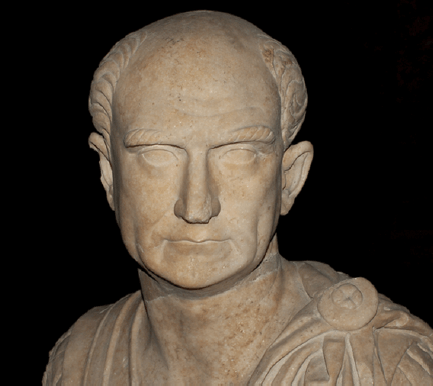
The style of this sculpture is an example of ______.
Roman idealism
Roman realism
Roman satire
Roman mythology
This quotation that attacks human folly is best described as an example of ______.
“This is a fault common to all singers, that among their friends they never are inclined to sing when they are asked, but unasked, they never desist.” —Horace
epic poetry
satire
philosophy
scientific theory

