
 Worksheets
US HISTORY EOC PREP H1-H12
Total questions: 158
Worksheet time: 3hrs 53mins
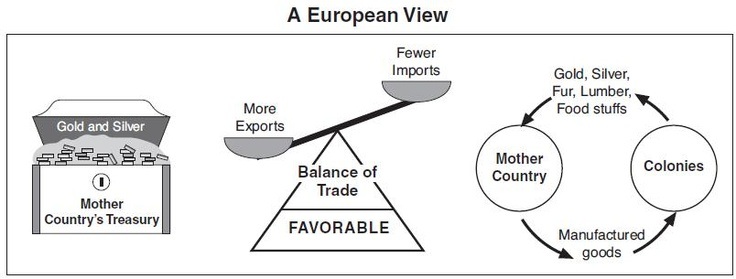
What is mercantilism?
A system where a mother countries gains money and power from natural resources that come from its colonies.
where colonies trade gold and silver with each other.
Wars that start over money.
Plantation colonies trading slaves for money.
True or False:
New England was settled by Puritans seeking freedom from religious persecution in Europe
True
False
The Virginia House of Burgesses, now known as the General Assembly of Virginia was:
the first government building in the nation
the last capital of the confederacy
the first elected assembly in the New World

Relaxed enforcement on trade laws imposed on colonies
Burgesses
Joint Stock Company
Charter
Salutary Neglect
What was salutary neglect?
Britain was strictly controlling the colonies
Britain left the colonies to govern themselves
Britain sent an army to the colonies
Britain sold the colonies to France
The trade pattern between the colonies, Africa, and Europe was called what?
Middle Passage
Navigation Acts
Triangular Trade
Columbian Exchange
Ministers of The Great Awakening preached ___________
God was kind and forgiving
people were not equal
colonists should not be independent
colonists could save themselves
How did the Great Awakening change America?
It brought people from all over the colonies together for the first time
It led to people denying God and leading secular lives
It spread abolitionism throughout the land and led to the end of slavery
It brought French rule to America
The Great Awakening was a __________ movement.
political
scientific
religious
artistic

How were the conditions of the slave boats during the Middle Passage?
The lodgings were clean and sanitary for the slaves
The slaves were well fed and clothed
The conditions were dirty and unsanitary for the slaves
All of the above
Which statement describes the Gullah language?
It was the language spoken by the slaves when they lived in Africa.
It was the language spoken by Native American tribes in SC.
It was a mixture of many different languages brought to America by African slaves.
It was a combination of English and Spanish and was spoken by plantation owners.
The 1763 Treaty of Paris concluded a conflict between which two colonial powers?
SSUSH3
England and Spain
France and England
Spain and Portugal
Portugal and France
Ended the French and Indian War and effectively kicked the French out of North America.
SSUSH3
Treaty of Paris (1763)
Treaty of Paris (1783)
Declaration of Independence
U.S. Constitution
Stated that no colonists could settle in lands to the west of the Appalachian mountains-- made the colonists very upset.
SSUSH3
Proclamation of 1763
Stamp Act
Townshend Act
Quartering Act
A group of colonists who formed a secret society to oppose British policies at the time of the American Revolution
SSUSH3
Sons of Liberty
Daughters of Liberty
Stamp Act Congress
Committees of Correspondence
A series of laws to punish colonist actions at the Boston Tea Party
SSUSH3
Intolerable Acts
Townshend Acts
Quartering Act
Sugar Act
American colonists who remained loyal to Britain and opposed the war for independence
SSUSH3
British
Loyalists
Patriots
Colonists
A pamphlet written by Thomas Paine that identified colonial grievances against the king and galvanized support for independence
SSUSH4
Common Sense
Declaration of Independence
Olive Branch Petition
Bill of Rights
Treaty Between England and the Colonies , formally ended the American Revolutionary War
SSUSH4
Treaty of Paris (1763)
Treaty of Paris (1783)
Olive Branch Petition
Declaration of Independence
Last major battle of the American Revolution that forced the British to surrender
SSUSH4
Battle of Charleston
Battle of Cowpens
Battle of Yorktown
Battle of Saratoga
Who was the commander in chief during the American Revolution and the 1st President of the United States?
SSUSH4
George Washington
John Adams
Thomas Jefferson
Samuel Adams
American intellectual, inventor, and politician He helped to negotiate French support for the American Revolution.
SSUSH4
Benjamin Franklin
John Adams
George Washington
Thomas Jefferson
Law that taxed printed goods, including: Dice, playing cards, documents, newspapers, etc.
SSUSH3
Townshend Act
Sugar Act
Stamp Act
Tea Act
A refusal to buy or use goods and services to show your displeasure
SSUSH4
Boycott
Petition
Taxation
Sons of Liberty
Identify the law passed by parliament allowing the British East India Company to sell its tea directly to the colonies without Tax, while taxing colonial tea merchants.
SSUSH4
Tea Act
Townshend Act
Intolerable Acts
Stamp Act
Protest against tea tax in which Sons of Liberty dumped British tea into The Boston harbor
SSUSH3
Boston Massacre
Boston Tea Party
Battle of Lexington
Battle of Concord
A movement that emphasized science, self determination and reason
SSUSH3
Enlightenment
Scientific Revolution
American Revolution
Great Awakening
This is where delegates appointed George Washington Commander of the Continental Army and wrote the Declaration of Independence.
SSUSH4
First Continental Congress
Second Continental Congress
Committees of Correspondence
Committee of Five
Author of Common Sense
SSUSH3
John Locke
Thomas Paine
Thomas Jefferson
John Adams
Wrote the Declaration of Independence
SSUSH4
Thomas Jefferson
John Locke
Benjamin Franklin
John Adams
This document would sever ties with colonies and England, ultimately leading to the American Revolution.
SSUSH4
Declaration of Independence
Treaty of Paris (1783)
Olive Branch Petition
Treaty of Paris (1763)
Basic rights of the people that may not be taken away
SSUSH4
Civil Rights
Human Rights
Unalienable Rights
Bill of Rights
Continental Army victory over British troops considered the turning point of the American Revolution.
SSUSH4
Battle of Saratoga
Battle of Trenton
Battle of Bunker's Hill
Battle of Yorktown
Why were the committees of correspondence important?
SSUSH4
They presented an alternative to violent resistance to the laws so that colonists could claim the moral advantage in their disputes with Britain
They allowed colonial loyalist to communicate with each other quickly in order to avert crises following the passage of new laws
They controlled the newspapers and therefore how acts of resistance and the British response to such acts were reported to the public
They unified colonists who were dissatisfied with the political situation into more effective groups of resistance
What was the MOST significant contribution of the Marquis de Lafayette during the American Revolution?
He identified Benedict Arnold as a traitor
He was the most important general during the war
He was a great writer
He gained military and naval support from France at the battle of Yorktown
When Thomas Jefferson wrote the Declaration of Independence he was using the ideas of which of the following?
SSUSH4
Enlightenment philosophers like John Locke
King George
Louis XIV
George Washington
Which strong feature of the Articles of Confederation created a method for territories to become states?
SSUSH5a
The ability to sign peace treaties
Shays' Rebellion
Northwest Ordinance
60,000 Ordinance
In the Articles of Confederation, where was most of the government power placed?
SSUSH5b
The States
The National Government
The Continental Congress
The Legislative Branch

Which is a weakness of the Articles of Confederation?
SSUSH5b
Congress couldn't collect taxes
Weak central government
Provided for no common currency
All of the these
The uprising of Massachusetts farmers who did not want to lose their farms to pay for heavy state taxes after the American Revolution was known as
SSUSH5b
Shays Rebellion
The Boston Tea Party
The Civil Rights Movement
The Constitutional Convention
Ultimately, the weaknesses of the Articles of Confederation lead to the adoption of:
SSUSH5c
The Treaty of Paris
The Affordable Care Act
The U.S. Constitution
The Declaration of Independence
Which statement best reflects the views of an Anti-Federalist?
SSUSH5d
“I demand a new constitution”
“I support ratification”
“I fear a strong government”
a. “I oppose a bill of rights”
At the Constitutional Convention, the New Jersey plan proposed:
SSUSH5c
a two-house legislature
a court system
one vote for each state
a chief executive chosen by the legislature.
The Great Compromise solved the problem of both big and small states wanting representation.
SSUSH5c
True
False
The Three-Fifths Compromise help settle the debate over whether to count slaves in the population or not.
SSUSH5c
True
False
Federalist SUPPORT a strong, national government and creating a new constitution.
SSUSH5d
True
False
Anti-federalists wanted a Bill of Rights added to the constitution to help protect...
SSUSH5d and SSUSH5e
Individual Rights
State Rights
Slavery
The Articles of Confederation
The Federalists papers were written to persuade people to support the new constitution.
SSUSH5d
True
False

The Articles of Confederation was successful in managing new lands with laws such as (there are multiple correct answers)
SSUSH5a
Northwest Ordinance of 1787
Land Ordinance of 1785
Proclamation Line of 1763
Western lands Ordinance
How did Federalists and Anti-Federalists "compromise" to ratify (approve) the U.S. Constitution?
they added the Bill of Rights (first 10 amendments)
ensured due process of law
they outlawed cruel and unusual punishment
the Federalists threatened the Anti-Federalists with war
A major principle of US foreign policy know as _______ first espoused in the famous farewell address by George Washington
Emancipation
Belligerence
Interposition
Neutrality
The Louisiana Purchase of 1803
was a major cause of the Spanish-American War
resulted in increase conflict between the US and France
resulted in the removal of all British military forces from North America
Almost doubled the area of the US and gave it control of the Mississippi River
Which of these was a precedent set by the first President of the United States, George Washington
the popular election of the President
the tradition of only serving two terms
naming the nine Justices to the Supreme Court
addressing the Chief Executive as a "Your Highness"

The cartoon refers to the Monroe Doctrine issued in 1823. The Monroe Doctrine was intended to prevent European expansion in
China
North Africa
South America
Southeast Asia
During George Washington's presidency, which was the major reason for conflict between Thomas Jefferson and Alexander Hamilton?
Washington's decision not to get involved in the revolution in France
the distribution of power between the judicial branch and the legislative branch
Hamilton's objection to Jefferson's strict interpretation of the Constitution
the US government's decision to remain neutral in the war between France and Britain
The War of 1812 resulted in
Great Britain gaining control of Canada
the United States gaining control of Spain
the United States maintaining its previous strength
Great Britain agreeing to end the practice of impressment
The main idea behind the settling of western lands by Americans in the early-1800s was known as
Women Suffrage
Manifest Destiny
the Industrial Age
the Abolition Movement
According to Washington's Farewell Address, which of these BEST explains Washington's view on religion?
Religion would soon lose popularity among the American people
Religion should become the backbone of the America government
Religion causes people to behave badly and could hurt the country
Religion plays a large role in the United States success
"It is emphatically the duty if the Judicial Department to say what the law is. Those who apply the rule to particular cases must, of necessity expound and interpret the rule. If two laws conflict with each other, the Court must decide on the operation if each
-John Marshall, Chief Justice of the Supreme Court
making laws
judicial review
veto any laws of Congress
issuing writs of mandamus in all cases
The Election of 1800 was significant because it
played a major role in America's acquisition of the Louisiana Territory
was the first peaceful transition of political power between opposing parties in US history
gave the Federalist control of the executive and legislative branches
marked the beginning of the era known as "Jacksonian Democracy"
Why was Monroe's presidency known as the "Era of Good Feelings"?
Slavery had begun to decrease which led to more national unity
There was more national unity due to the end of the War of 1812
The Federalist party came to a compromise with the Democratic-Republican party
The Homestead Act was passed which led to widespread expansion and land ownership
When studying the Constitution and early United States History, the Alien and Sedition Acts of 1798 can be viewed as a violation of which of these
Checks and Balances
Popular Sovereignty
Fifth Amendment
First Amendment
Which of these was an economic result of the War of 1812
the end of the "Era of Good Feelings"
the beginning of the "Market Revolution"
the end of using steam to transport goods
the beginning of long-distance trade with Europe
Whose on-field leadership is responsible for the success of the United States in the Battle of New Orleans during the War of 1812
Jacob Brown
James Madison
Andrew Jackson
William Henry Harrison
Which aspect of governance is at the heart of the Monroe Doctrine ?
Federalism
Foreign Policy
Domestic Policy
Monetary Policy
THe Nullification Crisis concerned...
Whether the President had the power to assasinate people
Whether States could cancel out federal laws they didnt like
Alliances with foreign powers
Slavery
Which is not an example of infrastructure?
Roads
Canals
Railroads
Farms
Which if these were not a part of Henry Clay's "American System"
Ending slavery
Government investment in infrastructure
National bank and national currency
Tariffs to protect American products
Which of these people were abolitionists?
Thomas Jefferson
Frederick Douglas
Henry Clay
John C Calhoun
Nat Turner led a...
Movement for public schools
Political party
Slave rebellion that killed 60 people
Movement to allow Native Americans to vote
How did Andrew Jackson appoint members to his administration?
Spoils system
professional knowledge of its members
members of the federalist party and the whigs
those who supported slavery only
The major social reform movement for the 1840's and 1850's was known as .......
1st Great Awakening
2nd Great Awakening
War of 1812
Manifest Destiny
The Liberator was the name of newpaper published by William Loyd Garrison. Which social issue did the paper focus on?
Suffrage
Prohibition
Slavery
Immigration
Horace Mann is associated with which reform movement?
Education reform
Prison reform
Immigration reform
Abolition
During the age of Jackson the term "Jacksonian Democracy" emphasized
decreasing the power of the executive branch
preserving tribal land
increasing voting rights in the United States
states rights
The Seneca Falls Convention of 1848 drew national attention to
Women's rights
Abolition
prohibition
Immigration
Which election is referred to as the "corrupt bargain"?
1816
1820
1824
1828
Prior to the Missouri Compromise, the Tallmadge Amendment would have restricted the spread of slavery in Missouri. The amendment passed in the House of Representatives but failed in the Senate. Why?
Representation in the Senate was based on population and dominated by the North, while representation in the house was more evenly divided between slave and free states.
Representation in the house was based on population and dominated by the North, while representation in the Senate was more evenly divided between slave and free states.
Campaigns for seats in the Senate were often funded by agricultural lobbyists, while industrialists opposed to slavery lobbied more heavily in the house.
Campaigns for seats in the house were often funded by agricultural lobbyists, while industrialists opposed to slavery lobbied more heavily in the Senate.
The (a) allowed Maine to enter the union as a free state and involved the creation of a line that defined slavery and antislavery territories.

Which of the following is BEST represented by the map?
the Missouri Compromise of 1820
the Compromise of 1850
the Gadsden Purchase
the Treaty of Guadalupe Hidalgo
One provision of the Missouri Compromise of 1820 was that Maine be admitted to the Union as a free state. What was the reason for this?
to keep slavery from being legal in Northern states
to keep a balance of free states and slave states
to encourage Southern states to abolish slavery
to create a majority of free states in Congress
Which of the following became a state during the presidency of James K. Polk?
California
Nevada
Oregon
Texas

Look at the map of the Oregon Country in 1840, claimed by both Great Britain and the United States.
James K. Polk won the 1844 presidential election under the Democratic Party's slogan of "All Oregon," rejecting Great Britain's border proposal of the forty-second parallel. After Polk took office, he sought a compromise border at the forty-ninth parallel, a move that was unpopular with expansionist members of his party. What slogan did expansionists use to oppose this proposal?
"Forty-nine is not fine!"
"Britain out of Oregon!"
"Fifty-four forty or fight!"
"No king on the continent!"
One of James K. Polk's goals as president was to fulfill the manifest destiny of the United States. Did he achieve this goal by the end of his term?
Yes, Polk expanded US territory and the country spread from the Atlantic to the Pacific by the end of his term.
Yes, Polk expanded US territory to the northern coast of North America by completing the purchase of Alaska.
No, Polk agreed to cede territory to Mexico in the Treaty of Guadalupe Hidalgo after fighting Mexico to a stalemate.
No, Polk failed to bring an end to the Mexican-American War before the end of this term and the US did not gain territory.

Under which president did the United States gain the territory highlighted on the map?
Thomas Jefferson
James K. Polk
Zachary Taylor
John Tyler
What was one cause of the tensions that led to the Mexican-American War?
the expansion of slavery into the American West
the treatment of American Indians by Mexico
the impressment of Mexicans into the US Navy
the disputed border between Texas and Mexico
What treaty ended the Mexican-American War?
the Treaty of Mortefontaine
the Treaty of Guadalupe Hidalgo
the Treaty of Madrid
the Treaty of Paris
What was the purpose of the Wilmot Proviso?
to ban slavery in the Mexican Cession territory
to ensure the legality of slavery in the Mexican Cession territory
to ban slavery in the Louisiana Purchase territory
to ensure the legality of slavery in the Louisiana Purchase territory

Which region was acquired as a result of the Mexican Cession in 1848?
Region 1
Region 2
Region 3
Region 4
Which of the following was part of the agreement known as the Compromise of 1850?
Missouri would be allowed to join the United States as a slave state.
Slavery would be illegal in any state north of the Mississippi River.
Settlers in the New Mexico and Utah would be allowed to vote on whether slavery would be legal in the territories.
New states would be admitted to the United States until there was a equal number of slave and free states.
Tensions over what issue led to the Compromise of 1850?
whether slaves counted toward a state's population
the legality of slavery in the Mexican Cession territories
whether American Indians counted toward a state's population
the legality of slavery in the Louisiana Purchase territories
California was admitted to the Union as a free state, the New Mexico and Utah territories were organized using popular sovereignty, the slave trade was abolished in Washington, DC, and a new and more effective fugitive slave law was enacted under which compromise?
Missouri Compromise
Compromise of 1850
Crittenden Compromise
Compromise of 1877
What was one requirement imposed by the bundle of laws known as the Compromise of 1850?
The transportation of slaves across state lines required the approval of the federal government.
Runaway slaves, even those in the north, were required to be returned to their owners under penalty of law.
All slaveowners were required to apply for a license from the federal government and provide proof of ownership.
Transactions involving the transfer of ownership of slaves required the payment of an additional fee to the federal government.
Which statement about John Brown's 1859 raid at Harpers Ferry, Virginia, is correct?
Brown defeated a combined force of state militia and federal troops.
Brown secured weapons for an upcoming slave rebellion in Virginia.
It caused the North and South to cooperate against abolitionist forces.
It heightened tensions between the Northern and the Southern states.
Which THREE statements about the Dred Scott v. Sandford ruling are correct?
Free African Americans were denied US citizenship.
Slaves were ruled to be property rather than citizens.
The Missouri Compromise was ruled unconstitutional.
Slave owners could keep their slaves even in free states.
Slavery was to be outlawed in any newly formed territories.
What piece of legislation was overruled as a result of the Dred Scott v. Sandford case?
Wilmot Compromise
Northwest Ordinance
Missouri Compromise
Kansas-Nebraska Act
Which of the following pieces of legislation effectively repealed the Missouri Compromise?
the Kansas-Nebraska Act
the Wilmot Proviso
the Compromise of 1850
the Northwest Ordinance
Which THREE of the following were advantages that the North had over the South leading into the Civil War? Select all that apply.
larger farms
more factories
larger population
extensive railroad system
more well-trained officers
Though many immigrants came to the United States during the Antebellum Period, few of them settled in the South. Why?
There were few available jobs in the South due to the availability of slaves.
Most immigrants were opposed to slavery and wanted nothing to do with the South.
The Nativist movement was strong in the South and locals treated immigrants poorly.
Immigrants preferred the pastoral landscapes of the North to the industry of the South.
Which of the following statements about the impact of tariffs on the Northern and Southern economies is correct?
Tariffs benefited the North but harmed the South.
Tariffs harmed the North but benefited the South.
Tariffs benefited both the North and the South.
Tariffs harmed both the North and the South.
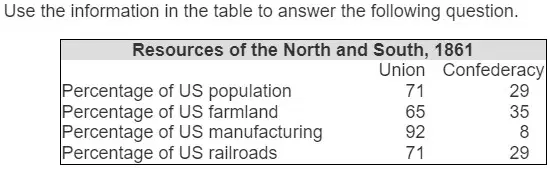
Which statement BEST explains the importance of the information presented in the table?
It shows the disparity between the Union and the Confederacy at the end of the Civil War in population, railroads, farmland, and manufacturing, indicating the problems caused by the lack of European support for the South.
It shows the disparity between the Union and the Confederacy during the Civil War in population, railroads, farmland, and manufacturing, indicating the great success of the blockade of Confederate ports.
It shows the disparity between the Union and the Confederacy at the outset of the Civil War in population, railroads, farmland, and manufacturing, indicating the great advantage the Union would have in the war.
It shows the disparity between the Union and the Confederacy at the outset of the Civil War in population, railroads, farmland, and manufacturing, indicating the slight advantage the Confederacy would have in the war.
Which of the following was a primary goal of President Abraham Lincoln at the outset of the Civil War?
A
B
C
D
to abolish slavery in both Union and Confederate states
to restore the Confederate states to the Union
to punish the Confederate states for secession
to prevent slavery from spreading to western territories
During the Civil War, President Abraham Lincoln suspended the right of habeas corpus for which MAIN reason?
to conscript citizens into the Union Army
to free slaves throughout the Confederacy
to prevent British interference in the conflict
to keep Confederate sympathizers imprisoned
The Emancipation Proclamation freed
all slaves in the United Slates.
all slaves born in the United States.
all slaves who were living in rebelling states.
all slaves living in states under Union control.
Read the quotation below and then answer the question that follows.
"A house divided against itself cannot stand."
— Abraham Lincoln, June 16, 1858
What meaning did Lincoln wish to convey in this quotation?
Abolitionists and slavery supporters must seek a compromise.
Division over the issue of slavery was a significant threat to the Union.
Slavery was driving the world's powers to avoid engaging with the United States.
The nation's reliance on slavery threatened its economic stability and stood in the way of progress.
What is the significance of the events at Appomattox Courthouse, Virginia, on April 9, 1865?
President Abraham Lincoln issued the Emancipation Proclamation, declaring the freedom of all slaves throughout the Confederacy.
Confederate General Robert E. Lee surrendered to Union General Ulysses S. Grant, thus bringing an end to the Civil War.
Union forces under the command of General George Meade defeated a much larger Confederate army, preventing Southern troops from invading the North.
Confederate troops fired on Union soldiers camped outside the town, thus beginning the Civil War.
Which statement correctly describes General William Sherman's victorious strategy in the Battle for Atlanta?
With a surprise frontal attack on Confederate troops, he forced them to abandon the city.
With a surprise rear attack on Confederate troops, he forced them to abandon the city.
By cutting off all railroad supply lines, he forced Confederate troops to abandon the city.
By burning down much of Atlanta, he forced Confederate troops to abandon the city.
How did the actions of General Ulysses S. Grant during the siege of Vicksburg affect the civilian population?
Grant ordered that anyone not in the military be expelled from the region.
Many starved as Grant and his troops took food and supplies from area farms.
Grant paid civilians in the area who were willing to house and feed his soldiers.
Many died because Grant forced civilians to camp with his army discourage attacks.
How did Sherman's "March to the Sea" MOST directly impact the civilian populace of the South?
Thousands of civilians lost their lives as a result of Sherman's campaign.
Many Southerners were forced to join the Union army as a result of Sherman's campaign.
Large numbers of civilians lost property as a result of Sherman's campaign.
Southerners' resolve was strengthened against the Union as a result of Sherman's campaign.
What was historically significant about the Battle of Gettysburg?
It was the bloodiest battle of the Civil War.
It was the first large-scale battle of the Civil War.
It inspired a surge of enlistment in the Confederate Army.
It allowed the Confederacy to gain control of Pennsylvania.
The Confederate bombardment of which fort on April 12-13, 1861, marked the beginning of the American Civil War?
Fort Pickens
Fort Sumter
Fort McHenry
Fort Donelson
Which of the following geographic features made the city of Atlanta an essential target for Union forces, leading to the Battle for Atlanta in 1864?
the city's location on a ridge above the Chattahoochee River
the city's location in the foothills of the Appalachian Mountains
the city's location as a hub of railroads carrying military supplies
the city's location as a hub of canals carrying military supplies
Read the text. Then answer the question that follows.
In May of 1863, General Robert E. Lee led the Army of Northern Virginia into Union territory. His goal was to advance into the North and pressure the government there to end the war. In early July, Lee engaged his enemy with the intention of crippling the opposing army and gaining foreign recognition for the Confederacy. The battle raged for three days, and when it ended, it had claimed more casualties than any other battle of the war.
Which battle is described in the text?
The Battle of Appomattox Court House, in which the Union crushed the rebellion and forced Lee's surrender.
The Battle of Gettysburg, which ended Lee's aggressive ambition and drove his army back into the South.
The Battle of Chancellorsville, which routed the Union forces and opened the way toward Washington, DC.
The Battle of the Antietam, in which neither the Union nor Confederate forces won a decisive victory.
What was a major reason the North defeated the South in the Civil War?
The North was more industrialized and had better use of railroads and telegraph
The South actually won the war because of its ability to fight and superior infrastructure
The North had better generals and soldiers but lacked technological advancements
The South actually had more people for the war and technologically advanced weapons
Which of the following was NOT an action taken by President Abraham Lincoln during the Civil War?
He signed a law freeing slaves in the Confederate states.
He authorized the suspension of habeas corpus during the conflict.
He ordered that any escaped slaves captured in the North be conscripted into the Union Army.
He instituted a draft to supply the Union with enough soldiers to win the war against Confederacy.
Which statement BEST illustrates President Abraham Lincoln's hopes and expectations following the issuing of the Emancipation Proclamation?
Lincoln was hopeful that Southern states would renounce their loyalty to the Confederacy and believed that they would quickly rejoin the Union.
Lincoln was hopeful that slaves in the South would be freed and believed that many freed slaves would attempt to escape captivity and flee to the North
Lincoln was hopeful that Southern states would renounce their loyalty to the Confederacy and believed that many Southerners would rebel against Confederate leaders.
Lincoln was hopeful that slaves in the South would be freed and believed that freed slaves in the North would join the Union Army
After the Civil War, what was the purpose of the 13th ammendment?
To make it illegal to leave or secede from the union ever again
To make slavery illegal, except for forms of Criminal punishemen
To allow Abraham Lincoln to serve a third and fourth term as president during reconstruction
To promote Women's Suffrage, Temperance, Public schools, and Manifest Destiny
What was the purpose of Augusta Institute, a school founded in 1867 in the basement of Springfield Baptist Church in Augusta, Georgia, which eventually became Morehouse College?
to provide education for freedmen to become teachers or clergymen
train politicians to lead Southern governments during Reconstruction
to provide education for freedmen in agricultural and mechanical trades
to train state militia and police to enforce Reconstruction laws in the South
Why was the Battle of Appomattox Court House an important event in the Civil War?
General Lee’s surrender showed that the Southern states had lost the Civil War.
General Lee’s defeat by General Meade ended the South’s invasion of Northern territory
General Grant achieved control of the Mississippi River by capturing a major fortress.
General Grant defeated the Southern army that was defending the Confederate capital.
Which BEST explains why Vicksburg was important in the Civil War?
It was located on the Mississippi River, a crucial supply route
It was on the border between the North and the South.
It was the site of the war's deadliest battle
. It was burned to the ground by General Sherman.
The agency with the GREATEST impact on helping former slaves adjust to their new lives after the Civil War was: (SSUSH10b)
The State Department
The Emancipation Proclamation
The Bureau of Family and Human Services
The Freedman’s Bureau
In their attempts to impede the implementation of the Fifteenth Amendment during and just after the Reconstruction Era, white southern politicians enacted all of the following EXCEPT
poll taxes.
strict ID laws
literacy tests.
grandfather clauses
Which of the following BEST explains the growing popularity of the Ku Klux Klan throughout the South in the 1860s and 1870s?
The organization capitalized on Southerners' fear of the changes that occurred after the Civil Wa
The organization established the first public high schools and universities in many Southern states.
. The organization built many large factories and helped the South became a major manufacturing center.
The organization was the dominant political party in the South and helped influence federal policy
Which of the following statements about the Compromise of 1877 is NOT correct?
It brought an end to the Reconstruction Era.
It removed federal troops from the former Confederate states.
It provided the legal basis for racial segregation.
It introduced laws that helped the South rebuild economically.
How was the disputed presidential election of 1876 resolved?
through the Compromise of 1877, which awarded Rutherford B. Hayes the presidency with the agreement that Hayes would end military occupation of the South
through the Compromise of 1877, which awarded Samuel Tilden the presidency with the agreement that Tilden would end military occupation of the South
through the Compromise of 1877, which awarded Rutherford B. Hayes the presidency with the understanding that he would support the Democratic state governments in the South
through the Compromise of 1877, which awarded Samuel Tilden the presidency with the understanding that he would support the Democratic state governments in the South
What industry contributed to rapid growth in the steel and oil industries?
Automobile
Electrical Power
Coal
Railroad
This man controlled the steel industry during the Gilded Age
Andrew Carnegie
John D Rockefeller
JP Morgan
Cornelius Vanderbilt
This is a term for when one company controls the majority of an industry
Monopoly
Merger
Corporation
Company
This man owned Standard Oil and controlled 90% of the oil industry during the Gilded Age
Andrew Carnegie
Cornelius Vanderbilt
John D Rockefeller
JP Morgan
This business practice is when one person or a company own controlling interest in other companies but allow them maintain their own identity
Trust
Corporation
Merger
Subsidiary

This person invented the phonograph, motion pictures, an electric generator.
Thomas Edison
Nicolai Tesla
Alexander Graham Bell
Andrew Carnegie
Where were European immigrants processed when entering the U.S.
Angel Island
The Statue of Liberty
New York City
Ellis Island
Where were Asian immigrant processed when entering the U.S
Angel Island
The Statue of Liberty
New York City
Ellis Island
Who was the first president of the American Federation of Labor
Samuel Gompers
John McCormick
Cornelius Vanderbilt
President Teddy Roosevelt
What was an advantage of labor union?
helps workers finish jobs quickly
allows employers to fire workers easily
makes sure that new workers are trained by older, experiences workers
gives workers the collective power to bargain with their employers
Who was the railroad owner who consolidated smaller railroads companies and improved railroad services?
Alexander Graham Bell
George Pullman
George Westinghouse
Cornelius Vanderbilt
Wealthy business owners that paid low wages for long hours in unsafe working conditions in the late 19th and early 20th century were known as
Tycoons
The Privileged Class
Robber Barons
Entrepreneurs
What did the Bessemer process achieve?
created electric power to streetcars.
allowed meat to be processed and refrigerated.
more efficiently converted iron to steel.
allowed telegraphs to travel faster and farther distances.
What was most responsible for connecting factories on the east coast to markets on the west coast?
steamboats
the transcontinental railroad
automobiles
canals
The Central Pacific and the Union Pacific companies hired workers from _________ and _________ to build their railroads.
Japan and Germany
China and Ireland
China and Germany
Ireland and Japan
Which development had the greatest impact of territorial growth, economic growth, industrial growth
during the years after the Civil War? (SSUSH12a)
Canals
Airplanes
Railroads
Telephones
Which of the following technological advances played an important role in opening the Great Plains
in the late nineteenth century? (SSUSH12b)
Advance irrigation techniques
Corporate development of
drought-resistant grains
Steel plows, barbed wire and the
mechanical reaper
Scientific development of synthetic
pesticides
He was the famous Sioux leader who fought the U.S. Army and led his people to a brief exile to
Canada before finally agreeing to settle on a reservation? (SSUSH12c)
Metacom
Chief Joseph
Powhatan
Sitting Bull
How did the growth of the western population and innovations in farming and ranching impact Plains
Indians? (SSUSH12b)
Native American were moved off their
land and into reservations
Native Americans lead several successful
court cases that allowed them to stay on
their land
Native Americans assimilated into the
western population
Native Americans developed farmers
unions to protect their cattle
Which battle ended the Plains Indians’ long conflict against settlers moving to the Great Plains?
(SSUSH12c)
Battle of Gettysburg
King Philip’s War
Bacon’s Rebellion
Battle of Wounded Knee
Federal land set aside for Native Americans.
Ghetto
Reservation
Black Hills
Great Plains
⋅ Built by immigrant labor
⋅ Connected Omaha, Nebraska to Sacramento, California
⋅ Reduced the time required to cross the country
What do the elements in this list describe?
The Erie Canal
The Missouri River
The Pony Express
The Transcontinental Railroad

