wayground logo

Free Printable Worksheets

NEW

Font size

S
M
L
XL
Worksheets

Atmosphere & Weather Review

Total questions: 50

Worksheet time: 25mins

Name
Class
Date
1.
Which of the following is the correct composition of Earth's atmosphere?
a)
78% oxygen, 21% nitrogen, 1% other
b)
78% nitrogen, 21% oxygen, 1% other
c)
50 % oxygen, 50% nitrogen
d)
75% oxygen, 25% nitrogen
2.
What is the layer of gases called that surrounds Earth?
a)
atmosphere
b)
litosphere
c)
asthenosphere
d)
space
3.
The layers of the atmosphere are classified according to changes in 
a)
altitude
b)
temperature
c)
pressure
d)
density
4.
Which of the following is the correct order of the atmosphere layers from Earth to space?
a)
troposphere, stratosphere, mesosphere, thermosphere, exosphere
b)
troposphere, mesosphere, thermosphere, exosphere, stratosphere
c)
thermosphere, stratosphere, mesosphere, troposphere, exosphere
d)
troposphere, stratosphere, mesosphere, exosphere, thermosphere
5.

Which layer of the atmosphere do you live in and is also the layer in which weather occurs?

a)

Stratosphere

b)

Troposphere

c)

Exosphere

d)

Thermosphere

6.
The layer of the atmosphere where the ozone layer is found is the...
a)
Ionosphere
b)
Stratosphere
c)
Troposphere
d)
Hydrosphere
7.

This layer of the atmosphere is the coldest layer. This layer also protects Earth from getting hit by meteors.

a)

Thermosphere

b)

Mesosphere

c)

Stratosphere

d)

Troposphere

8.

This is the hottest layer of our atmosphere and contains the Northern Lights as well as the ionosphere.

a)

Thermosphere

b)

Mesosphere

c)

Stratosphere

d)

Troposphere

9.

This layer is our exit into space.

a)

Stratosphere

b)

Exosphere

c)

Mesosphere

d)

Thermosphere

10.

Wind is caused by...

a)

Uneven landforms

b)

Earthquakes

c)

Differences in temperature caused by uneven heating of the Earth

d)

All of the above

11.
Winds blow in curved lines because of...
a)
the greenhouse effect.
b)
the Coriolis effect.
c)
convection.
d)
the location of landforms.
12.
The force of a column of air pressing down is called what?
a)
Air Mass
b)
Air Pressure
c)
Air
d)
Heavy
13.

As altitude increases, air pressure....

a)

Increases

b)

Decreases

c)

Stays the same

d)

Goes up and down

14.

Which factor causes global wind patterns?

a)

changes in the distance between Earth and the Moon

b)

unequal heating of Earth’s surface by the Sun

c)

daily changes in the tilt of the Earth’s axis

d)

rapid rotation of the Sun on its axis

15.
Movement of air caused by differences in pressure
a)
air
b)
wind
c)
snow
d)
clouds
16.
Where is the air pressure the greatest?
a)
1
b)
2
c)
3
d)
4
17.

Global winds that blow between 30 and 60 degrees north and south latitude... We live here.

a)

Polar easterlies

b)

Westerlies

c)

Trade Winds

d)

Equator Winds

18.
Global winds that blow between 30 degrees north latitude and 30 degrees south latitude 
a)
Westerlies
b)
Trade Winds
c)
Polar Easterlies
d)
Jet Stream
19.
Wind zones between 60 degrees latitude and the poles
a)
Polar easterlies
b)
Westerlies
c)
Trade Winds
d)
Jet Stream
20.

During the day, the land heats up more quickly than the water. The air over the land heats up and rises then moves over the water pushing cool air in from the sea. This is called?

a)

Land Breeze

b)

Sea Breeze

21.

During the night, the water is now warmer than the cool land. Air warms up and rises over the water and moves towards land. The cool air is pushed out from land. This is called?

a)

Land Breeze

b)

Sea Breeze

22.
What type of cloud is letter E in the picture?
a)
Cumulonimbus
b)
Cumulus
c)
Nimbostratus
d)
Cirrus
23.
What type of cloud is letter D on the picture?
a)
Cumulonimbus
b)
Nimbostratus
c)
Cumulus
d)
Cirrus
24.
This type of cloud is thin, wispy, and made of ice crystals
a)
cumulus cloud
b)
stratus cloud
c)
cirrus cloud
d)
cumulonimbus cloud
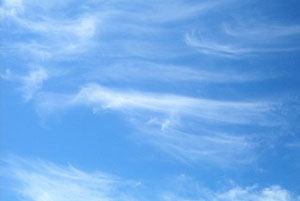
25.
what type of cloud is shown?
a)
cumulus
b)
cirrus
c)
stratus
26.
The amount of moisture in the air
a)
wind
b)
cloud
c)
cold front
d)
humidity
27.
The warmer the air the __________ water vapor it can hold.
a)
less
b)
more
28.

Which of these instruments is used to measure air pressure?

a)

Thermometer

b)

Anemometer

c)

Barometer

d)

Psychrometer

29.

Which instrument is used to measure wind speed?

a)

Barometer

b)

Anemometer

c)

Thermometer

d)

Psychrometer

30.

Which Instrument is used to measure humidity?

a)

Thermometer

b)

Psychrometer/hygrometer

c)

weathervane

d)

anemometer

31.

This weather instrument measures air temperature.

a)

Anemometer

b)

Thermometer

c)

Barometer

d)

Weather Balloon

32.

This weather instrument determines wind direction.

a)

Barometer

b)

Thermometer

c)

Wind Vane

d)

Compass Rose

33.
Dew Point is the
a)
temperature air cools down to reach condensation (or turn into a liquid)
b)
temperature where ice melts to liquid water
c)
temperature where ice turns directly into water vapor
d)
time of day when dew on the ground disappears
34.
Which of the following is NOT a form of precipitation?
a)
Rain
b)
Sleet
c)
Snow
d)
Fog
35.

Distinguish between sleet and snow.

a)

Sleet is not precipitation

b)

Sleet starts as rain

c)

Sleet forms in cold weather

d)

Sleet falls as single crystals

36.
At which humidity is it more likely to rain?
a)
50%
b)
20%
c)
77%
d)
99%
37.
Whirling mass of cool dry air that brings fair weather
a)
low pressure
b)
high pressure
c)
medium pressure
d)
wind
38.
Whirling mass of warm, moist air that brings stormy weather 
a)
cold front
b)
warm front
c)
low pressure
d)
humidity
39.
Which of the following states is NOT a part of Tornado Alley?
a)
Texas
b)
Oklahoma
c)
Nevada
d)
Nebraska
40.
What scale measures the strength of tornadoes?
a)
Richter
b)
Saffir-Simpson
c)
BMI
d)
Enhanced Fujita
41.
What are tornadoes?
a)
a storm with thunder and lighting and typically also heavy rain or hail
b)
a storm that can be the same as thunderstorms, but can be even more dangerous
c)
a mobile, destructive vortex of violently rotating winds having the appearance of a funnel shaped cloud and beneath a large storm system.
d)
a huge storm with strong winds and storm surges
42.

Describe the conditions that produce a thunderstorm.

a)

cold air near Earth's surface and an unstable atmosphere

b)

warm, moist air near the Earth's surface and an unstable atmosphere

c)

warm, moist air near Earth's surface

d)

an unstable atmosphere

43.

Determine the conditions which cause lightning to occur.

a)

an electric discharge between two positively charged areas

b)

an electric discharge between a negatively charged and positively charged area

c)

an electric discharge between two negatively charged ares

44.

Decide which of the following statements best describes a hurricane.

a)

a storm that usually lasts only a few minutes

b)

a rotating tropical storm with winds of 120 km/h

c)

a funnel cloud that touches the ground

d)

a thunderstorm formed over cold ocean water

45.
What is the scale used to measure hurricanes?
a)
MPH scale
b)
Fujita Scale
c)
Weight Scale
d)
Saffir/Simpson Scale
46.

The number one thing hurricanes need is...

a)

warm water

b)

cold air from cold fronts

c)

cold water

d)

strong warm front

47.
Someone who studies the weather.
a)
rain gauge
b)
taxonomists
c)
meterologist
d)
satellites
48.

What is weather?

a)

The amount of moisture in the air

b)

The number of clouds in the sky

c)

The speed of the wind

d)

The state of the atmosphere at any particular time.

49.

If it's a hot day outside, what can you conclude?

a)

There are a lot of clouds in the sky

b)

The air can hold a lot of moisture

c)

The wind is blowing extremely fast

d)

The air can hold very little moisture

50.

What are three types of winter storms ?

a)

Blizzards, snow and ice storms

b)

Cow, sheep and werewolf

c)

David Le, IT and Mr Dorje

d)

Blizzards, snow and ice ice baby