
 Worksheets
Chapter 15 Review
Total questions: 30
Worksheet time: 3hrs 30mins
When CH3OH is dissolved in water, how many particles are in solution for each unit?
1
3
4
5
6
When CaBr2 is dissolved in water, how many particles will be in solution for each unit?
1
2
3
4
5
At the same concentration, which salt will have the largest effect on the freezing point?
C2H4O2
H2S
LiBr
CaF2
Adding a nonvolatile solute to a liquid will ___.
depress both the freezing point and the boiling point
elevate both the freezing point and the boiling point
depress the freezing point and elevate the boiling point
elevate the freezing point and depress the boiling point
Molality (m) = moles of solute / _________________________.
kilogram of solvent
kiloliter of solvent
kilometer of solvent
ounces of solvent
What is the molality of a solution made by dissolving 2 moles of NaOH in 400 grams of water?
5 mol/kg. solvent
4 mol/kg solvent
3 mol/kg. solvent
2.5 moles /kg solvent
Molarity is measured in _____.
moles per g.
mols per L.
moles per mm.
moles per mL.
The _____ is the thing being dissolved.
solute
solvent
What is a solvent?
The substance that does the dissolving in a solution.
The substance that is being dissolved in a solution.
The mixing of different substances.
The process in which neutral molecules lose or gain electrons.

Using the graph above, solubility of which compound is influenced the most by changes in temperature?
KCl
NaCl
K2Cr2O7
KClO3
The molal boiling point elevation and freezing point depression constants depend upon...
enthalpy change.
nature of the solvent.
nature of solute.
vapour pressure of the solution.
. We have three aqueous solutions of NaCl labelled as ‘A’, ‘B’ and ‘C’ with concentrations 0.1M, 0.01M and 0.001M, respectively. The value of van’t Hoff factor for these solutions will be in the order __________ .
iA < iB > iC
iA = iB = iC
A < iB < iC
iA > iB > iC
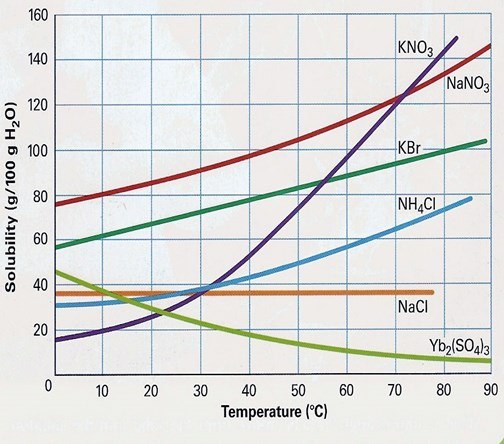
At 30'C, which substance has the lowest solubility?
KNO3
KBr
NaCl
Yb2(SO4)3
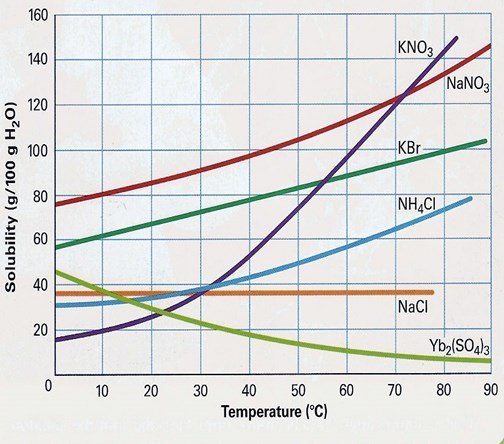
At which temperature do KBr and KNO3 have the same solubility?
60
55
50
Never
How could you change a saturated solution to an unsaturated solution?
Add solvent
Add solute
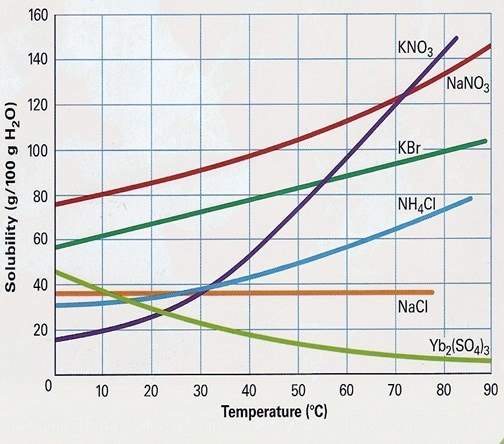
Determine the solubility for the substances at 55'C and arrange them in order from lowest to highest solubility.
NaCl, NH4Cl, KBr, NaNO3
NaCl, NH4Cl, NaNO3, KBr
NH4Cl, NaCl, NaNO3, KBr
NaNO3, KBr, NH4Cl, NaCl
Colligative properties of solutions are those properties that depend on
the amount of solute only
the identity of solute only
both the identity and the amount of solute

Which one of the following diagrams has the highest boiling point?
1
2
3
4
5
Styrene glycol (C8H10O2) is a plasticizer. How many grams of stryrene glycol must be dissolved in 98.7 g of benzene to raise the boiling point by 8.57 degrees C? Kb for benzene is 2.67 degrees C / m.
.098 g
138 g
3.21 g
43.8 g
Ethylene Glycol (C2H6O2) is the principal ingredient in antifreeze. How many grams of ethylene glycol will be needed to lower the freezing point of 2100 grams of water by 20 Co? Kf for water is 1.86 Co/m
10.75 g
1400 g
22.58 g
62 g
Using the graph above, solubility of which compound is influenced the most by changes in temperature?
KCl
NaCl
K2Cr2O7
KClO3
Which of the following statements is TRUE?
Ionic solutes affect colligative properties more than covalently bonded solutes because they produce more moles of solute in solution.
Ionic solutes affect colligative properties less than covalently bonded solutes because they produce less moles of solute in solution.
Covalent solutes affect colligative properties more than ionically bonded solutes because they produce more moles of solute in solution.
Covalent solutes affect colligative properties less than ionically bonded solutes because they produce more moles of solute in solution.
At the same concentration, which of the following will elevate (increase) boiling point the most?
CH3OH
C6H12O6
KNO3
SrCl2

Examine the models below. Assuming the same concentration, which would affect colligative properties more?
beaker A
beaker B
I. A 0.5 m NaBr soln has a higher vapor pressure than 0.5 m BaCl2 soln.
II. A 0.5 m NaOH soln freezes at a lower T. than pure water.
III. Pure water freezes at a higher T than pure methanol.
142 g of sodium sulfate, Na2SO4, are dissolved in 875 g of H2O. (Assume 100% ionization)
What will be the freezing point of the resulting solution?
(MM Na2SO4 = 142 g/mol; Kf =1.86)
−4.3 oC
−4.5 oC
−3.8 oC
−6.4 oC

