
 Worksheets
Chemistry Test #2 Review (2nd Semester)
Total questions: 271
Worksheet time: 6hrs 33mins


SO2 + O2 <=> SO3
If the concentration of SO2 is increased, the equilibrium position of the reaction will shift ___________.
2 NO(g) + O2(g) ⇌ 2 NO2(g)
2SO2(g) + O2(g) <=> 2SO3(g): ΔΗ = - 197 kJ mol -1
Which of the following will NOT shift the equilibrium position to the right?
Raising the pressure, by decreasing the volume of the container, will...

SO2 (g) + NO2 (g) <=> SO3 (g) + NO (g)
had reached a state of equilibrium, was found to contain
0.40 mol L-1 SO3 , and 0.30 mol L-1 NO,
0.15 mol L-1NO2 , and 0.20 mol L-1 SO2.
Calculate the equilibrium constant for this reaction.
Fe3O4(s) + 4H2(g) <=> 3Fe(s) + 4H2O(g)
Kc =
What is the concentration equilibrium constant expression?
CO2(g) + H2(g) ↔ CO(g) + H2O(l)
4Br2(g) + CH4(g) ↔ 4HBr(g) + CBr4(g)
Which direction does the reaction shift if NH3 was added?
Which direction does the reaction shift if NH3 was removed?
Which direction does the reaction shift if H2 was removed?
Which direction does the reaction shift if N2 was removed?
The forward reaction forms the substance __________.
SO2 + O2 <−> SO3
If the equilibrium shifts to the right, the concentration of O2 will ___________.
heat + N2 + O2 <−> 2NO
If NO is removed from the system, the concentration of N2 will _______.
H2 (g) + Cl2 (g) <−> 2HCl (g) + heat
If the temperature is cooled, the _________ reaction will be favored.
N2 (g) + 3 H2 (g) <−> 2 NH3 (g)
If the pressure in the system is increased, which substance will increase in concentration?
What is the effect of increasing the pressure on the following equilibrium: 2NO(g) + O2 (g) ⇌2NO2(g)?
The yield of NO2 increases
The yield of NO2 decreases
The reaction is slower
The concentration of O2 increases.
Decreasing volume of container will
For the following reaction: H2(g) + Cl2 (g) ↔ 2HCl(g), calculate the concentration of HCl when Keq= 2.3x10⁻⁵, [H2]= 0.0056mol, [Cl2]= 0.0048mol.
6.2 x 10⁻¹⁰ M
2.5 x 10⁻⁵ M
1.1 M
1.2 M
PCl3 (g) + Cl2 (g) ↔ PCl5 (g) + energy
Which of the following causes an increase in the moles of PCl5 present at equilibrium shown?
decreasing the volume of the container
raising the temperature
adding a mole of He gas at constant volume
adding a mole of He gas at constant pressure
What kind of equilibrium does the reaction below show?
H2(g) +I2(g) ↔ 2HI(g)
Heterogeneous equilibrium, all the reactants and products are in the same physical state.
Homogeneous equilibrium, all the reactants and products are in the same physical state.
Heterogeneous equilibrium, the reactants and products are present in more than one physical state
Homogeneous equilibrium, the reactants and products are present in more than one physical state
heat + N2 + O2 <−> 2NO
If the heat is removed from the chemical system, the concentration of N2 will _______.
H2 (g) + Cl2 (g) <−> 2HCl (g) + heat
If the pressure in the system is increased, the equilibrium will _______.
H2(g)+Cl2(g)⇌2HCl(g)
The forward reaction is exothermic. What will happen to the equilibrium if the temperature is increased?
equilibrium shifts right
equilibrium shifts left
You cannot predict the effect
no change


Such reactions which continue in both directions are called:
Irreversible reactions
Reversible reactions
Non-reactive reactions
dynamic reactions
A complete reaction is in which:
All the reactants convert into products
All the reactants do not convert into products
Half reactants convert into products
only 10% reactants convert into products
When we investigate the rate of reaction we are looking at the...
amount of product formed
speed of reaction
concentration of reacting particles
combining reactants with products
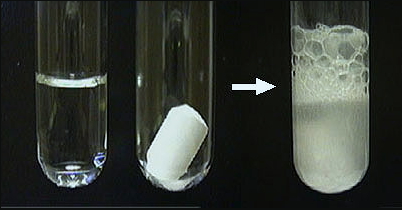
How could we make this reaction happen more quickly?
Decrease the concentration of the acid
crush the chalk to increase the surface area
Put the test tube in an ice bath
Creating fossils is a very _____ chemical reaction
Fast
Slow
It is not a chemical reaction
What does the M after a concentration value stand for?
meters
music
Molarity
moles
Which is the highest concentration?
10m
2M
25 mmol
0.5M
The major theory of reaction rate is called
Collision theory
Crash theory
Newton's laws
Thermodynamics
When surface area is decreased the rate of reaction...
Decreases, because there are LESS possible sites for correct collisions
Increases, because there are LESS possible sites for correct collisions
Decreases, because there are MORE possible sites for correct collisions
Increases, because there are MORE possible sites for correct collisions
You know that a chemical reaction is occurring here because you see __________________ . (Pick 3)
purple color
smoke
ice formation
fire
a yellow precipitate
In this chemical reaction, what was the first evidence that you saw?
Production of fire
Production of light
Production of purple smoke
Production of white powder
The result of the experiment between Iodine and Aluminum was the production of __________________.
clear liquid.
a white powder.
yellow precipitate.
bubbles.
When zinc reacted with hydrochloric acid, what was the result of this reaction?
a white powder
a blue liquid
a brown precipitate
a gas
We know that there was a chemical reaction occurring when 2 clear liquids were mixed together. That is because we show the production of a _____________.
solid.
precipitate.
gas.

A precipitate is a ___________ that forms when 2 liquids react together.
solid
liquid
gas
plasma

Reactants are the chemicals that are present at the beginning of an experiment. Reactants react together to make the product.
We can know that a chemical reaction is occurring when we see ______.
that the product looks just like the reactants.
nothing new.
that the product looks different from the reactants.
Which of the following is evidence of a chemical reaction?
Tearing paper.
Change in color.
Production of a gas.
Change in temperature.
Production of a precipitate.
List four factors that affects the rate of a reaction
temperature
concentration
surface area
volume
catalysts
A temperature increase causes the particles ......
to slow down
move faster
collide higher
in the right order
How does a catalyst work in speeding up a reaction?
By lowering the activation energy or reaction
by giving them more energy
by making them more available

Why does a higher concentration increase the rate of reaction?
it increases the amount of reactants
it lowers the activation energy
it increases the energy of particle collisions
it increases the frequency of particle collisions
Why does a higher temperature increase the rate of a reaction?
it increases both the frequency and energy of particle collisions
it only increases the frequency of particle collisions
it only increases the energy of particle collisions
it reduces the activation energy of the reaction
The ______________is required to break the bonds of the reactants.
Carbonic energy
Activation energy
Plutonic energy
Energi Gaib
The minimum amount of energy needed for colliding particles to react is called
Chemical Energy
Kinetic Energy
Activation Energy
Potential Energy
A temperature increase causes the particles ......
to slow down
move faster
collide higher
in the right order
Adding a catalyst ___________ the activation energy.
Raises
Lowers
Doesn't affect
Inreases
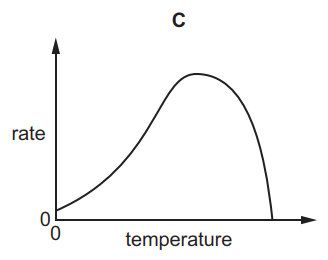
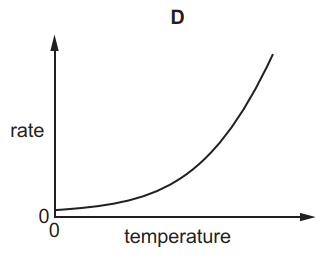
Which graph shows the effect of increasing temperature on the rate of reaction of calcium carbonate with dilute hydrochloric acid?
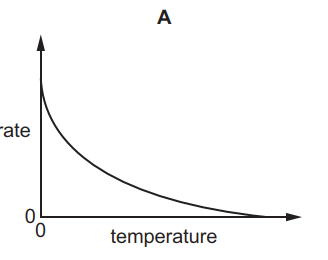
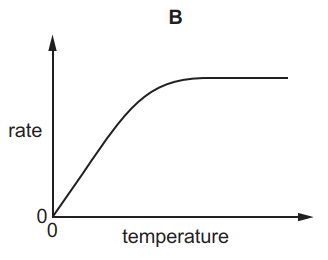
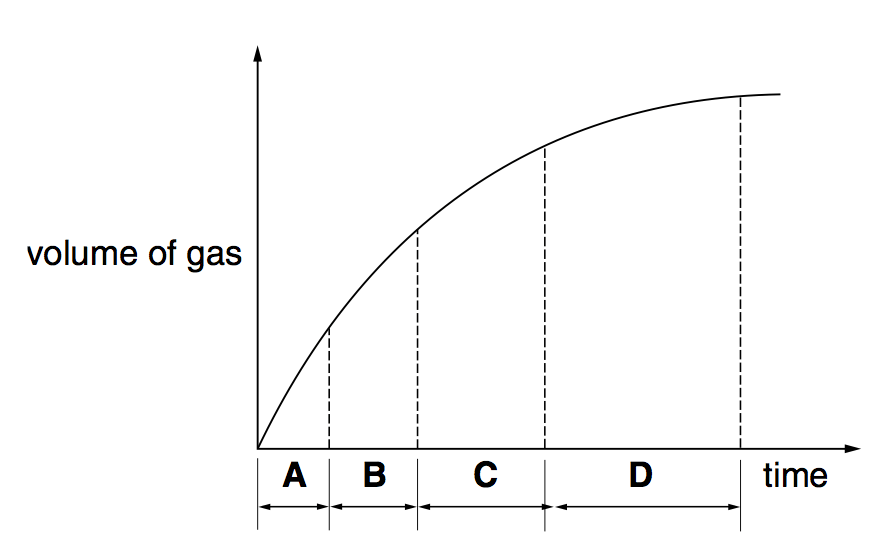
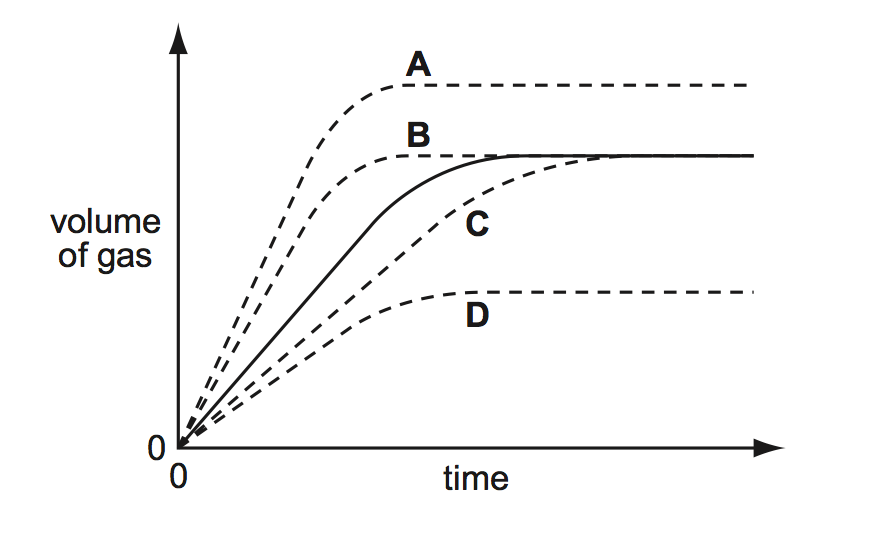
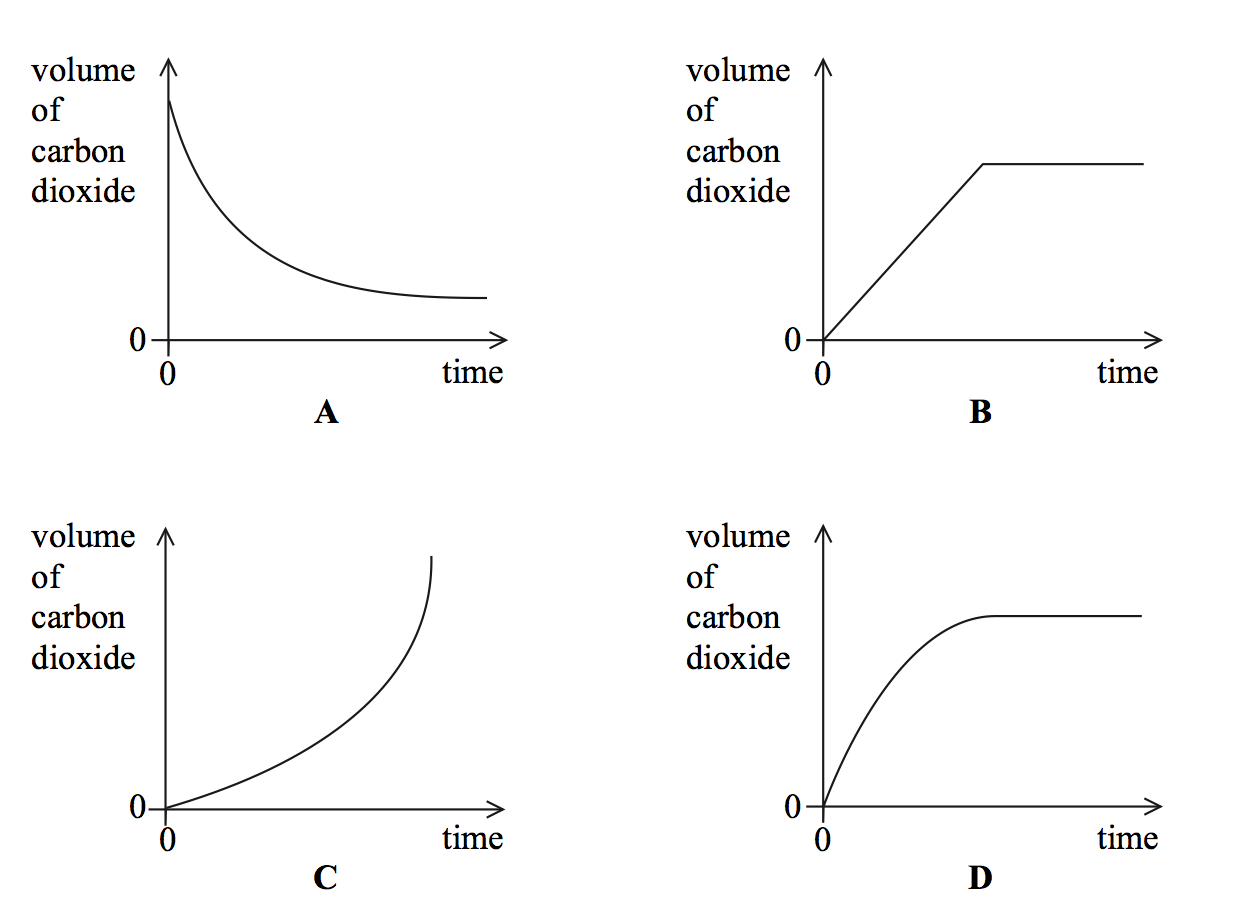
Which graph shows the correct results?


Which factors affect the rate of a reaction?
temperature
concentration
surface area
pressure
catalyst
How does a catalyst work in speeding up a reaction?
By lowering the activation energy or reaction
by giving them more energy
by making them more available
The minimum amount of energy needed for colliding particles to react is called the
Chemical Energy
Kinetic Energy
Activation Energy
Potential Energy
A substance that increases the rate of a reaction without being used up during the reaction is called a
catalyst
product
reactant
solute
What is the name given to a catalyst in the human body?
Biology
Catalyst
Chemical
Enzyme

Which of the reaction pathway shows the catalysed reaction?
1
2
When a catalyst is added to a reaction the rate of reaction,,,
Increases
Decreases
Does not change
How does a catalyst work in speeding up a reaction?
By lowering the activation energy or reaction
by making them more available
by giving them more energy
A catalyst
is used up
is nevr used up
A catalyst be regenerated or used again and again
False
True
A catalyst changes the mechanism of the reaction
True
False
Catalysts may be in the state of ___________.
Solid and liquid only
Liquid and gases only
Solid and gases only
Solid, liquid or gases

The following graph shows two different reaction pathways for the same overall reaction at the same temperature. Which pathway is slower and why?
Red, because the activation energy is larger
Blue, because the activation energy is lower
both reaction progress at the same rate
Enzymes in your body probably work best at which of the following temperatures>
25oC
37oC
98oC
100oC
What is activation energy?
energy to get up in the morning
energy to boil a kettle
minimum energy required for a reaction to occur
maximum energy needed for a reaction to occur
the number of particles in a reaction
What does increasing the temperature do?
breaks the reactants up in to smaller pieces
increase amount of product
increase energy of particles
increase the number of particles
slower the particles down
What does increasing the surface area do?
breaks the reactants up in to smaller pieces
increase amount of product
increase energy of particles
increase the number of particles
slower the particles down
What does increasing the concentration do?
breaks the reactants up in to smaller pieces
increase amount of product
increase energy of particles
increase the number of particles
slower the particles down
Enzymes are found in
our cells
animals
plants
all of the options are correct
There are many different types of enzymes.
True
False
If the temperature of the environment is not correct the enzyme may not work.
True
False
What will the balanced equation be if you react:
CaCl2 + NaOH
CaCl2 + 2 NaOH --> Ca(OH)2 + 2 NaCl
CaCl2 + 2 NaOH --> CaOH + 2 NaCl
CaCl2 + 2 NaOH --> CaNa2 + 2 ClOH
no reaction
What is the precipitate formed between CaCl2 and NaOH?
CaCl2
NaOH
Ca(OH)2
NaCl
no precipitate is formed
Will the reaction between NaOH and KCl occur?
Yes
No
Mark the indicators of a double displacement reaction.
Water is formed
gas is formed
a precipitate is formed
a phase change occurs
none of these are correct
Will the reaction between Cu(NO3)2 and K2SO4 happen?
yes
no
Which equation is a double displacement reaction?
Cl2 + 2KI --> 2KCl
Fe + O2 --> Fe2O3
CaCO3 --> CO2 + CaO
CaCO3 + 2HCl --> CaCl2 + H2CO3
What are the products for a reaction between KCl and AgNO3
KAg + ClNO3
KCl + AgNO3
KNO3 + AgCl
no reaction occurs
Identify the single replacement reaction
Cl2 + 2KI --> 2 KCl + I2
Fe + O2 --> Fe2O3
CaCO3 --> CaO + CO2
2P + 5O2 --> P2O5
Identify the decomposition reaction
Cl2 + 2KI --> 2 KCl + I2
Fe + O2 --> Fe2O3
CaCO3 --> CaO + CO2
2P + 5O2 --> P2O5
Predict the products:
Mg(NO3)2 + CaCl2 →
Mg(NO3)2 + CaCl2
MgCa + Cl2(NO3)2
Ca(NO3)2 + MgCl2
CaNO3 + MgCl
Based on the activity series, will this reaction occur?
Au (s) + HCl (aq) →
Yes
No
Which metal is more reactive than calcium?
magnesium
potassium
silver
aluminum
Which among the following is(are) double displacement
reaction(s)?
(i) Pb + CuCl2 --> PbCl2 + Cu
(ii) Na2SO4 + BaCl2 --> BaSO4 + 2NaCl
(iii) C + O2 --> CO2
(iv) CH4 + 2O2 --> CO2 + 2H2O
(a) (i) and (iv)
(b) (ii) only
(c) (i) and (ii)
(d) (iii) and (iv)
Barium chloride on reacting with ammonium sulphate forms barium sulphate and ammonium chloride. Which of the following correctly represents the type of the reaction involved?
(i) Displacement reaction
(ii) Precipitation reaction
(iii) Combination reaction
(iv) Double displacement reaction
(a) (i) only
(b) (ii) only
(c) (iv) only
(d) (ii) and (iv)
Determine the two products when Na3PO4 reacts with SnO2.
NaO and SnPO4
Na2O and Sn(PO4)2
Na2O and Sn3PO4
Na2O and Sn3(PO4)4
Determine the products when FeCO3 and AgOH mix.
Fe(OH)3 and Ag2CO3
Fe(OH)2 and Ag2CO3
Fe(OH)2 and AgCO3
Fe(OH)3 and AgCO3
When ammonium dichromate reacts with zinc nitride, what are the products?
zinc nitrate and ammonium chromate
zinc dichromate and ammonium nitrate
zinc chromate and ammonium nitride
zinc dichromate and ammonium nitride
___ Na2CO3 + ___ Ag3P → ___ Na3P + ___ Ag2CO3
3, 2, 1, 3
2, 2, 2, 3
3, 2, 2, 3,
3, 2, 3, 2
Pick the products when KMnO4 reacts with Al2S3 mix.
K2S
AlMnO4
Al(MnO4)3
KS2
Predict the products when sodium chlorate reacts with barium hydroxide.
NaOH and BaClO3
NaOH and Ba(ClO4)2
Na2OH and Ba(ClO3)2
NaOH and Ba(ClO3)2
____ Cu(OH)2 + ____ (NH4)3P → ____ Cu3P2 + ____ NH4OH
1, 1, 1, 3
3, 1, 1, 3
3, 2, 1, 6
3, 1, 1, 6
____ PbS2 + ____ K3PO4 →____ Pb3(PO4)4 + ____ K2S
3, 2, 1, 3
3, 4, 1, 6
3, 4, 1, 2
3, 2, 1, 2
____ (NH4)2SO4 + ____ AgNO3 → ____ NH4NO3 + ____ Ag2SO4
1, 2, 2, 1
1, 1, 1, 1
1, 1, 2, 1
2, 2, 2, 1
Which products result from nickel II chromate reacting with potassium sulfate?
NiSO4
K2Cr2O7
Ni2SO4
K2CrO4
Predict the products:
NaOH + Fe(NO3)3 →
NaFe + OH(NO3)3
Na(NO3)2 + Fe(OH)3
NaOH + Fe(NO3)3
NaNO3 + Fe(OH)3
Predict the products:
KOH + H3PO4 →
K3PO4 + HOH
KH3 + OHPO4
KOH + H3PO4
KPO4 + H3OH
Predict the products:
Mg(NO3)2 + CaCl2 →
Mg(NO3)2 + CaCl2
MgCa + Cl2(NO3)2
Ca(NO3)2 + MgCl2
CaNO3 + MgCl
Predict the products
Ba(NO3)2 + K2CO3 →
BaNO3 + KCO3
CO3NO3 + KBa
BaCO3 + K2NO3
BaCO3 + KNO3
____ Pb(NO3)2 + ____ Ca3P2 → ____ Pb3P2 + ____ Ca(NO3)2
1, 1, 1, 1
3, 3, 1, 3
3, 1, 1, 3
3, 1, 1, 1
What are the correct products when fluorine gas mixes with ammonium chloride?
F2 + NH4Cl
Cl2 + NH4F2
Cl + NH4F
Cl2 + NH4F
Balance: ____ Al + ____ ZnCO3 → ____ Zn + ____ Al2(CO3)3
1, 1, 2, 2
2, 3, 3, 1
2, 1, 1, 1
2, 3, 1, 1
What are the products when copper II chloride reacts with magnesium metal?
Cu + MgCl2
Cu2 + MgCl2
Cu + MgBr2
Cu + MgCl
Balance: ____ Al2(SO4)3 + ____ Sn → ____ Al + ____ Sn(SO4)2
1, 1, 1, 1
1, 3, 2, 1
2, 3, 4, 3
2, 2, 2, 3
Fe + Ag2CrO4 react. What are the products?
Ag + Fe2CrO4
Ag + Fe(CrO4)3
Ag + FeCrO4
Ag + Fe3CrO4
N2+O2--> _NO
__Li + __Cl2 -> __LiCl
indicates substance is a liquid
g
cr
aq
l


HCl + Zn → H2 + ZnCl2

H2 + O --> H2O
Without balancing the final equation, predict the products for the synthesis reaction: Li + Cl2 → ?
LiCl2
LiCl
Li2Cl2
Li2Cl
Without balancing the final equation, predict the products for the synthesis reaction: Mg + Br2 → ?
MgBr
MgBr2
Mg2Br
Mg2Br2
Without balancing the final equation, predict the products for Al + Cl2 → ?
Al3Cl
AlCl
AlCl3
Al3Cl2
Without balancing the final equation, predict the products for the synthesis reaction: Li + P4 → ?
Li3P
LiP3
LiP4
LiP
Without balancing the final equation, predict the products for the synthesis reaction: Al + S8 → ?
AlS8
Al3S2
Al3S8
Al2S3
What is the final balanced equation for: Ca + F2 → ?
Ca + F2 → CaF2
Ca + F2 → 2CaF
2Ca + F2 → 2CaF2
2Ca + F2 → Ca2F2
What is the final balanced equation for: Li + P4 → ?
Li + P4 → LiP4
4 Li + 3 P4 → 4 LiP3
4 Li + P4 → 4 LiP
12 Li + P4 → 4 Li3P
What is the final balanced equation for: Na + Br2 → ?
Na + Br2 → NaBr2
2 Na + Br2 → 2 NaBr
Na + Br2 → 2 NaBr
4 Na + Br2 → 2 Na2Br
Write the overall balanced chemical equation for the synthesis reaction: Sr + N2 → ?
Sr + N2 → SrN2
Sr + N2 → Sr3N2
3 Sr + N2 → Sr3N2
2 Sr + N2 → 2 SrN
Write the overall balanced equation for the synthesis reaction: Li + S8 → ?
16 Li + S8 → 8 Li2S
Li + S8 → LiS8
2 Li + S8 → Li2S8
8 Li + S8 → 8 LiS
2HgO → 2Hg + O2
2Mg + O2 → 2MgO
Al(OH)3 → Al2O3 + H2O
C2S2 + O2 → CO2 + S2O
Balancing the following:
____ Al + ____ HCl → ____ AlCl3 + ____ H2
Balance the following:
____ H2SO4 + ____ NaNO2 → ____ HNO2 + ____ Na2SO4
Which type of reaction is:
2 H3AsO4 → As2O5 + 3 H2O
Balance this reaction:
____ Na3PO4 + ____ KOH ---> ____ NaOH + ____ K3PO4
1,3,3,1
1,3,2,1
2,3,3,1
1,1,3,1
Balancing this reaction:
____ CH4 + ____ O2 ---> ___ CO2 + ____ H2O
2,1,3,1
1,2,1,2
1,2,2,1
2,1,1,2
Balance this reaction:
____ RbNO3 + ____ BeF2 ----> ____ Be(NO3)2 + ____ RbF
1,1,1,1
1,2,1,1
2,1,1,2
2,1,2,1
Balance the following:
Aluminum nitrate and Carbonic acid react to form
Aluminum carbonate and Nitric acid
CoCO3 → CoO + CO2

What type of reaction involves one element replacing another element in a compound?
Single Replacement Reaction
Double Replacement Reaction
Synthesis Reaction
Decomposition Reaction
What type of reaction involves ions from 2 compounds exchanging places to form 2 completely new compounds?
Single Replacement Reaction
Double Replacement Reaction
Synthesis Reaction
Decomposition Reaction

What are the reactants in the chemical equation pictured?
CH4 and CO2
CH4 and O2
CO2 and H2O
O2 and H2O

What are the products of the chemical reaction pictured?
CH4 and CO2
CH4 and O2
CO2 and H2O
O2 and H2O
What type of chemical reaction is this one?
Al(OH)3 --> Al2O3 + H2O
Decomposition
Combustion
Synthesis
Single Replacement
What type of chemical reaction is this one?
CUO + CO2 --> CuCO3
Decomposition
Combustion
Synthesis
Single Replacement
What type of chemical reaction is this one?
Ca + MgCl2 --> CaCl2 + Mg
Decomposition
Combustion
Synthesis
Single Replacement
3KOH + H3PO4 --> K3PO4 + 3H2O
Combination
Decomposition
Single replacement
Double replacement
Combustion reactions will always involve
Oxygen and a solid
Liquid nitrogen and heat
Oxygen and heat/energy
CO and H2O
Balancing this reaction:
____ CH4 + ____ O2 ---> ___ CO2 + ____ H2O
2,1,3,1
1,2,1,2
1,2,2,1
2,1,1,2
Balance this reaction:
____ Na3PO4 + ____ KOH ---> ____ NaOH + ____ K3PO4
1,3,3,1
1,3,2,1
2,3,3,1
1,1,3,1
Balance this reaction:
____ NaF + ____ Br2 ---> ___ NaBr + ____ F2
3,1,2,1
1,2,3,4
2,1,2,1
1,2,1,2


Predict the products for this substance: Al2O3 → ? + ?
Al + O2
O2 + Al3
Al2 + O3
Al + O
Al3 + O
Cu+ AgNO3-->
Mg + Al(OH)3 →
4Fe + 3O2 → 2Fe2O3
2H2O2 →2 H2O + O2
Fe + CuSO4 -> Cu + FeSO4
What are the products of this reaction?
Cu2+ + AgNO3 →
Cu(NO3)2 + Ag
CuNO3 + Ag
CuAg + NO3
Cu + AgNO3
Write a balanced reaction for this reaction [Zn has a charge of 2+]
Zn(s) + H2S(aq) →
ZnS + H
ZnS + H2
ZnS2 + H
Zn2S + H2
K + HCl -->
Predict the products for the this reaction:
Mg + CuCl2 →
MgCl2 + Cu
MgCl + Cu
MgCu + Cl2
CuMg + Cl2
Predict the products for the this reaction: [Ag has a charge of 1+]
Ag3N + KCl →
AgCl + K3N
AgK + ClN3
AgN3 + KCl
KAg + N3Cl

