Wayground logo

Free Printable Worksheets

Font size

S
M
L
XL
Worksheets

Chemical Reactions, Proteins, Enzyme Honors

Total questions: 40

Worksheet time: 47mins

Name
Class
Date
1.

What is the by-product of dehydration reactions?

a)

Water

b)

Carbon dioxide

c)

Ethanol

d)

Hydrogen

2.

The minimum energy particles must have to react is the

a)

acting energy

b)

active energy

c)

activation energy

3.

Bond making is

a)

Endothermic

b)

Exothermic

4.

Bond breaking is..

a)

Endothermic

b)

Exothermic

5.

Which letter shows the activation energy

a)

A

b)

B

c)

C

6.

Which letter represents the reactants?

a)

A

b)

B

c)

C

d)

D

e)

E

7.

Which letter represents the products?

a)

A

b)

B

c)

C

d)

D

e)

E

8.
During an endothermic reaction in a beaker if we are part of the surroundings and touched the beaker, it would feel _______. 
a)
Warm
b)
Cold
9.

A single unit that can bond to other single units to form a polymer is a:

a)

Lego

b)

Monounits

c)

Monopoly

d)

Monomer

10.

Many monomers bonded together form a:

a)

Multimer

b)

Polygon

c)

Polymer

d)

Manymer

11.

Monomers bond to other monomers through this process:

a)

Hydrolysis

b)

Dehydration synthesis

c)

Gluation

d)

Freezing

12.

Which of the following is true in a dehydration synthesis reaction?

a)

hydroxyl forms as a product as H is removed from one monomer and O is removed from the other

b)

water is added to the reactants as H is added to 1 monomer and OH is added tothe other

c)

water forms as a product as H is removed from 1 monomer and OH is removed from the other

d)

carboxyl forms as a product as CO is removed from one monomer and OH is removed from the other

13.

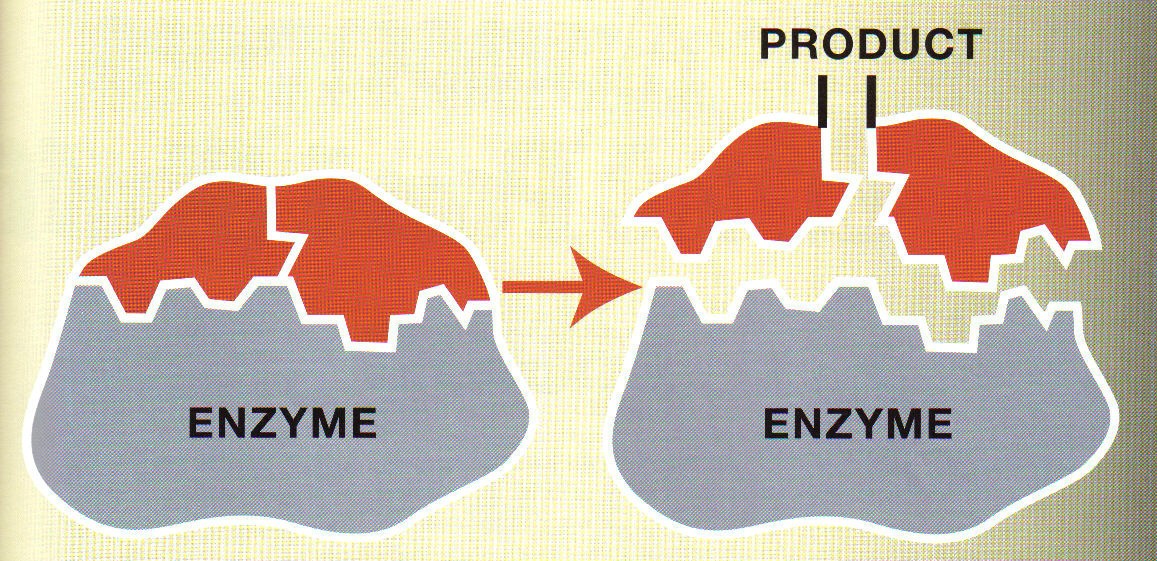
This image represents a _______ reaction.

a)

over

b)

condensation

c)

dehydration synthesis

d)

hydrolysis

14.

A polymer is broken down into its monomer through:

a)

condensation

b)

dehydraton synthesis

c)

hydrolysis

d)

nonreaction

15.

Macromolecules form through each of the following except:

a)

condensation reactions

b)

dehydration synthesis

c)

polymerization

d)

hydrolysis

16.

Which of the following represents the monomer of this image?

a)
b)
c)
17.
What is a peptide bond?
a)
Bond that holds two amino acids together.
b)
A bond that holds hydrogen and oxygen molecules together.
c)
A bond that holds the phosphate group of one nucleotide and a sugar of a neighboring nucleotide.
d)
A bond that is formed by the sharing of electrons.
18.
The structure of proteins can be changed by environmental factors such as temperature or pH.
a)
True
b)
False
19.
When a protein unfolds, it is
a)
Denatured
b)
Building
c)
Adding amino acids
d)
Making food
20.
The primary sequence of a protein refers to the:
a)
Order of amino acids
b)
α-Helix or β-Pleated Sheet
c)
Interaction of subunits
d)
Hydrogen Bonding
21.
The two types of folding in the secondary structure are.....
a)
alpha-helix & beta-pleated sheets
b)
polypeptide & nucleotide
c)
globular & fibrous
22.
What gives a protein its unique shape?
a)
the unique sequence of amino acids in its polypeptide chain
b)
the unique folding due to the sequence of amnio acids in the polypeptide chain
c)
hydrogen bonding & unique interactions between the 'R' groups
d)
all of these
23.
The main bonding in the secondary structure of a protein is due to.....
a)
covalent bonding
b)
ionic bonding
c)
hydrogen bonding
d)
polar bonding
24.
The tertiary structure folding in proteins is primary due to the interactions of....
a)
the 'R' groups
b)
the 'P' groups
c)
the 'A' groups
d)
the 'S'
25.

The entire polypeptide forms a three-dimensional structure

a)

Primary

b)

Secondary

c)

Tertiary

d)

Quaternary

26.

Two or more polypeptides attached together and work as one unit

a)

Primary

b)

Secondary

c)

Tertiary

d)

Quaternary

27.
What is a substance called if it speeds up a chemical reaction?
a)
reusable
b)
catalyst
c)
specific
d)
fragile
28.
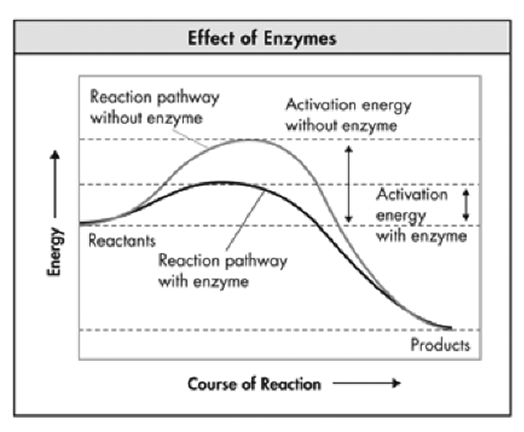
The graph shows how enzymes affect reactions in cells. Which statement best summarizes the information shown in the graph?
a)
Enzymes increase the energy of the reactants.
b)
Enzymes decrease the energy level of the products.
c)
Enzyme decrease the activation energy of the reaction.
d)
Enzymes reverse the direction of the reaction.
29.
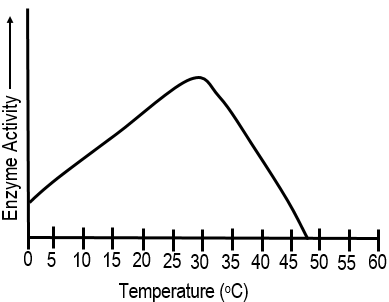
Based on the graph, what is the optimal temperature for this enzyme? 
a)
15oC
b)
40oC
c)
30oC
d)
35oC
30.
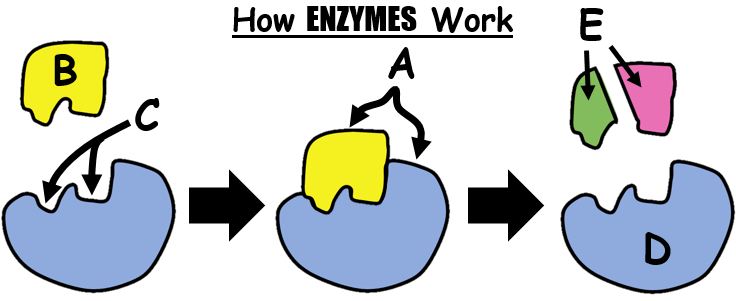
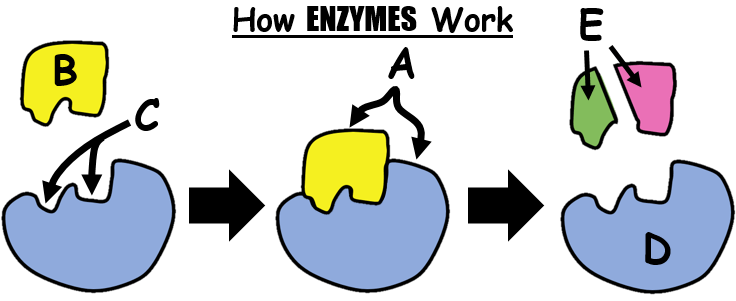
In the diagram, what is letter A? 
a)
product
b)
substrate
c)
enzyme-substrate complex
d)
active site
31.
Enzymes are...
a)
nucleic acids
b)
proteins
c)
lipids
d)
carbohydrates
32.
What is the function of an enzyme?
a)
enzymes break themselves into small pieces
b)
enzymes slow down chemical reactions
c)
enzymes speed up chemical reactions
d)
enzymes combine products to form reactants 
33.
Enzymes speed up reaction rates by changing...
a)
Activation Energy
b)
pH
c)
Hydrogen Bonds
d)
Kinetic Energy
34.
Letter B...
a)
active site
b)
enzyme
c)
substrate
d)
products
35.
With what 3 letters do enzymes typically end?
a)
-ose
b)
-ase
c)
-ese
d)
-tic
36.
Which of the following conclusions can be drawn from this graph?
a)
The optimum pH of the enzyme is 6.6.
b)
The optimum pH of the enzyme is 5.8
c)
The enzyme’s activity increases as pH increases 5.0 to 9.0
d)
The enzyme’s activity is greater around pH of 8.0 .
37.

What happens when enzymes are heated to a high temperature?

a)

The enzymes die.

b)

The shapes of the enzyme are altered.

c)

The enzymes' amino acid sequence changes.

d)

The enzymes remain the same

38.
What happens to an enzyme when it is denatured?
a)
Activation energy is lowered.
b)
It becomes stronger.
c)
It loses its shape.
d)
Activation energy is raised.
39.

What happens when an enzyme is placed outside it's normal environment?

a)

It functions normally

b)

It functions better

c)

It's function ceases

40.

Which of the following is a characteristic of amino acid R-groups?

a)

nonpolar

b)

polar

c)

charged

d)

all of the options