
 Worksheets
dihybrids and pedigrees
Total questions: 28
Worksheet time: 1hrs 17mins
What is the genotype for a pea plant homozygous for round seeds (R), and heterozygous for yellow seeds (Y)?
RrYy
RRyy
RRYy
rryy

A parent with genotype YyRR could produce which gametes?
YR, YR, yR, yR
Yy, Rr, yy, rr
Yr, Yr, yr, yR
YR, YR, yr, yr

What genotype would go in box 1?
AABb
AABB
aabb
AaBb
What genotype would go in box 3?
AABb
Aabb
aabb
AaBB
If you cross two homozygous plants (RRYY x rryy)
R = round seeds, r = wrinkled seeds Y = yellow seeds, y = green seeds
What percent will have round and yellow seeds?
0%
25%
50%
100%
A white mouse with red eyes is crossed with a black mouse with brown eyes. The white mouse is recessive for both of its traits. The black mouse is dominant for both of its traits.
This cross would be
BBEE x bbee
BBEe x BbEe
BbEE x BbEe
BBee x BBEE


How many alleles does a child get from each parent for a trait?
1
2
3
4
Aa, DD, Bb, yy are all examples of ---
genotypes.
phenotypes.
What you see, or the physical appearance of an organism, is called the ---
genotype.
phenotype.
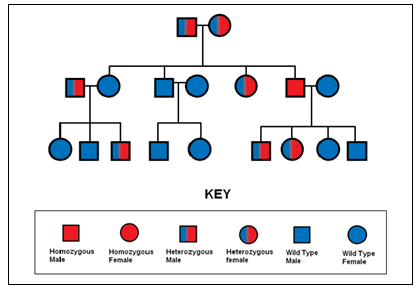
In a pedigree, which shape represents a male?
circle
square

On a pedigree, this symbol represents a ----
not affected male.
not affected female.
affected male.
affected female.

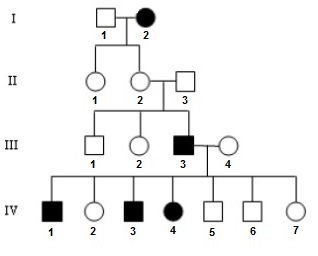
How are individuals III-2 and II-4 related?
Brother and sister
Dad and daughter
Uncle and niece
Grandfather and granddaughter

What is the mode of inheritance shown here?
Recessive because it "skips" a generation
Dominant because it shows up in every generation


If this pedigree shows a recessive disorder, what MUST the genotype of individual 4 be?
HH
Hh
hh

How many alleles does a person carry for a trait?
1
2
3
4

On this pedigree, the allele for curly hair is dominant. The couple labeled 2 both have curly hair, but have a daughter who does not have curly hair. Therefore, we can tell from the chart that for the couple labeled 2 -
the male is heterozygous and the female is heterozygous.
the male is homozygous recessive and the female is homozygous dominant.

