Wayground logo

Free Printable Worksheets

Font size

S
M
L
XL
Worksheets

Prokaryotic cells and virus

Total questions: 34

Worksheet time: 22mins

Name
Class
Date
1.

What is the only organelle without a cell membrane?

a)

nucleus

b)

ribosomes

c)

chloroplast

d)

mitochondria

2.

All of the following are Eukaryotic EXCEPT . . . .

a)

animal cells

b)

plant cells

c)

fungi

d)

bacteria

3.

Where is DNA found in a Eukaryotic cell?

a)

in the nucleus

b)

in the cell wall

c)

in the vacuole

d)

in the mitochondria

4.

What is E?

a)

cell wall

b)

cell membrane

c)

cilia

d)

flagella

5.

What is A?

a)

cytoplasm

b)

nucleus

c)

DNA

d)

vacuole

6.

What is D?

a)

cilia

b)

cytoplasm

c)

ribosome

d)

flagella

7.
What are the two broad categories of cells?
a)
prokaryotic and eukaryotic
b)
prokaryote and nucleoid
c)
eukaryotes and cells
d)
bacteria and archaea
8.
Bacteria and Archaea are classified as?
a)
eukaryotes
b)
nucleoid
c)
prokaryotes
d)
proteins
9.
cells of animals, plants, fungi, and protists are all?
a)
nucleoid
b)
prokaryote
c)
archaea
d)
eukaryotes
10.
Prokaryote are?
a)
simple, mostly single-celled organism that lacks a nucleus, or any other membrane-bound organelle.
b)
have a peptidoglycan cell wall and many have polysaccharide capsules.
c)
have a true nucleus, which means the cell's DNA is surrounded by a membrane.
d)
contain membrane-bound organelles, such as the nucleus
11.
plasma membrane
a)
consisting of a jelly-like cytosol within the cell which other cellular components are found
b)
the genetic material of the cell
c)
an outer covering that seperates the cell's interior from its surrounding environment
d)
synthesize proteins
12.
cytoplasm....
a)
consisting of a jelly-like cytosol within the cell in which other cellular components are found.
b)
an outer covering that seperates the cell's interior from its surrounding environment
c)
the genetic material of the cell
d)
synthesize proteins
13.
DNA
a)
synthesize proteins
b)
the genetic material of the cell
c)
an outer covering that separates the cell's interior from its surrounding environment
d)
consisting of a jelly-like cytosol within the cell in which other cellular components are found
14.
ribosomes
a)
an outer covering that separates the cell's interior from its surrounding environment
b)
the genetic material of the cell
c)
consisting of a jelly-like cytosol within the cell in which other cellular components are found
d)
synthesize proteins
15.
Do most prokaryotic have a peptidoglycan cell wall and many have a polysaccharide capsule?
a)
True
b)
False
16.
What three things does the cell wall act as?
a)
nucleoid, ribosomes, membrane
b)
an exxtra layer of protection, helps the cell maintain its shape, and prevents dehydration.
c)
flagella, pili, fimbriae
d)
pathway, flagella, and prevents dehydration
17.
All Microbes cause disease....
a)
True
b)
False
18.
Eukaryotic cells ar smaller than prokaryotic cells.
a)
True
b)
False
19.
Prokaryotes depend on __________ to obtain some materials and to get rid of wastes.
a)
ribosomes
b)
flagella
c)
cell division
d)
diffusion
20.
Pili
a)
Used to attach to a host cell by bacteria.
b)
Used to exchange genetic material during conjugation in prokaryotes.
c)
Used for locomotion in prokaryotes.
d)
this structure acts as an extra layer of protection, helps the cell maintain it's shape, and prevents dehydration.
21.

All bacteria cells are...

a)

Prokaryotic Cells

b)

Eukaryotic Cells

22.

In a prokaryotic cell, where is the DNA located?

a)

In the cell wall

b)

In the nucleus

c)

In the cell membrane

d)

in the nucleoid

23.
Reasons that viruses are considered to be nonliving is because
a)
They are not cellular
b)
They cannot reproduce on their own
c)
They cannot make proteins
d)
all of the above
24.
What do viruses need to reproduce?
a)
they need genetic material
b)
They need a host cell
c)
They need  bacteria
d)
They need insulin
25.
A(n) _____ is a virus that enters a bacterial cell.
a)
endospore
b)
decomposer
c)
plasmid
d)
bacteriophage
26.
When a virus invades a living cell, its _______
takes over the cell's functions.
a)
outer coat
b)
genetic material
c)
core
d)
cytoplasm
27.
Antibiotics kill viruses
a)
True
b)
False
28.
Viruses are cells. 
a)
True 
b)
False
29.
How could you describe the size of a virus?
a)
Smaller than bacteria
b)
Larger than a parasite
c)
About the size of a dime
d)
Smaller than a proton
30.
an organism that lives in or on another is called a
a)
parasite
b)
paramedic
c)
pasadena
d)
pair of dice
31.

Which viral cycle takes the longest to show symptoms?

a)

Lysogenic

b)

Lytic

32.

If Andy is feeling symptoms from a virus that he contracted, the virus must be in the

a)

lytic cycle

b)

lysogenic cycle

c)

the capsid bursts

d)

the virus becomes dormant

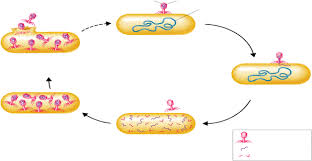
33.
What is shown here?
a)
Lysogenic Cycle
b)
Lytic Cycle
c)
Binary Fission
d)
Conjugation
34.
What process is this?
a)
phagocytosis
b)
lytic cycle
c)
lysogenic cycle
d)
formation of antibodies