
 Worksheets
Chemical Calculations
Total questions: 29
Worksheet time: 31mins

What is the relative atomic mass of metal X?
(a)
If metal x has a relative atomic mass of 24, what is it?
(a)
The copper chloride solution used in the investigation contained 300 grams per dm3 of solid CuCl2 dissolved in 1 dm3 of water.
The students used 50 cm3 of copper chloride solution in each experiment.
Calculate the mass of solid copper chloride used in each experiment.
(a)
2Na + Cl2 --> 2NaCl
4.6 g of sodium reacts with chlorine to produce 11.7 g of sodium chloride.
What mass of chlorine reacted?
(a)

Calculate the mean mass of solid after heating.
Give your answer to 3 significant figures.
(a)
A solution of hydrochloric acid contains 3.2 g of hydrogen chloride in 50 cm3
Calculate the concentration of hydrogen chloride in g per dm3
(a)
Calculate the percentage by mass of oxygen in ammonium nitrate (NH4NO3).
Relative atomic masses (Ar): H = 1 N = 14 O = 16
Relative formula mass (Mr): NH4NO3 = 80
(a)

Calculate the mean temperature change for metal Y.
Do not include the anomalous result in your calculation.
(a)
100 cm3 of the copper sulfate solution contains 1.8 g of copper sulfate.
Calculate the mass of copper sulfate in 25 cm3 of this copper sulfate solution.
(a)

Calculate the mass of chlorine that reacts with 3.94 g of gold.
(a)
Calculate the relative formula mass (Mr) of gold chloride (AuCl3).
Relative atomic masses (Ar): Cl = 35.5 Au = 197
(a)
Sodium reacts with chlorine to produce sodium chloride. Balance the equation for the reaction.
(a) Na + Cl2→ (b) NaCl
Magnesium reacts with oxygen to produce magnesium oxide.
Calculate the percentage mass of magnesium in magnesium oxide (MgO).
Relative atomic mass (Ar): Mg = 24
Relative formula mass (Mr): MgO = 40
(a) %

Calculate value X in Table 1.
Do not use the anomalous result.
Give your answer to 2 significant figures.
(a)
500 cm3 of copper chloride solution contains 6.50 g of copper chloride.
Calculate the mass of copper chloride in 40.0 cm3 of this copper chloride solution.
(a)
Sodium reacts with water to produce sodium hydroxide and hydrogen. Balance the equation for the reaction.
(a) Na + 2 H2O → 2 NaOH + H2
Calculate the relative formula mass (Mr) of sodium hydroxide (NaOH).
Relative atomic masses (Ar): H = 1 O = 16 Na = 23
(a)

Calculate the relative atomic mass (Ar) of potassium.
Give your answer to 1 decimal place.
(a)
Solutions of hydrochloric acid and sodium hydroxide are reacted and the
temperature change is recorded.
In the reaction, 3.65 g of hydrogen chloride reacts with 4.00 g of sodium hydroxide.
1.80 g of water is produced.
Calculate the mass of the other product.
(a)
This question is about elements and compounds. Magnesium and oxygen react to produce magnesium oxide. Balance the equation for the reaction.
(a) Mg + O2 → 2 MgO
Calculate the relative formula mass (Mr) of magnesium fluoride (MgF2).
Relative atomic masses (Ar): F = 19 Mg = 24
(a)
The potassium sulfate solution has 0.86 g of potassium sulfate dissolved in
25 cm3 of water.
Calculate the mass of potassium sulfate needed to make 1.0 dm3 of solution.
(a)

Calculate value Y in Table 1.
(a)
The student then added 1.2 g of magnesium to 50 cm3 of zinc sulfate solution.
The temperature increased by 9.0 °C.
Calculate the temperature increase when the student adds 0.40 g of magnesium
to 50 cm3 of zinc sulfate solution.
(a)
Balance the equation for the reaction.
TiCl4 + 4 Na → Ti + (a) NaCl
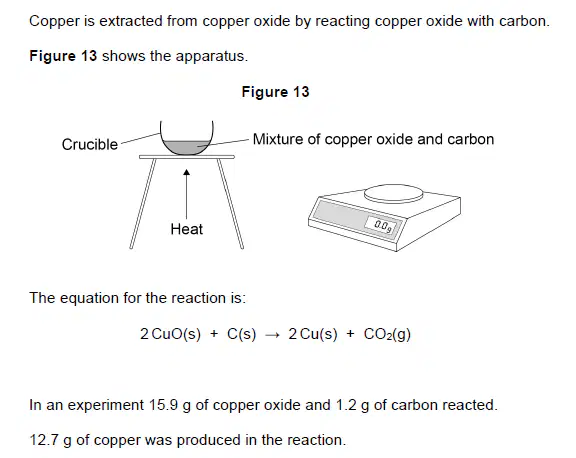
Calculate the mass of carbon dioxide produced in this experiment.
(a)
Calculate the relative formula mass (Mr) of sulfuric acid (H2SO4).
Relative atomic masses (Ar): H = 1 O = 16 S = 32
(a)
Calculate the percentage by mass of oxygen in lithium sulfate (Li2SO4).
Relative atomic mass (Ar): O = 16
Relative formula mass (Mr): Li2SO4 = 110
Give your answer to 2 significant figures.
(a)
A solution of lithium sulfate contains 0.30 g of lithium sulfate in 25 cm3.
Calculate the concentration of lithium sulfate in g/dm3.
(a)

