
Font size
 Worksheets
midterm
Total questions: 122
Worksheet time: 6hrs 6mins
The job of the heart is to . . .
pump blood around the body.
send food to the small intestines.
break down food.
give energy to the body.

Blood vessels that carry blood away from the heart.
Veins
Capillaries
Arteries
Arteries
carry oxygenated blood to the heart
carry oxygenated blood away from the heart
carry deoxygenated blood to the heart
carry deoxygenated blood away from the heart

State one reason why blood at location B contains more oxygen than blood at location A.
because blood at location A goes to the lungs
because blood at location A comes from the lungs
because blood at location B comes from the lungs
because blood at location B goes to the lungs

Select the structure and explanation of how it contributes to the way the human system functions.
heart replaces carbon dioxide with oxygen
blood vessels transport nutrients and oxygen
heart replaces oxygen with carbon dioxide
blood vessels pump heart rate

In diagrams, the red blood shows that the blood is carrying
More oxygen
More Carbon dioxide

The blood obtains the oxygen from which organ?
Brain
Lungs
Heart
Stomach

In diagrams, the blue blood shows that the blood is carrying
Oxygen
Carbon dioxide

In the lungs, the blood gets rid of...
Oxygen
Carbon Dioxide

In the lungs, what is removed from the blood?
Oxygen
Carbon Dioxide

When blood enters the right atrium, where is it coming from?
The body
Left ventricle
Right Atrium
Lungs
Pulmonary circulation describes the flow of blood from the heart to the _____.
lungs
body
_____ are thick walled vessels designed to withstand high pressure.
Veins
venuoles
capillaries
arteries
The artery carry oxygenated blood except..
Aorta
Carotid artery
Coronary artery
Pulmonary artery
All arteries carry oxygenated blood.
True
False
___________ carry blood at high pressure and ___________ carry blood at low pressure.
Arteries; veins
Capillaries; veins
Veins; arteries
Veins; capillaries
Why are the walls of capillaries very thin?
to facilitate diffusion of gasses
to facilitate diffusion of nutrient
to facilitate diffusion of blood
to facilitate diffusion of wastes
midway along the capillary, _______ diffuse out of the capillary, and _______ diffuse into the capillary
oxygen and nutrients; red blood cells and plasma proteins
oxygen and nutrients; carbon dioxide and wastes
carbon dioxide and wastes; oxygen and nutrients
red blood cells and plasma proteins; carbon dioxide and wastes;
Vessels with walls that are one cell thick
arteries
capillaries
veins
Vessels with thick muscular and elastic walls
arteries
capillaries
veins
Vessles that carry only oxygenated blood (except for pulmonary circulation)
arteries
capillaries
veins
Vessels that carry high pressure blood
arteries
capillaries
veins
Vessels that receive blood from the heart
arteries
capillaries
veins
vessels with thin but multiple cell layer thick walls
arteries
capillaries
veins
Vessels that carry deoxygenated blood (except for pulmonary circulation)
arteries
capillaries
veins
Vessels with walls that are one cell thick
arteries
capillaries
veins
Vessels that allow gas exchange
arteries
capillaries
veins

What is the best course of action for the person shown below?
a
b
c
d


Is it safe to drink salt water?
Yum, so salty!
No, you could die of dehydration.
In diffusion, particles move from _________ to __________ concentrations.
high; low
low; high

Which way will water move in this situation?
Towards side A.
Towards side B.
Move equally to both sides.

The solution surrounding the cell in Diagram B, would be defined as:
hypertonic
hypotonic
isotonic

The solution surrounding the cell in Diagram C, would be defined as
hypertonic
isotonic
hypotonic
A HYPOTONIC solution has a ______________ concentration of solute (dissolved stuff) compared to inside the cell.
lower
equal
higher
In the word hypertonic the "HYPER" part stands for...
No amount
Low amount
Equal amount
High amount
In the word hypotonic the "HYPO" part stands for...
No amount
Low amount
Equal amount
High amount
In the word isotonic the "ISO" part stands for...
No amount
Low amount
Equal amount
High amount
What happens when you put a red blood cell in a solution with high salt concentration?
the red blood cell will shrink as the water rushes out of the cell toward the salt
the red blood cell will burst as water rushes inward toward the cell
the red blood cell will stay the same size as water flows in and out evenly
If a potato was placed in a salt solution and no mass changed, what would that show?
It shows what concentration of water in solution that would be the same to the potato cells
It shows what concentration of water in solution that would be lower than the potato cells
It shows what concentration of water in solution would be higher to the potato cells
Which type of solution has the following result: Equal movement of materials move into and out of the cell; potato stays the same size.
hypertonic
hypotonic
isotonic
phototonic
Which of the following is a function of the cell membrane?
breaks down lipids, carbohydrates, and proteins from foods
stores water, salt, proteins, and carbohydrates
keeps the cell wall in place
maintain homeostasis by regulating which materials enter and leave the cell
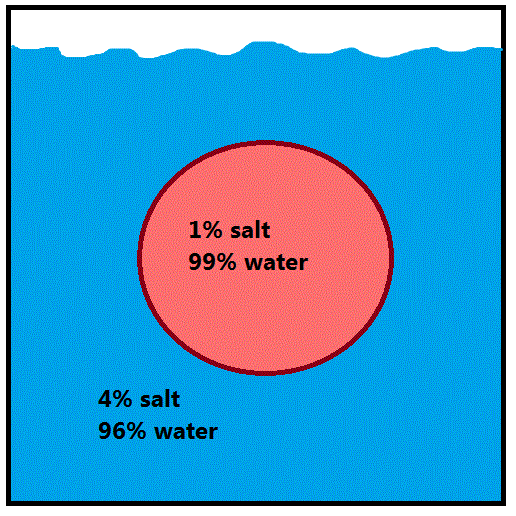
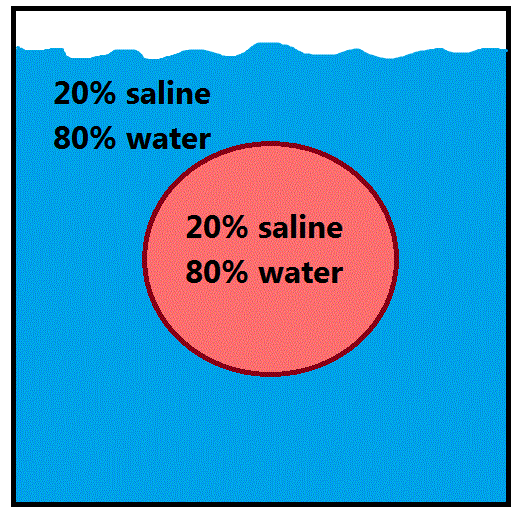
What is the difference between active and passive transport?
Active is high to low; Passive is low to high
Active uses no cell energy; Passive uses cell energy
Passive is high to low and uses no energy; Active uses energy and is low to high
Passive uses no cell energy
Fill in the blank:
Osmosis is the movement of ________ across a cell membrane from high to low.
Carbon dioxide
Starch
Water
Oxygen


In an isotonic solution which way will the water flow
it will not flow at all
it will flow into the cell
it will flow both ways at equal rates
out of the cell
A solution outside of a cell that contains a higher water concentration than the cytoplasm of a cell is called:
solution
hypertonic
hypotonic
isotonic

Which of the following molecules crosses through a semipermeable membrane during the process of osmosis?
water
salt
sugar
protein

If the semipermeable membrane allows the green chemical to pass through it freely, where will the green chemical move?
right to left
left to right
up and down

The concentration of red molecules outside the cell is higher than the concentration inside the cell. The red molecules cannot penetrate the cell. The cell is inside a ______.
hypotonic solution
hypertonic solution

The membrane does not allow the green molecules to pass through it. What will happen next?
Water will flow into side A.
Water will flow into side B.
Water will stay still.

Which Type of solution is the middle cell placed in?
Hypertonic
Hypotonic
Isotonic
Robotonic

What would happen to a cell placed in a hypertonic solution
The cell would shrink
The cell would expand and possibly burst
The cell would remain the same
The cell would dance and do the Nay Nay!
Cells form tissues, tissues form organs, organs work together to form
lungs
organ systems
skin
heart

What is a group of cells that are alike and work together?
a cell team
a tissue
a cell family

These parts of the body work together to help us breath. They need to work together to make that happen. This image shows an example of:
A cell
A Tissue
An Organ
An Organ System
What is the term for the control center for the entire body that sends signals from throughout the body to the brain?
circulatory system
respiratory system
excretory system
muscular system
nervous system

A specialized cell is a cell that has ...
the ability to divide
a specific role to do
no specific function in the bod


The heart is made of which of the following types of muscles?
Cardiac muscle
Striated muscle
Smooth muscle
None of the above

A
B
C
D

A
B
C
D
A
B
C
D

A
B
C
D

A
B
C
D

A
B
C
D

A
B
C
D

A
B
C
D
Which of the following is NOT part of the circulatory system?
heart
blood
bones
arteries
Which of the following is a connection between the circulatory system and the muscular system?
the heart is composed of cardiac muscle
the heart makes calcium to give to muscles
muscles create blood cells that get circulated through body
the two systems are not connected
Which of the following is NOT a function of the circulatory system?
circulate blood
regulate calcium production
carry nutrients and hormones through blood stream
deliver oxygen to tissues
Arteries
Carry blood low in oxygen
Carry blood rich in oxygen
only place diffusion can occur
Veins
only place diffusion can occur
carry oxygen rich blood
carry deoxygenated blood
Capillaries
only blood vessel where diffusion can occur
carry oxygenated blood
carry blood low in oxygen
The type of blood vessel that normally carries oxygenated blood from the heart to the body cells?
arteries
capillaries
veins
The type of blood vessel where exchange of gases, nutrients, and wastes occurs?
arteries
capillaries
veins
Which gas is transported by the circulatory system in humans and is used by cells during respiration to release energy stored in food?
carbon dioxide
nitrogen
hydrogen
oxygen
State one reason why blood at location B contains more oxygen than blood at location A.
because blood at location A goes to the lungs
because blood at location A comes from the lungs
because blood at location B comes from the lungs
because blood at location B goes to the lungs
Select the structure and explanation of how it contributes to the way the human system functions.
heart replaces carbon dioxide with oxygen
blood vessels transport nutrients and oxygen
heart replaces oxygen with carbon dioxide
blood vessels pump heart rate

What is blood pressure?
Pressure of the blood against the walls of the veins.
Pressure of the heart pushing the blood out.
Pressure of the heart receiving blood.
Pressure of the blood against the walls of the arteries.

If the dots represent sugar which is more concentrated
Inside the cell
Outside the cell
Neither they are equal (equilibrium)
Which cell would water move into?


What are TWO ways you can predict the movement of water?
from a [High] of water to a [Low] of water
towards the [Lower] of solutes
towards the [Higher] of solutes
from a [Low] of water to a [High] of water
Which solution is more concentrated?
Solution 1:
500 mL of water
100 g of salt
Solution 2:
500 mL of water
90 g of salt
Solution 1
Solution 2
They have the same concentration
I have no idea

In the picture the red dots represent...
solvent
solute
solution
diffusion

In the picture the blue region represents...
solvent
solute
solution
diffusion

During diffusion a solute generally moves...
From a region of low concentration to one of high concentration.
From a region of high concentration to one of low concentration.

Examine the diagram and determine, based on the concentrations of salt, if salt will move into or out of the cell.
INTO
OUT OF


What is the role of the cell membrane?
It is impermeable and does not allow water to enter the cell.
It is permeable and allows for water and solutes to move into and out of the cell.
It removes water from the cell.
It is semi-permeable and allows water to enter and leave the cell.

Which is more concentrated? Solution x or Y
x
y
same

