wayground logo

Free Printable Worksheets

NEW

Font size

S
M
L
XL
Worksheets

Invertebrate I Review

Total questions: 54

Worksheet time: 43mins

Name
Class
Date
1.

Sponges have radial symmetry.

a)

True

b)

False

2.

The large opening at the top of the sponge is called the

a)

Osculum

b)

Porocyte

c)

Spicule

d)

Spongocoel

3.

Sponges can only reproduce asexually through fragmentation.

a)

True

b)

False

4.

Describe the water flow through the sponge.

a)

In osculum out porocytes

b)

Out osculum in porocytes

c)

In porocytes out osculum

d)

Out porocytes in osculum

5.

The sponge has no organs, tissues, and no nervous system.

a)

True

b)

False

6.

Flagella inside a sponge keep water moving through its body. Why is this necessary?

a)

It prevents the sponge from floating away

b)

It allows the sponge to feed

c)

It allows the sponge to absorb carbon dioxide

d)

It maintains the water pressure inside the sponge

7.
Sponges get their food by 
a)
going through photosynthesis
b)
decomposing it
c)
sponges do not eat
d)
filter feeding
8.
Most sponges are hermaphrodites.  What does this mean?
a)
sponges can produce their own food
b)
sponges can produce both eggs and sperm
c)
sponges cannot reproduce
d)
sponges can swim around
9.
What is the name of the phylum sponges belong to?
a)
mammals
b)
chordate
c)
cnidarians
d)
Porifera
10.
___________ are tiny hard particles that give a sponge support and can provide protection when they stick out of a sponge.
a)
spongin
b)
bones
c)
buds
d)
spicules
11.
Sponges have many pores or ______ to circulate water. 
a)
osculum
b)
holes
c)
ostia
d)
spongin
12.
What is true about sponges?
a)
They have organs
b)
They have bilateral symmetry
c)
They have a true coelom
d)
They are animals
13.

Sponges are primarily sessile organisms. What does this mean?

a)

They live permanently in one palce

b)

They move around their whole life

14.

Which of the following type of cell digests and distributes food for the sponge?

a)

Choanocytes

b)

Amoebocytes

c)

Endodermal cells

d)

Epidermal cells

15.
Asexual sponge reproduction where a piece of the adult sponge breaks off and settles in a new area growing to adulthood.
a)
broadcast spawning
b)
branching
c)
budding
d)
forcast spawning
16.

Name this body type.

a)

Medusa

b)

Polyp

17.

Name this body type.

a)

Medusa

b)

Polyp

18.

Cnidarians are named after __________, the stinging cells found in their tentacles.

a)

cnidocytes

b)

cnidocils

c)

nematocysts

d)

cniliocysts

19.

All animals belong to Domain __________.

a)

Animalia

b)

Eukarya.

c)

Probiotica.

d)

Plantae.

20.

All jellyfish belong to phylum ____________.

a)

Cnidaria

b)

Hydrozoa

c)

Anthozoa

d)

Scyphozoa

21.

All animals in phylum Cnidaria demonstrate _____________.

a)

radial symmetry

b)

asymmetry

c)

bilateral symmetry

d)

pretty symmetry

22.

All of the following animals belong to phylum Cnidaria EXCEPT:

a)

jellyfish

b)

anemones

c)

corals

d)

octopuses

23.

The _______________ is where the barb and thread are stored until the cnidocyte is triggered.

a)

nematocyst

b)

cnidocil

c)

operculum

d)

overture

24.

Which is the correct order of taxa from broadest to most specific?

a)

Domain, Kingdom, Phylum, Class, Order, Family, Genus, Species

b)

Domain, Kingdom, Family, Phylum, Order, Class, Genus, Species

c)

Domain, Phylum, Kingdom, Genus, Class, Order, Family, Species

d)

Species, Domain, Kingdom, Phylum, Class, Order, Family, Genus

25.

Animalia is a...

a)

kingdom

b)

phylum

c)

domain

d)

class

26.

When writing a scientific name, you must ___________ the genus.

a)

capitalize and italicize

b)

lowercase and italicize

c)

italicize only

d)

capitalize only

27.

Sessile, tube shaped body form of cnidarians such as corals and hydra.

a)

Polyp

b)

Medusa

28.

Free swimming, umbrella shaped body with tentacles that hang down.

a)

Polyp

b)

Medusa

29.

What type of cnidarian is pictured?

a)

Jellyfish

b)

hydra

c)

sea anemone

d)

coral

30.

In Cnidarians, where does digestion occur?

a)

spongocoel

b)

nematocyst

c)

gastrovascular cavity

d)

tentacles

31.

How do cnidarians absorb oxygen from the water and expel carbon dioxide?

a)

Through their tentacles

b)

Through diffusion

c)

By using their nematocysts

d)

By using their respiratory organs

32.

How do cnidarians reproduce?

a)

only sexually

b)

only asexually

c)

both sexually and asexually

d)

genetically reproduced in labs

33.

What term describes the 2 name naming system for organisms?

a)

dichotmous key

b)

binomial nomenclature

c)

2 scientific names

d)

binomial key

34.

What type of asexual reproduction is shown here?

a)

Gemmules

b)

Fragmentation

c)

Budding

d)

Sexual reproduction

35.
What does the term echinoderm mean?
a)
tube feet
b)
star shaped
c)
spiny skin
d)
stomach foot
36.
Echinoderms have the ability to regenerate body parts.
a)
False
b)
True
37.
Echinoderms have an internal skeleton and a system of fluid-filled tubes called a(n)...
a)
water vascular system
b)
nervous system
c)
notochord
d)
ampulla
38.
You will find the mouth, tube feet, and ambulacral groove on the aboral side of the starfish.
a)
True
b)
False
39.
On the oral side of the starfish you will find the madreporite and eyes.
a)
True
b)
False
40.
What system in their body helps them catch and hold their food?
a)
Madreporite
b)
Tube Feet
c)
Radial Canal
d)
Ambulacral Groove
41.

What structures is designated by the number 7?

a)

Gonads

b)

Pyloric Caeca

c)

Aboral stomach

d)

Radial Canals

42.
How do echinoderms eat?
a)
By ejecting their stomachs
b)
They don't eat
c)
Through their back
43.
Which is an example of an Asteroidea member?
a)
sea star
b)
sea cucumber
c)
sea urchin 
d)
sand dollar 
44.
Which side of the sea star is the top side?
a)
aboral surface
b)
oral surface
45.
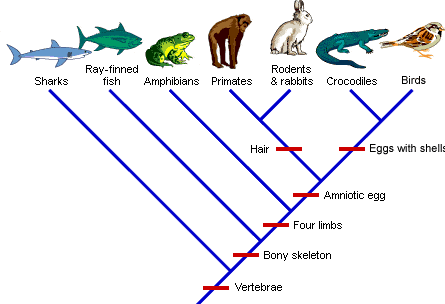
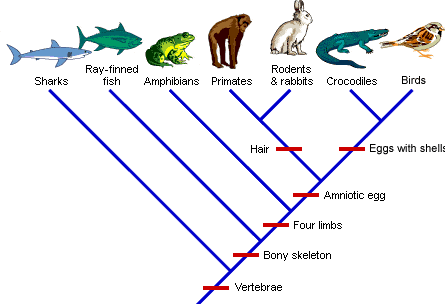
According to this cladogram, sharks are MOST closely related to which organism? 
a)
Amphibians
b)
Ray finned fish
c)
Crocodiles
d)
Birds
46.
According to this cladogram, birds are LEAST related to: 
a)
Amphibians
b)
Sharks
c)
Ray Finned Fish
d)
Crocodiles
47.
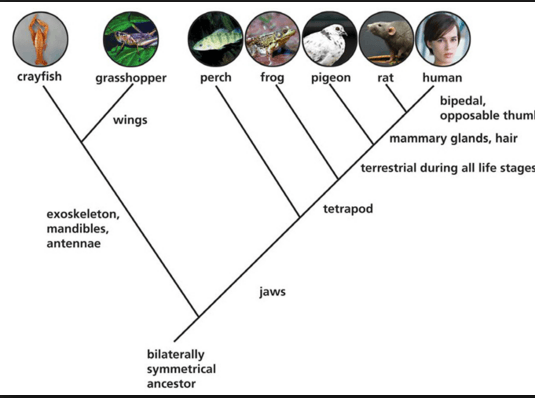
Which trait do only humans have, according to the cladogram?
a)
jaws
b)
mammary glands & hair
c)
terrestrial during all life stages
d)
bipedal & opposable thumbs
48.
Cladograms are constructed by grouping organisms together based on their____________ characteristics.
a)
shared
b)
different
c)
similar
d)
opposite
49.

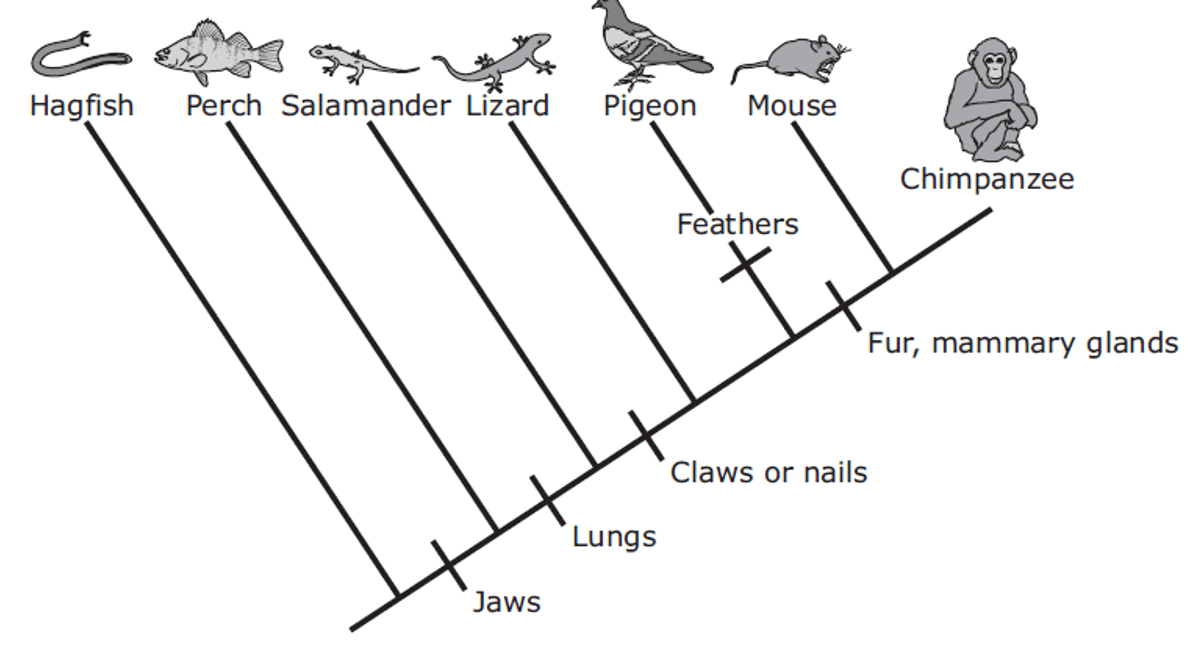
What is this a picture of?

a)

Pedigree

b)

Cladogram

c)

Family Tree

d)

Oak Tree

50.
All the animals to the right of the hagfish would have the common characteristic of -
a)
Fur
b)
Claws or nails
c)
Lungs
d)
Jaws
51.
What is the purpose of a dichotomous key?
a)
to find a common ancestor
b)
to show the evolution of organisms
c)
to show relationships between organisms
d)
to identify organisms
52.
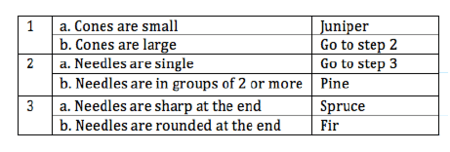
A dichotomous key for trees is provided. Hikers found a tree that has large brown cones and single sharp needles. What species of tree have the hikers found?
a)
Juniper
b)
Pine
c)
Spruce
d)
Fir
53.
When using a dichotomous key to identify organisms, what do we look at?
a)
physical features
b)
weather patterns
c)
environment
d)
diet
54.
The first part of a scientific name is an organism's _______________ and the second part is its ________________.
a)
species, genus
b)
phylum, order
c)
class, spices
d)
genus, species