wayground logo

Free Printable Worksheets

Font size

S
M
L
XL
Worksheets

Art Quarterly Review

Total questions: 70

Worksheet time: 45mins

Name
Class
Date
1.
A term used by artists that describes the action used to create a copy of the originally designed print.
a)
pull
b)
ink brayers
c)
bench hook
d)
matrix
2.
A generic term for printmaking where raised surfaces are inked and printed; non-image areas have been cut away so that they will not print.
a)
proofs
b)
woodcut
c)
monoprint
d)
relief
3.
Safety accessory used to provide a stop for the matrix and a safe place for fingers; carving is accomplished by pushing away from the body.
a)
spoon
b)
bench hook
c)
carving tools
d)
ink tray
4.
The first pulls of a print to see if the product meets the artist's standards.
a)
brayers
b)
ink trays
c)
proofs
d)
intaglio
5.
Special substances in tubes or jars of the type that will roll onto a surface forming static, tacky sounds.
a)
printing ink
b)
acrylic paint
c)
oil paint
d)
watercolor
6.
A printmaking method in which you add water soluble materials to a prepared plate in a way that creates an image to print.
a)
additive
b)
subtractive
c)
baren
d)
printmaking
7.
An assortment of cutters that make different shaped grooves in all matrixes of relief printing.
a)
ink tray
b)
intaglio
c)
carving tools
d)
spoon
8.
Words referring to the condition of ink when it is ready to be rolled onto a plate.
a)
beady, crackling, staticky, tacky
b)
slippery, thick
c)
slimy, smooth
d)
moist, glossy
9.
Process of making original artwork by printing on paper; there are many types; some are created by hand printing and some are created by press printing.
a)
bench hook
b)
printmaking
c)
pull
d)
relief
10.
A hand tool used to roll the ink on the matrix; ink must make a staticky sound and form beads on the matrix before printing.
a)
ink brayers
b)
matrix
c)
ink trays
d)
baren
11.
A relief print carved into linoleum as the matrix; also called a lino print or lino cut.
a)
relief
b)
intaglio
c)
woodcut
d)
linoleum print
12.
What is Value?
a)
How dark something is
b)
How light an object looks
c)
The degree of lightness to darkness
d)
What you get from the sun too long
13.
Lines that go on one direction, in shading, is called
a)
Hatching
b)
Shading
c)
Stippling
d)
Smudging
14.
The technique that uses lines that cross each other is called
a)
Crosstippling
b)
Hatching
c)
Smudging
d)
Crosshatching
15.
A simple drawing tool that helps you see and draw values is called ______.
a)
Grey Scale
b)
Black Scale 
c)
Range of value scale
d)
Value Scale 
16.

A technique of shading so that there is a gentle and gradual transition from one to the other.

a)

Value

b)

Blending

c)

Stippling

d)

Hatching

17.

Any device/sun serving as a source of illumination.

a)

Sun

b)

Light source

c)

Lamp

d)

Cast shadow

18.

Which shading technique is this?

a)

Blending

b)

Stippling

c)

Cross hatching

d)

Hatching

19.
What is a continuous mark made on a surface?
a)
Space
b)
Line
c)
Point
d)
Shape
20.
What are the 5 basic ways to show line variation? 
a)
Direction, length, width, texture, degree of curve
b)
Space, length, width, degree of curve, 
c)
Vertical, horizontal, diagonal, zig zag, and jagged
d)
Gesture, continuous, expressive, contour, and cross-contour
21.
What line is used to express confusion or excitement?
a)
horizontal
b)
jagged
c)
curved
d)
zig zag
22.
What line can be used to express anger?
a)
Zig Zag
b)
Curved
c)
Vertical
d)
Jagged
23.
What type of line drawing is displayed?
a)
Contour
b)
Blind-Contour
c)
Gesture
d)
Cross-Contour
24.
What emotions are expressed in the artwork?
a)
Excitement & Delicate
b)
Calm & Confusion
c)
Anger & Excitement
d)
Anger & Tension
25.
Shapes are
a)
the form of an object
b)
two-dimensional
c)
three-dimensional
d)
open spaces
26.

Which of these is not an element of art?

a)

Value

b)

Form

c)

Line

d)

Paint

27.
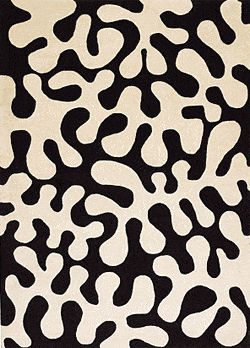
What phrase best describes this image?
a)
geometric forms
b)
geometric shapes
c)
organic shapes
d)
organic forms
28.
The elements of art are:
a)
the way art is arranged
b)
pure chemical substances used in art
c)
the building blocks of art
d)
pens, pencils, paint, ect...
29.

To make hatching values darker, lines should be

a)

Thicker

b)

Thinner

c)

Closer together

d)

Farther apart

30.

Choose all examples of crosshatching.

a)
b)
c)
d)
31.
a line in an artwork that is not physically there but suggested by points in the artwork
a)
Random
b)
Gestual
c)
Implied
d)
contour
32.

The act of showing gradual change from light to dark or dark to light.

a)

Shade

b)

Tint

c)

Coloring

d)

Shading

33.

When black is added to a color the color becomes a....

a)

Shade

b)

Tint

c)

Highlight

d)

Shadow

34.

When white is added to a color it makes a _____ of that color.

a)

Tint

b)

Shade

c)

Color

d)

Light

35.

What are the 3 characteristics of 3-D

a)

Height

b)

Volume

c)

Width

d)

Depth

36.

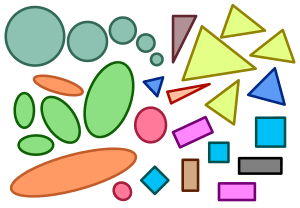
Are these shapes Geometric or Organic

a)

Geometric

b)

Organic

37.

What phrase best describes this image?

a)

geometric forms

b)

geometric shapes

c)

organic shapes

d)

organic forms

38.

What is the 'Warp' and 'Wheft' in weaving.

a)

Different types of yarn used for weaving.

b)

The name of the threads that tells you which direction they are woven in - horizontal (left to right) or vertical (up and down)

39.

A design or motif that is regularly repeated

a)

Fiber

b)

Warp

c)

Pattern

d)

Weft

40.

A long thin thread or material like wool or cotton.

a)

Fringe

b)

Fiber

c)

Loom

d)

Weft

41.

A simple weave where the weft alternates over one and under one warp end

a)

Yarn

b)

Tapestry

c)

Basic Weaving

d)

Weft

42.

A frame (or machine) on which weaving is done

a)

Warp

b)

Weft

c)

Loom

d)

Yarn

43.

In which cultures can we find weaving?

a)

In many cultures around the world.

b)

In only a few cultures around the world.

44.

How long has weaving been around?

a)

The last 200 hundred years.

b)

Up to hundreds and thousands of years ago.

45.

True or false? Weaving can also be used to make baskets.

a)

True.

b)

False.

46.
What is this person doing wrong?
a)
They are cutting towards their fingers.
b)
They are holding the cutter wrong.
c)
They are working without a bench hook.
d)
All of the above.
47.

Artist Andy Warhol used which Principle of Design in this artwork?

a)

Abstract

b)

Repetition

c)

Pattern

d)

Realistic

48.

A piece of thick, flat material, with a design on its surface, used to print repeated impressions of that design.

a)

Brayer

b)

Block

c)

Burin

d)

Lithograph

49.

A set of identical prints that are numbered and signed.

a)

Proofs

b)

Monoprint

c)

Chine Colle

d)

Edition

50.
What is this called? 
a)
baren
b)
brayer
c)
roller
d)
rubbing tool
51.
How is emphasis shown here?
a)
through contrast
b)
through texture
c)
through color
d)
through size
52.
How is emphasis shown in this sample?
a)
shading
b)
value
c)
variety
d)
movement
53.
What part of the critique process is when you use focus on the facts, only explaining what you see?
a)
Critique
b)
Judgement
c)
Analysis
d)
Description
54.
When you have to know what the artist is trying to say.
a)
Analysis
b)
Description
c)
Interpretation
d)
Judgement
55.
What is it when one discusses artistic choices of the artist and how the work is organized?
a)
Judgement
b)
Interpretation
c)
Judgement
d)
Analysis
56.
The four steps in the art critique process are:
a)
describe
b)
analyze
c)
interpret
d)
desrcibe analyze interpret  judge
57.
linear perspective
a)
paper, pencil, ruler
b)
color wheel, shading, movement
c)
vanishing point, horizon line, vertical lines, horizontal lines, converging lines
d)
texture, shape, rhythm, hatch
58.
What part of the critique process is when you use focus on the facts, only explaining what you see?
a)
Critique
b)
Judgement
c)
Analysis
d)
Description
59.
Judgement is when you what?
a)
When you explain the art using the elements of art.
b)
Talk about what you think of the artwork
c)
Discuss what the artist is trying to say.
d)
Explain how the work is organized.
60.
Line
a)
art criticism
b)
principles of art
c)
element of art
d)
percive
61.
The quality of seeming whole and complete, with all parts working right together.
a)
unity
b)
balance
c)
proportion
62.
Importance given to certain objects or areas in an artwork.
a)
emphasis
b)
variety
c)
contrast
63.
The difference between two unlike things.
a)
contrast
b)
emphasis
c)
variety
64.
Which element was used to create contrast?
a)
texture
b)
color
c)
value
65.
How does this sample show emphasis?
a)
size
b)
background
c)
overlap
d)
color
66.
Contrast is the...
a)
difference between elements
b)
in all things
c)
thing that works to make an image whole
d)
element that repeats
67.
Form is...
a)
Silly
b)
2 Dimensional
c)
3 Dimensional and can be organic or geometric
d)
feels real
68.
The distance or area between, around, above, below, or within things. 
a)
Scale
b)
Form
c)
Space
d)
Unity
69.
What are the seven Elements of Art?
a)
red, yellow, blue
b)
line, shape, color, texture, space, form, 
value
c)
geometric, organic, shading, color, pattern, pencil, ruler
d)
 lily, and, alexis, are, better, than, you
70.
what are the seven Principles of Art?
a)
Contrast, landscape, paint, sculpture, movement, line, tint
b)
Contrast, emphasis, movement, balance, pattern , rhythm, unity 
c)
geometric, organic, composition, blue
d)
value, shade, line, eraser