wayground logo

Free Printable Worksheets

Font size

S
M
L
XL
Worksheets

Unit 3 Topics 1-4 Review: Heat and Temperature

Total questions: 43

Worksheet time: 6hrs 39mins

Name
Class
Date
1.
heat rises
a)
true
b)
false
2.
When things are hot molecules are moving...
a)
Fast
b)
Slow
c)
They are not moving
d)
They are moving by not fast or slow
3.
When things are cold molecules are moving...
a)
Fast
b)
Slow
c)
They are not moving
d)
They are moving by not fast or slow
4.
Heat and Temperature are the same thing
a)
True
b)
False
5.
How do gases behave in a container?
a)
Cluster together
b)
form a solid
c)
They take the shape of their container
d)
leak out 
6.
Which states allow easy flow of particles
a)
Gas and Solid
b)
Gas and Liquid
c)
Solid and Liquid
d)
Gas only
7.
How do materials change from one state of matter to another?
a)
They gain or lose energy
b)
They break appart
c)
The particles get stickyer
d)
They are magnetised to themselves
8.
What sorts of things are made of particles?
a)
Everything in the universe
b)
Anything solid
c)
Water 
d)
Most solids, liquids and gases. 
9.
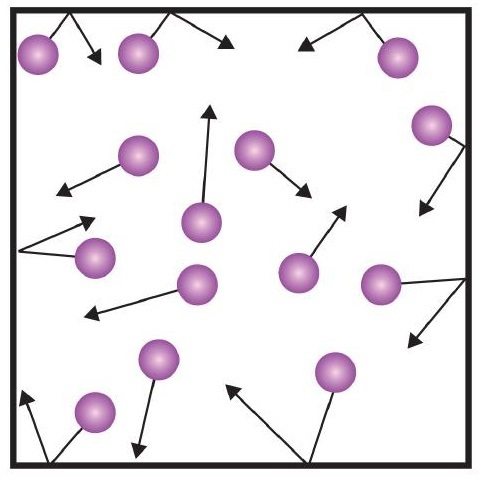
Which description best matches this particle model?
a)
Closely packed and can't move a lot. 
b)
Particles are close together but can move a little. 
c)
Particles have lots of energy and can move around. 
10.
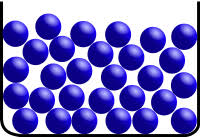
Which description best matches this particle model?
a)
Closely packed and can't move a lot. 
b)
Particles are close together but can move a little. 
c)
Particles have lots of energy and can move around. 
11.

What are the states of matter?

a)

solid, liquid, and juice

b)

solid and liquid

c)

solid and gas

d)

solid, liquid, and gas

12.

Which form of matter does not take the shape of its container?

a)

liquid

b)

gas

c)

solid

d)

air

13.

A gas

a)

has a definite shape but no definite volume

b)

has a definite volume but no definite shape

c)

has fast-moving particles

d)

none of the above

14.

At higher temperatures

a)

particles in an object have less energy

b)

particles in an object move faster

c)

a gas contracts

d)

none of the above

15.

________ says the tiny particles in all matter are in constant motion

a)

potential theory

b)

kinetic theory (particle theory)

c)

Einstein Boseman theory

d)

motion theory

16.

Which of the following occurs when a liquid becomes a gas?

a)

the particles slow down

b)

the particles break away from one another

c)

the particles move closer together

d)

none of the above

17.

In the above diagram, "State of Matter B" is a liquid. This means that it has:

a)

definite shape and volume.

b)

no definite shape or volume.

c)

definite volume, but changing shape.

d)

definite shape, but changing volume.

18.

What is happening when my ice cream changes from a solid to a liquid?

a)

freezing

b)

melting

c)

burning

d)

evaporation

19.

What is happening when my water bottle in the freezer goes from a liquid state to a solid state?

a)

melting

b)

evaporating

c)

freezing

d)

cutting

20.

What happens when my glass of water is sitting in the sun and disappears into a gas?

a)

evaporation

b)

burning

c)

melting

d)

freezing

21.

What do you mean by "absolute zero"?

a)

The coldest possible temperature.

b)

The hottest possible temperature.

c)

The mean or average of the hottest possible temperatures in the world.

d)

The mean or average between hottest and coldest possible temperature in the world.

22.

What happens when molecules reach absolute zero?

a)

The molecules move and stop alternately.

b)

The molecules stop moving.

c)

The molecules start moving.

d)

The molecules continue to move.

23.

As particles are exposed to warmer temperatures they __________

a)

speed up

b)

slow down

c)

stay the same

d)

vibrate at fixed positions

24.
As particles are exposed to colder temperatures they _____
a)
speed up
b)
slow down
c)
stay the same
d)
become ions
25.

Which characteristic is included in the particle theory of matter?

a)

All matter is made up of tiny particles

b)

All particles in a pure substance are the same

c)

Particles are always moving

d)

All of the above

26.

Number 2 represents a ________

a)

solid

b)

liquid

c)

gas

27.
Particles in a _____________ are tightly packed together.
a)
solid
b)
liquid
c)
gas
d)
plasma
28.

There are two answers for this.


Particles in a _________ take the shape of the container.

a)

solid

b)

liquid

c)

gas

d)

plasma

29.
As particles are exposed to warmer temperatures they __________
a)
speed up
b)
slow down
c)
stay the same
d)
vibrate
30.
When objects absorb heat, the particles...
a)
gain energy and vibrate at fixed position.
b)
gain energy and increase in size.
c)
gain energy and move slower.
d)
gain energy and move faster.
31.
When objects contract upon cooling...
a)
volume increases and density increases.
b)
volume increases and density decreases.
c)
volume decreases and density decreases.
d)
volume decreases and density increases.
32.
3. If the atoms of an object are moving or vibrating fast, the temperature would be...
a)
Hot
b)
Cold
c)
Unknown
33.
4. If the atoms of an object are moving or vibrating slow, the object would feel...
a)
Cold
b)
Hot
c)
Unknown
34.
What is Thermal Contraction 
a)
A Potato
b)
A decrease in a materials  volume when its temperature decreases 
c)
The movement of fluids in a cycle because of convection 
d)
A material through which  thermal energy does not flow easily.
35.
What is Thermal expansion?
a)
The transfer of thermal energy between materials by the collisions of particles 
b)
Is a decrease in a materials volume when temperature decreases 
c)
An increase in a materials volume when temperature increases
d)
Chicken fried rice
36.
Objects gain heat and _________. 
a)
expand
b)
contract
37.
The liquid in the thermometer rises when it is placed in the hot water because ___________. 
a)
it gains heat from the hot water and expands.
b)
loses heat from the hot water and contracts. 
c)
the surrounding air is too warm. 
d)
the liquid is boiling. 
38.

Temperature is related to the average kinetic energy of the particles in an object due to their random motions through space.

a)

True

b)

False

39.

An increase in the volume of a material due to a temperature increase in the material.

a)

Thermal contraction

b)

Thermal expansion

c)

Thermal heat

40.

Thermal expansion occurs when particles of matter move farther apart as temperature increase.

a)

True

b)

False

41.

The instrument used for measuring temperature

a)

barometer

b)

thermometer

c)

calorimeter

42.

When temperature increases, distance between molecules ______________.

a)

decreases

b)

increases

c)

stays the same

43.

When temperature decreases, distance between molecules ____________.

a)

increases

b)

decreases

c)

stays the same