wayground logo

Free Printable Worksheets

NEW

Font size

S
M
L
XL
Worksheets

Evolution Unit Review

Total questions: 70

Worksheet time: 1hrs 5mins

Name
Class
Date
1.

Over generations of time apart on different islands with different food sources, the separated populations of Galapagos finches accumulated genetic differences until each group had different beaks. This is an example of _____.

a)

natural selection

b)

genetic drift

c)

adaptation

d)

speciation

2.

Individuals undergo evolution.

a)

True

b)

False

3.

A phenotype that improves an organism’s chance of survival in their environment is considered a(n) ____________.

a)

natural selection

b)

adaption

c)

speciation

4.

Which of the following is NOT an example of natural selection?

a)

People selectively breeding hamsters for size.

b)

Insect populations developing resistance to certain pesticides.

c)

Bacteria becoming resistant to antibiotics.

d)

Male birds of certain species inheriting colorful feathers that are more attractive to females.

5.
Genetic drift is change in the allele frequency of a population due to...
a)
random chance
b)
natural selection
c)
non-random mating (sexual selection)
d)
artificial selection
6.

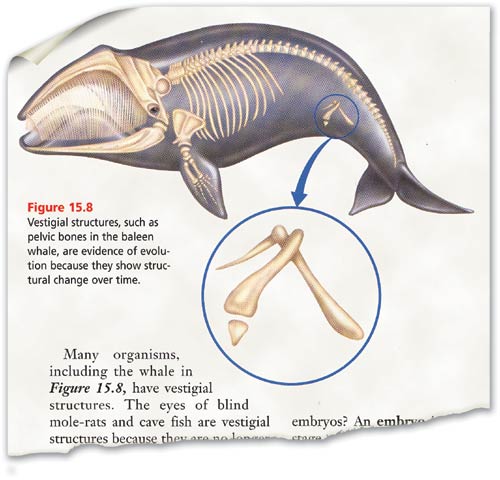
The pelvic bone of whales is not needed for movement within the water. This is an example of a(n) ______________ structure.

a)

vestigial

b)

analogous

c)

homologous

7.

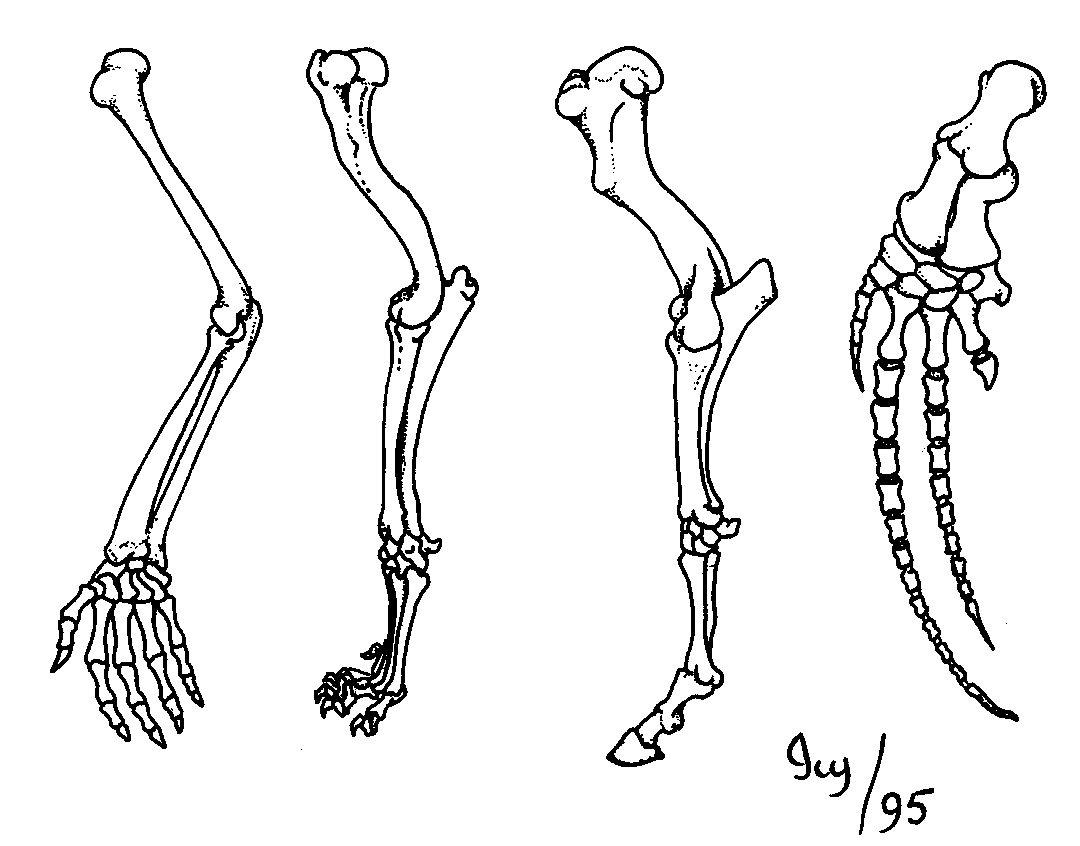
The forelimbs of mammals have similar anatomy because these groups descended from a recent common ancestor. Their bone structure is an example of a(n) ______________ structure.

a)

vestigial

b)

analogous

c)

homologous

8.

Many different groups of organisms have wings, even though they do not share a recent common ancestor. This is because they evolved in environments with similar selective pressures. Wings are an example of a(n) ______________ structure.

a)

vestigial

b)

analogous

c)

homologous

9.

A flood drowns a large portion of an insect population, with only a few random individuals surviving. This is an example of ______.

a)

genetic drift

b)

adaptation

c)

natural selection

10.
Which of the following is a term for a group of similar organisms that can reproduce fertile offspring?
a)
individual
b)
population
c)
species
d)
fossil
11.
Mutations are important because they bring about
a)
death of the organism in which they develop
b)
genetic variation needed for a population to evolve
c)
benefits for the individual, not for the population
d)
Hardey-Weinberg equilibrium within a population
12.
Structures with the same parts have different functions; suggests that organisms share a common ancestry
a)
vestigial structures
b)
homologous structures
c)
adaptive radiation
d)
fossil
13.
Which of the following is an example of a vestigial structure?
a)
the wings of a red-tailed hawk
b)
the hind limbs of a house cat
c)
the fins of sharks
d)
the tailbone of a human
14.
The diagram shows fossils in different rock layers. Which of these statements about the age of these fossils is most likely correct?
a)
Fossil A and C are the same age
b)
Fossil B is older than fossil C
c)
Fossils A is older than fossil B
d)
Fossil D is older than fossil C
15.
If species A and B have very similar genes and proteins, what is probably TRUE?
a)
species A and B share a relatively recent common ancestor
b)
species A evolved independently of species B for a long period
c)
species A is younger than species B
d)
species A is older than species B
16.
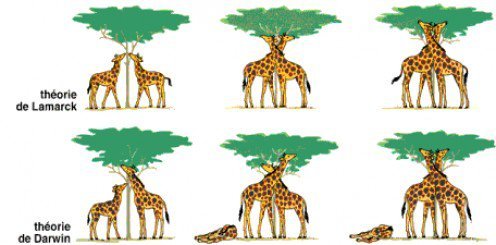
What would happen if the Giraffes never evolve?
a)
they would survive
b)
They would thrive
c)
They would become extinct
d)
They will find another source of food
17.
Why are advantageous traits more likely to be passed onto offspring?
a)
Because they are more likely to survive and reproduce.
b)
Because they come from dominant alleles.
c)
Because they come from recessive alleles.
d)
Because the trait is an acquired phenotype.
18.
The Physical remains of a plant or animal preserved in rock or Earth's crust. 
a)
Adapt
b)
Fossil
19.
This mechanism of evolution occurs when populations migrate.
a)
Extinction
b)
Gene flow
c)
Genetic drift
d)
Natural Selection
20.
What is another name for natural selection?
a)
survival of the smartest
b)
survival of the fastest
c)
survival of the biggest
d)
survival of the fittest
21.
What is the study of organisms at the early stages of development?
a)
DNA studies
b)
embryology 
c)
extinction
d)
fossil record
22.
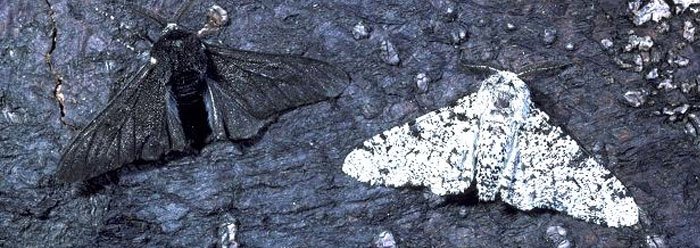
The trees these moths used to live on were white, but have been covered in soot from coal factories. Which moth will be more successful in this environment?
a)
Dark moth
b)
Light moth
c)
Both will be equally successful
d)
Neither will be successful
23.
Structures with the same parts have different functions; suggests that organisms share a common ancestry
a)
vestigial structures
b)
homologous structures
c)
adaptive radiation
d)
fossil
24.
Study of embryos of various organisms to show a common ancestor because of similarities in development
a)
natural selection
b)
embryology
c)
speciation
d)
evolution
25.

Whales are aquatic mammals that contain a pelvis (hip) bone. Even though it does not aid in its movement, the function must have been used by a common ancestor of the whale. Thus, the pelvis is referred to as a(n)

a)

vestigial structure

b)

analogous structure

c)

homologous structure

26.
Genetic differences between organisms of the same species
a)
Variation
b)
Adaptation
c)
Behavior
d)
Environment
27.
Vertebrate embryos pass through similar stages of development is evidence for
a)
use and disuse
b)
homologous structures
c)
common ancestry
d)
acquired characteristics
28.
All the individuals of a species that live in a particular area are called a 
a)
group
b)
population
c)
variation
d)
fossil
29.
What do phylogenetic trees do?
a)
Help you visualize how species are related.
b)
Provide windbreaks in your yard.
c)
Provide DNA details.
d)
Show the distribution of organisms
30.
Which two species are most related?
a)
B&C
b)
A&B
c)
A&C
d)
C&B
31.
Looking at this chart humans are most related to which of the following? (You are looking for the one that has the lowest number)
a)
Gibbon
b)
Dog
c)
Mouse
d)
Lamprey
32.
Which type of cell came first?
a)
Eukaryotic
b)
Prokaryotic
c)
Protists
d)
Both Eukaryotic and Prokaryotic were about the same
33.
These structures shown are ________.
a)
Homologous structures
b)
Analogous structures
c)
Structural adaptation
d)
Functional adaptation
34.
Which two organisms are the most closely related according to their DNA sequence?
Critter A--> ATG CTT AAC CCG TTA
Critter B--> ATC GTT TTC CCG TAA
Critter C--> ATG CTA TAG GCG TAA
a)
Critter A and B
b)
Critter A and C
c)
Critter B and C
d)
They are all equally related
35.

The circled areas in the diagram to the left represent bird species that are in the same genus, a classification group that includes closely related species. These birds are found on the Hawaiian Islands.


Which two finches are most closely related?

a)

Lesser Koa finch and Nukupuu

b)

Akialoa and Ou

c)

Kauai akialoa and Maui parrot bill

d)

Ou and Greater Koa finch

36.
What came into existence after the dragonfly?
a)
Spider
b)
Worm
c)
Ant
d)
Butterfly
37.
If you were to obtain DNA from the following species they would
a)
have identical DNA
b)
have identical amino acid sequences
c)
have nucleotide sequences that showed similarities
d)
have the same number of chromosomes
38.
When two species can no longer interbreed it is best known as?
a)
speciation
b)
new species
c)
nothing
d)
a species
39.
Gene flow happens when
a)
species die
b)
species migrate
c)
natural selection occurs
d)
species change colors
40.
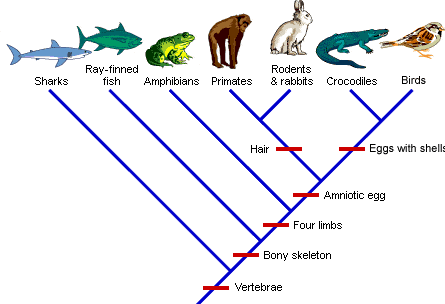
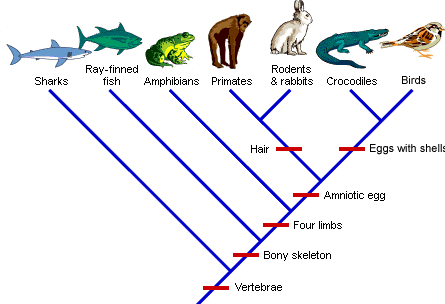
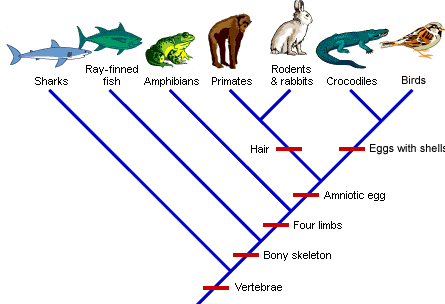
According to this cladogram, sharks are MOST closely related to which organism? 
a)
Amphibians
b)
Ray finned fish
c)
Crocodiles
d)
Birds
41.
Which two orgainsms have hair? 
a)
Sharks & Ray Finned Fish
b)
Primates & Rodents
c)
Birds & Crocodiles
d)
Rabbits & Birds
42.
According to this cladogram, birds are LEAST related to: 
a)
Amphibians
b)
Sharks
c)
Ray Finned Fish
d)
Crocodiles
43.
You look at two species and see very similar DNA. What does this likely tell you?
a)
These are the same animal.
b)
These animals have a common ancestor.
c)
These animals are not likely related.
d)
These animals are likely becoming one species.
44.
The 8 levels of classification, most broad to most specific.
a)
Domain, Genus, Family, Order, Class, Phylum, Kingdom, Species
b)
Domain, Species, Kingdom, Genus, Phylum, Family, Class, Order
c)
Domain, Kingdom, Phylum, Class, Order, Family, Genus, Species
d)
Order, Kingdom, Species, Domain, Phylum, Family, Class, Genus
45.

True or False: Mutations occur randomly.

a)

True

b)

False

46.

Which of the following is NOT required for natural selection?

a)

Organisms within a population show variation

b)

Traits are passed from parent to offspring

c)

Competition for limited resources exists within a population

d)

Members of a population must reproduce asexually

47.

Which of the following is NOT used as evidence of evolution?

a)

Body Shape

b)

DNA

c)

Fossils

d)

Morphology

48.

True or False: Bacteria reproduce through sexual reproduction, which means that it takes a long time for bacteria to produce offspring.

a)

True

b)

False

49.

All of these embryos show gill pouches in early development. What does this mean?

a)

They are all fish

b)

They are unrelated

c)

They all live in aquatic environments

d)

They share a common ancestor

50.

Which of the following is a mechanism by which evolution occurs?

a)

speciation

b)

extinction

c)

respiration

d)

gene flow

51.

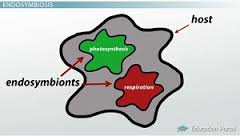
_____ and _____ are organelles that arose from endosymbiosis

a)

nucleus and cell membrane

b)

mitochondria and chloroplasts

c)

cell wall and chloroplasts

d)

mitochondria and nucleus

52.

Which of the following is evidence to support the endosymbiotic theory?

a)

Mitochondria and chloroplasts have their own DNA, which is similar to prokaryotic DNA.

b)

Fossil evidence shows that the first forms of life were prokaryotic cells.

c)

All eukaryotic cells have a double-layered membrane composed of phosplipids and proteins.

d)

Prokaryotes have the same number and types of enzymes as eukaryotes.

53.

The theory of Endosymbiosis explains

a)

The origin of eukaryotes

b)

How bacteria live

c)

How species develop

d)

Why cells rely on one another

54.
Theory that says eukaryotic cells formed from symbiosis among several different prokaryotes.
a)
Natural Selection
b)
Biogenesis Theory
c)
Evolutionary Theory
d)
Endosymbiotic Theory
55.

True or False: One of the major elements of natural selection is that all species have genetic variability.

a)

True

b)

False

56.

Which of the following is not a form of biochemistry (used to show relatedness of organisms)?

a)

DNA

b)

Amino Acid Sequences

c)

RNA

d)

Carbohydrates

57.
Which is a mechanism for change in allele frequency?
a)
gene flow
b)
genetic drift
c)
natural selection
d)
all answers are correct
58.
Which of the following is NOT a condition for Hardy-Weinberg Equilibrium?
a)
No mutations
b)
Random Mating
c)
No natural selection
d)
No offspring
59.
When a population is in Hardy-Weinberg Equilibrium.  What is not happening to the species?
a)
Survival
b)
Reproduction
c)
Death
d)
Evolution
60.
A group of Kent squirrels, they are black, accidentally get put on a truck to Cleveland.  After the squirrels are dropped off in Cleveland they begin to mate with all the squirrels there.  Which of Hardy-Weinberg conditions are being broken in this scenario?
a)
No Death or Reproduction
b)
No Gene Flow
c)
No Natural Selection
d)
No Genetic Drift
61.

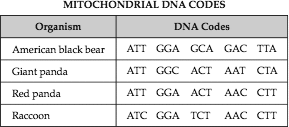
What conclusions can be made based on this table shown?

a)

the American black bear and the giant panda are most closely related

b)

the giant panda and the red panda are most closely related

c)

the red panda and the racoon are the most closely related

d)

the giant panda and the racoon are most closely related

62.

Describes a pattern of long, stable periods interrupted by brief periods of more rapid change

a)
convergent evolution
b)
coevolution
c)
punctuated equilibrium
d)
adaptive radiation
63.
The hypothesis that evolution of a species occurs gradually over time as a slow and constant process is known as
a)
speciation
b)
punctuated equilibrium
c)
gradualism
d)
microevolution
64.
The hypothesis that evolution of a species occurs in periods of rapid change separated by periods of little or no change is called
a)
divergence
b)
gradualism
c)
punctuated equilibrium
d)
isolation
65.
What is convergent evolution?
a)
evolution toward similar traits in unrelated species
b)
evolution toward different traits in closely related species
c)
elimination of a species from Earth
d)
the rise of two or more species from one existing species
66.

Sharks and dolphins both have streamlined bodies that allow them to move through water efficiently, despite being entirely unrelated. This is an example of which type of evolution?

a)
Divergent
b)
Coevolution
c)
Convergent
d)
Artificial
67.

Select the best answer based on the image.

a)

Gene Flow

b)

Genetic Drift

68.
A virus killed most of the seals in the North Sea (e.g. dropped the population from    8000 to 800).  In an effort to help preserve the species, scientists caught 20 of the   remaining seals and used them to start a new population in the northwest Pacific   Ocean.  Which of the following statements would accurately describe the new   population?  
a)
The new seal population is genetically less diverse than the original population 
b)
The new seal population is genetically more diverse than the original population
c)
There is equal genetic variety compared  to the original population 
d)
None of the answers
69.
Genetic drift is change in the allele frequency of a population due to...
a)
random chance
b)
natural selection
c)
non-random mating (sexual selection)
d)
artificial selection
70.
This mechanism of evolution occurs when populations migrate.
a)
Extinction
b)
Gene flow
c)
Genetic drift
d)
Natural Selection