
 Worksheets
Ecosystems Review
Total questions: 50
Worksheet time: 22mins
Energy that moves through a food chain starts with--
the sun.
Consumer
Food Chain
Energy
Plants, insects, frogs, and snakes live in an ecosystem. What would happen if the snakes were removed from the ecosystem?
Insect population would increase.
Frog population would decrease.
Plant population would decrease.
Frog population would increase.
The path of food energy from one organism to another.
Producer
the sun
Food Chain
Consumer
A food chain always begins with--
A Consumer
The Sun
A Decomposer
A Producer
The food chain is--
The movement of water from the surface to the atmosphere.
The path of food energy from one organism to another.
The ranking of organisms by size in an ecosystem.
A list of food that consumers will eat in an ecosystem.
What type of organisms make their own food for energy?
Consumers
Decomposers
Producers
Predators
Producer
An organism that makes its own food for energy.
The path of food energy from one organism to another.
Energy that moved through a food chain starts with--
Need to do work or cause a change.
Energy
Need to do work or cause a change.
The path of food energy from one organism to another.
An organism that gets energy from eating another organism.
An organism that makes its own food for energy.
What does the arrow represent in a food chain?
How far organisms live from each other.
The transfer of energy from one organism to another.
The size of the organisms from smallest to largest.
The amount of energy the organism receives from the sun.
Consumer
An organism that makes its own food for energy.
Energy that moves through a food chain starts with--
An organism that gets energy from eating another organism.
The path of food energy from one organism to another.

Which of the following is represented in the diagram?
Evaporation of water
Transfer of energy
Reflection of light
Animal life cycle

What is most likely the first thing to result from having fewer field mice in the food chain pictured here?
The snakes would have to find another food source.
The plants that make seeds would decrease in number.
The eagles would have to fly away to a location.
The mice would eat many more kinds of seeds.

A new fish that also eats plants is introduced into a pond. What changes would occur to this pond ecosystem?
The large fish population will decrease.
The plant population will decrease.
The small fish population will increase.
The new fish population will decrease.
Which of the following correctly shows how energy moves through a food chain?


Based on the food chain, what effect would be the most likely direct result of increasing the number of fish?
Beetles would have trouble finding food.
There would be more kinds of plants.
The population of beetles decreased.
Plants would no longer survive in this habitat.

The original source of energy for a food web is...
plants
sun
producers
decomposers

Decomposers get energy from...
the sun
eating plants
eating animals
dead things and waste

Producers are ...
plants
able to do photosynthesis
also called autotrophs
all of these are true

Arrows in a food web represent...
eating
sunlight
energy
matter

Photosynthesis is important because...
it makes carbon dioxide
it makes food for the food webs
it makes water
it's not important
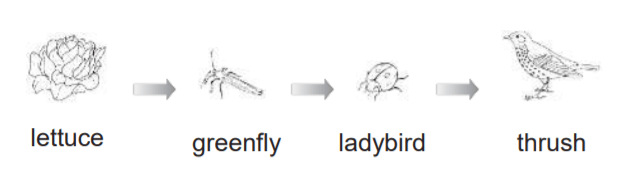
Who is the producer?
lettuce
greenfly
ladybird
thrush

What is a producer?
an organism that gets energy from eating other organisms
an organisms that uses sunlight to make its own food
an organism that gets energy from eating dead organisms, non-living material or waste

An animal that hunts other animals for food is a ___________
herbivore
predator
prey
omnivore

What is a herbivore?
an animal that gets energy from eating other animals
an organism that gets energy from eating only plants
an animal that gets energy by eating both plants and other animals

An organism that gets energy from eating other organisms is a ______________
producer
consumer
decomposer

A connection of food chains with many food energy paths in an ecosystem is a ____________
ecosystem
food web
environment

An animal that is hunted and eaten for food is a
predator
prey

What is a carnivore?
an animal that gets energy by eating other animals
An animal that gets energy by eating only plants
an animal that gets energy by eating both plants and animals

An animal that gets energy from eating both plants and animals is a(n)
herbivore
carnivore
omnivore

Which of the following is NOT a consumer
grass
dog
shark
fish

Which of the following is a living part of the ecosystem?
Air
Sunlight
Mushroom
Soil

What would happen to the bird if the green fish died out?
the bird population would grow
the bird population would die out
the smaller fish will die out
What is the bottom layer of the an energy pyramid?
producer
tertiary consumer
Secondary consumer
primary consumer
the top layer of an energy pyramid a primary consumer?
true
false
What does an energy pyramid show?
Energy flow in a community
Longest lifespans
The stronger animal the higher it is on the pyramid
All tertiary consumers are scavengers
true
false
What would happen if their were no producers?
Every population would grow larger
Everything would die out
The animals would make their own food
What would happen if the primary consumers died out?
the producers would grow and the secondary and tertiary consumers would die
producers would die out
consumers would grow
Is a scavenger a primary consumer?
Yes
No
decomposers are producers.
true
false
A cheetah can be a primary, secondary, tertiary consumers.
yes
No
What is an omnivore?
The type of consumer that eats plants.
The type of consumer that eats plants and animals.
The type of consumer that eats only animals.
What type of organisms are called autotrophs?
Omnivores.
Consumers.
Decomposers.
Producers.
What are heterotrophs?
Consumers that eat others.
Consumers that eat plants.
Consumers that create what they eat.
A pile of compost would be an example of this.
Producers
Consumers
Herbivores
Decomposers
What is competition?
Organisms sharing resources.
Organisms fighting for resources.
Organisms producing resources.
How does Symbiosis occur?
Only between species.
Only between communities.
Between different species in a community.
Between different communities.

Remora fish stuck in the shark so they can travel over water. This represents:
Mutualism
Commensalism
Parasitism
Mutualism
Commensalism
Parasitism

Why does the image represent parasitism?
Because the lice get benefit.
Because both get affected.
Because the kids get affected.
Because both get benefit.

