Font size
 Worksheets
Type of Reaction
Total questions: 50
Worksheet time: 38mins
In a ___________change, a substance changes into a different substance.
Physical
Chemical
What are reactants?
The chemicals that start the reaction.
The chemicals that the reaction produced.
The chemicals that are on the right side of the arrow.
What are products?
The chemicals that start the reaction.
The chemicals that the reaction produced.
The chemicals that are on the left side of the arrow.
The products are on the right side of the chemical equation.
True
False
Chemical reaction that involve two reactants into one product
Combination/Synthesis
Combustion/Burning
Single Displacement/Replacement
Chemical reaction that involves one reactant into several products.
Combination/Synthesis
Combustion/Burning
Single Displacement/Replacement
Chemical reaction that involves one elements replaces another in a compound.
Combination/Synthesis
Combustion/Burning
Single Displacement/Replacement
Double Displacement/Replacement
Chemical reaction in which the metal ions in the two compounds switch.
Combination/Synthesis
Combustion/Burning
Single Displacement/Replacement
Double Displacement/Replacement
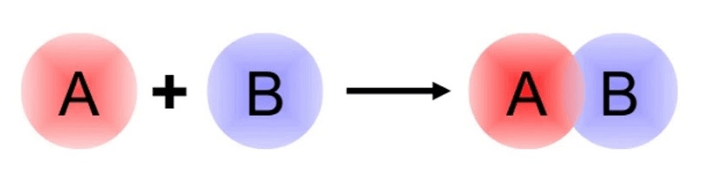
What is the type of reaction shown above?
Combination/Synthesis
Decomposition
Single Displacement/Replacement
Double Displacement/Replacement
What reaction has the following general formula:
AB --> A + B
Combination
Decomposition
Single Dispalcement/Replacement
Double Dsipalcement/Replacement
What reaction has the following general formula:
A + CD --> C + AD
Combination
Decomposition
Single Displacement/Replacement
Double Displacement/Replacement
What reaction has the following general formula:
AB + CD --> CB + AD
Combination
Decomposition
Single Replacement
Double Replacement
Combustion
What reaction has the following general formula:
A + B --> AB
Combination
Decomposition
Single Displacement/Replacement
Combustion/Burning
Double Displacement/Replacement
Single Displacement/Replacement
Combination/Synthesis
Which element is necessary in the reactants of a combustion reaction?
oxygen
hydrogen
carbon
water

What type of reaction involves the breaking down of a substance into simpler substances?
Single Displacement Reaction
Double Displacement Reaction
Combination/Synthesis Reaction
Decomposition Reaction

What type of reaction involves 2 substances combining to form 1 new compound?
Decomposition Reaction
Single Displacement Reaction
Double Displacement Reaction
Combination Reaction

What are the reactants in the chemical equation pictured?
CH4 and CO2
CH4 and O2
CO2 and H2O
O2 and H2O

What are the products of the chemical reaction pictured?
CH4 and CO2
CH4 and O2
CO2 and H2O
O2 and H2O
What is the general reaction scheme for a single displacement/replacement reaction?
A + B --> AB
AB --> A + B
A + CD --> C + AD
AB + CD --> CB + AD

Which symbol shows a chemical reaction has occured?
A
B
C
D

Identify the product(s) in this word equation
Sodium
Sodium chloride
Sodium and Chlorine
Sodium and sodium chloride

In this chemical reaction zinc is a...
Product
Reactant
Neither
non metal
The new substances formed in a chemical reaction are called
Reactants
Atoms
Products
Reagents


How many products are there in this reaction?
One
Two
Three
Four
There is more than one answer.
In a word equation the REACTANTS
Are written on the left hand side of the arrow
Are used up in a chemical reaction
Are always the same
Are the substances that react together

Sodium reacts with chlorine to produce sodium chloride. Choose the correct word equation.
sodium chloride → chlorine + sodium
sodium + carbon dioxide → sodium carbonate
sodium + chlorine → sodium chloride
sodium + chloride → sodium chloride
Magnesium + ________ → magnesium oxide
What is missing?
Hydrogen
Sulphur
Oxygen
Oxide
Copper oxide + _______________ → copper sulphate + water
What is missing?
sulphuric acid
hydrochloric acid
hydrogen
oxygen
In a word equation, what should be used when writing the reactants and products?
Words only
A mixture of words and chemical symbols
Chemical symbols only
chemical symbols and state symbols
Iron (a grey metal) reacts with sulfur (a smelly yellow solid) to produce iron sulfide (a black solid).
iron + sulfur → iron sulfide
iron + sulfur → iron sulfur
iron + sulfide → iron sulfide
iron + sulfur → iron sulfite
Magnesium (a grey metal) can be burned in air to produce magnesium oxide (a white powder). Which is the correct word equation for the reaction that happens?
magnesium + oxygen → iron oxide
magnesium + air gases → magnesium oxide
magnesium + oxygen → magnesium oxide
magnesium + air gases → white powder
Nitrogen and hydrogen react together to form ammonia. Give the word equation for the reaction.
Ammonia → Nitrogen + Hydrogen
Nitrogen + hydrogen → Ammonia
Nitrogen → Ammonia + Hydrogen
Hydrogen + Ammonia → Nitrogen

What is neutralisation?
This is a reaction between an acid and water to form salt and base.
This is a reaction between an acid and base to form salt and water.
This is a reaction between a base and salt to form water and acid.
This is a reaction between salt and water to form acid and base
When an acid and a base react, a ______________ reaction takes place.
Displacement
Oxidation
Neutralisation
Transamination
A decomposition reaction can be recognized because it has...
only one product
only one reactant
2 or more reactants and 2 or more products
the presence of a catalyst
A chemical change in which two substances react to form a new substance is a ____________________________.
decomposition reaction
combination reaction
displacement reaction
combustion reaction
A combination reaction can be recognized because it has...
only one product
only one reactant
2 or more reactants and 2 or more products
salt and water produced
displacement
neutralisation
combustion
oxidation
Which substance is a reactant in every combustion reaction?
carbon dioxide
hydrogen
oxygen
water
Which type of reaction is combustion?
combination
neutralisation
oxidation
displacement
Barium chloride on reacting with ammonium sulphate forms barium sulphate and ammonium chloride. Which of the following correctly represents the type of the reaction involved?
(i) Single Displacement reaction
(ii) Decomposition reaction
(iii) Combination reaction
(iv) Double displacement reaction
(a) (i) only
(b) (ii) only
(c) (iv) only
(d) (ii) and (iv)
When ammonium dichromate reacts with zinc nitride, what are the products?
zinc nitrate and ammonium chromate
zinc dichromate and ammonium nitrate
zinc chromate and ammonium nitride
zinc dichromate and ammonium nitride
water and salt
water and carbon dioxide