
 Worksheets
APES Unit 9 Part II
Total questions: 37
Worksheet time: 23mins
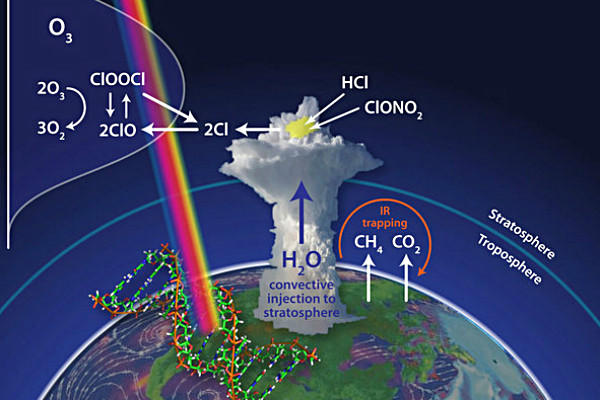
I. can originate from the emission of chlorofluorocarbons (CFCs).
II. is catalyzed through a free chlorine (Cl) atom.
III. prevents UV rays from reaching the earth’s surface.


Which of the following surfaces/objects has the highest albedo effect?
Sand
Snow/Ice
Oceans
Forests
What is the relationship between albedo and Earth's temperature?
As albedo increases, temperatures decrease.
As albedo decreases, temperatures decrease.
Which of the following is evidence that global warming is a positive feedback loop?
Global warming creates changes that slow down the warming of Earth.
Global warming melts glaciers which decrease albedo, leading to increased sunlight absorption.
Global warming melts glaciers which increases albedo, leading to increased sunlight absorption.
Global warming melts glaciers, cooler temperatures increases albedo, leading to decreased sunlight absorption.
Volcanic eruptions cause climate change by
reflecting sunlight and therefore decreasing temperatures
absorbing sunlight and therefore increasing temperatures
polluting the earth causing global warming
reflecting sunlight and therefore increasing temperatures
Periodic ice ages are due to
pollution
burning of fossil fuels
Milankovitch cycles
too much cloud cover over a period of time
This is a situation in which a factor or condition causes changes that further enhance that factor or condition.
positive feedback loop
wedge analysis
convection currents
MAIN greenhouse gas responsible for Climate Change is:
nitrogen
carbon
carbon dioxide
methane
Which natural process removes carbon dioxide from the atmosphere?
forest fires
volcanic eruptions
cellular respiration
photosynthesis
T/F - The amount of carbon dioxide CO2 in the atmosphere is decreasing.
True
False
Which human activity contributes the MOST carbon dioxide to the atmosphere?
fishing
farming
breathing
burning fossil fuels
Which of the following have been changed or altered due to climate change ?
droughts
flooding
melting of polar ice caps
all of the above
As polar ice caps melt, Earth lets less reflective. If less sun is reflected, the more light is absorbed which heats Earth up more which causes more ice to melt. This is an example of...
Negative feedback loop
Positive feedback loop
Higher temperatures cause more evaporation, which causes more water vapor to be in the air. Water vapor is a greenhouse gas, so more water vapor will lead to Earth warming even more. This is an example of...
Negative Feedback Loop
Positive Feedback Loop
Name the biomes which have greater chance of disappearance due to global warming
Cold desert
Tundra
Boreal forest
Prairies
Identify an example of negative feedback loop in relation to climate change.
Melting of ice caps leading to decresed albedo
Increased CO2 from increased biomass decomposition
Increased CO2 leading to increased plant growth and increased productivity
Increased forest cover decreases albedo
Carbon is added to the atmosphere through which of the following processes?
(Check all correct options)
Respiration (animals breathing)
Burning fossil fuels
Volcanic eruptions
Gas exchange (with the ocean)
Over the past hundred years, carbon dioxide concentration in the atmosphere has been ___ and the average global temperature has been ___.
increasing; increasing
decreasing; increasing
decreasing; decreasing
increasing; decreasing
Warming temperatures cause sea ice to melt. Less sea ice means:
less energy will be reflected by the ice and temperatures will increase even more.
more energy will be absorbed by the dark ocean water and temperatures will decrease.
simply that there is less sea ice; it has no effect on temperature.
True or False: The Earth has experienced major changes in climate in the past.
True
False
How do clouds affect surface temperature?
Clouds can block incoming energy, causing warmer temperatures.
Clouds can block outgoing energy, causing warmer temperatures.
Clouds can block outgoing energy, causing cooler temperatures.
Clouds can absorb incoming energy, causing warmer temperatures.

This graph demonstrates that:
the concentration of carbon dioxide is currently higher than it has been in over 400,000 years.
the average global temperature is currently higher than it has ever been on Earth.
the increase in carbon dioxide concentration we are experiencing today is similar in scale to the variation seen over the past 400,000 years.
When the ocean gets warmer, it dissolves less carbon dioxide. This means the atmosphere will have more carbon dioxide which causes the temperature to increase even more. This is an example of:
a feedback loop
carbon flux
ocean acidification
the lighthouse effect
When solar radiation reaches Earth, it can be:
(Check all correct options)
reflected back into space.
absorbed by the atmosphere.
absorbed by the Earth's surface.
transmitted through the Earth.

A giant chess board is sitting in the bright Sun. How (and why) do the temperature of the dark and light squares compare?
The dark squares would be warmer because they absorb more sunlight.
The dark squares would be cooler because they reflect more sunlight.
The squares would all be the same temperature because they're the same distance away from the Sun.
The light squares would be warmer because they absorb more sunlight.
A volcano erupts, sending a massive plume of ash into the atmosphere. How would you expect the global temperature to change as a result?
The temperature would increase due to the hot lava coming out of the volcano.
The temperature would decrease because of the ash blocking out the Sun.
The temperature would decrease due to all of the carbon dioxide coming out of the volcano.

