wayground logo

Free Printable Worksheets

Font size

S
M
L
XL
Worksheets

States of Matter, Phase Changes, and Gases Unit Review

Total questions: 57

Worksheet time: 38mins
Name
Class
Date
1.
At higher temperatures
a)
particles in an object have less energy
b)
particles in an object move faster
c)
a gas contracts
2.

Freezing

a)

Solid to gas

b)

Liquid to solid

c)

Gas to solid

3.

Boiling

a)

liquid to gas

b)

gas to solid

c)

gas to liquid

4.

The state of matter that has no definite size or shape is

a)

Solid

b)

Liquid

c)

Gas

5.

Particles in a ______________________ move quickly and are far apart.

a)

gas

b)

solid

c)

liquid

6.

Particles of a liquid

a)

are tightly packed together and stay in a fixed position.

b)

are free to move around one another but still touch.

7.

Solid to Gas

a)

Deposition

b)

Sublimation

c)

Evaporation

8.

What is condensation?

a)

gas to solid

b)

gas to liquid

c)

liquid to solid

9.
The temperature of a substance increases as___.
a)
the substance expands
b)
the average kinetic energy of its particles increases
c)
the substance's volume increases
d)
the substance's mass increases
10.

Definite shape and definite volume

a)

Solid

b)

Liquid

c)

Gas

11.

Has a definite volume but not a definite shape

a)

Solid

b)

Liquid

c)

Gas

12.

Liquid to Gas

a)

Condensation

b)

Evaporation

c)

Sublimation

13.

State of matter with a definite shape and definite volume.

a)

solid

b)

liquid

c)

gas

14.

State of matter with a definite volume, but no definite shape.

a)

solid

b)

liquid

c)

gas

15.

State of matter with no definite shape and no definite volume.

a)

solid

b)

liquid

c)

gas

16.
7. All phase changes (changing states) requires energy to be added or taken away.
a)
True
b)
False
17.
Change from Gas to Solid is called........
a)
Sublimation
b)
Deposition
c)
Fusion
d)
condensation
18.
Change from gas to liquid...
a)
condensation
b)
evaporation
c)
expansion
d)
movement
19.

Change from Liquid to Solid is called ...

a)

fusion

b)

Freezing

c)

sublimation

d)

evaporation

20.

What is the phase change of a solid to a liquid?

a)

freezing

b)

melting

c)

boiling

d)

condensation

21.
5. What is it called when a solid turns directly into a gas?
a)
Sublimation
b)
Condensation
c)
Liquid
22.

Change from liquid to gas is called....

a)

expansion

b)

evaporation

c)

condensation

d)

sublimation

23.

What happens to particles when energy is added (heated)?

a)

They speed up and spread out

b)

They slow down and compress

c)

They stop moving

d)

They move closer together and speed up
24.
What is sublimation?
a)
phase change between solid and liquid
b)
pahse change from gas to solid
c)
phase change from solid to gas
d)
phase change from solid to solid
25.
The phase change from water vapor to liquid water is known as...
a)
evaporation
b)
precipitation
c)
condensation
d)
sublimation
26.

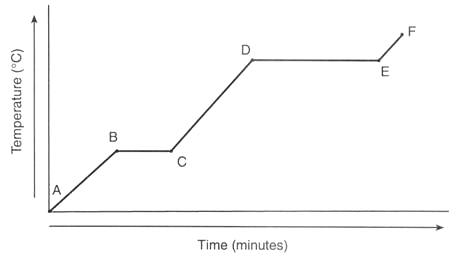
Is the substance gaining or losing energy?

a)

Gaining

b)

Losing

27.

Are the particles moving faster or slower as time goes on?

a)

Faster

b)

Slower

28.

What state/phase is the object likely from points A to B?

a)

Solid

b)

Liquid

c)

Gas

d)

Plasma

29.

What is happening to the particles in the substance between points A and B?

a)

Melting

b)

Freezing

c)

Speeding Up

d)

Slowing Down

30.

What is happening to the particles in the substance between points D and E?

a)

Melting

b)

Freezing

c)

Vaporizing

d)

Sublimating

31.

Is the substance gaining or losing energy?

a)

Gaining

b)

Losing

32.

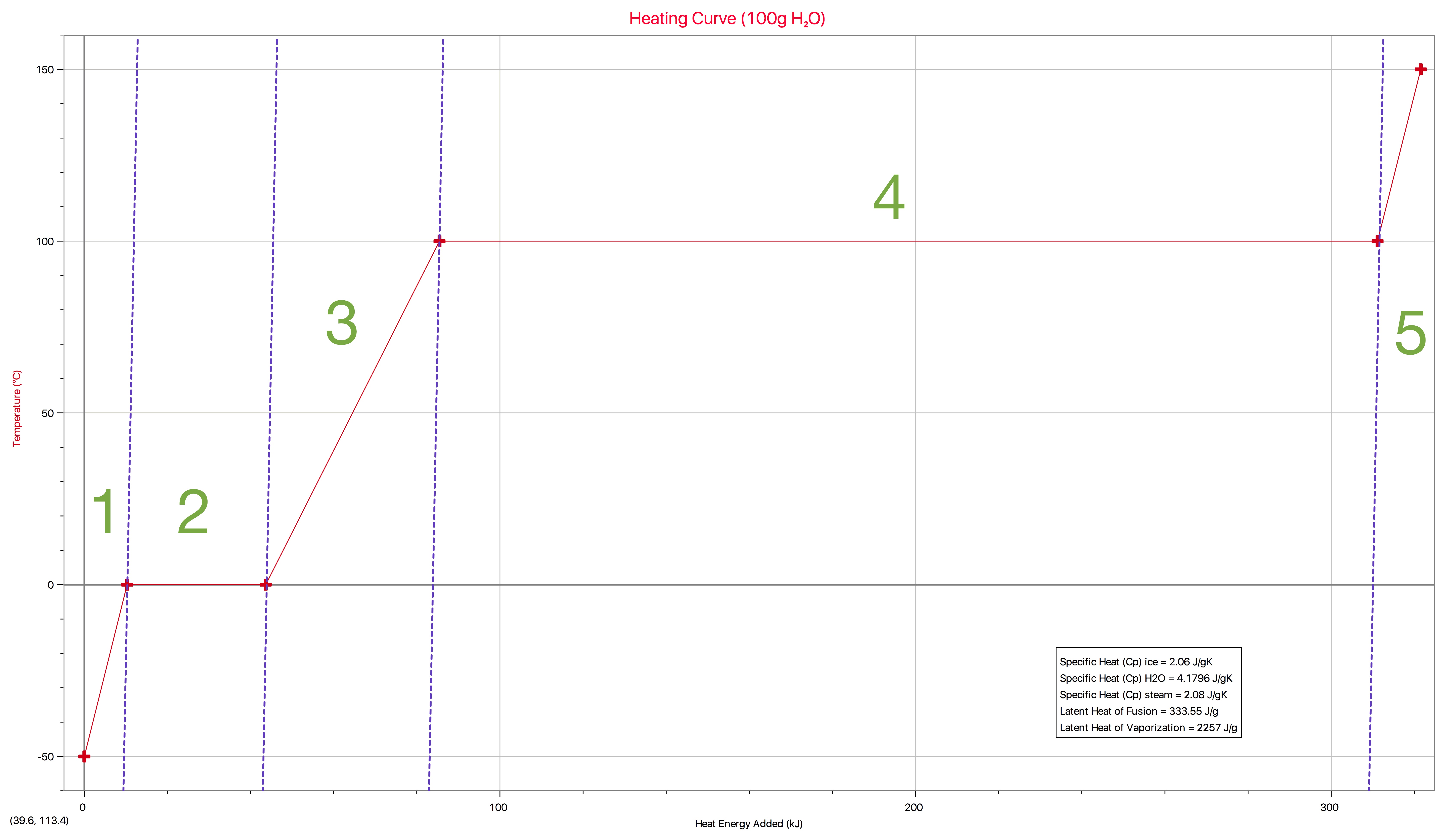
Where on the graph are phase changes taking place?

a)

1

b)

2

c)

3

d)

4

e)

5

33.
In a solid, the particles
a)
vibrate in place
b)
slide past one another
c)
overcome the strong attraction
34.

Between which two points is the gas heating up?

a)

A ----> B

b)

B <---- C

c)

C ----> D

d)

D ----> E

e)

E ----> F

35.

Between which two points is the solid cooling?

a)

A <---- B

b)

B <----> C

c)

C <---- D

d)

D <----> E

e)

E <---- F

36.

Between which two points is the gas condensing?

a)

A <---- B

b)

B <---- C

c)

C <---- D

d)

D <---- E

e)

E <---- F

37.
Between which points is the temperature of the substance remaining constant?
a)
A-B only. 
b)
A-B, C-D, E-F
c)
B-C only. 
d)
B-C, D-E
38.
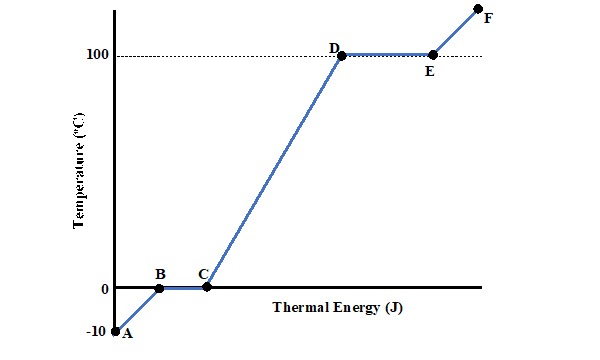
A substance's heating curve is shown in the graph.  What is its boiling point?
a)
100 C
b)
60 C
c)
80 C
d)
20 C
39.
The graph shows a cooling curve for an unknown substance.  What is happening during segment DE?
a)
boiling
b)
condensation
c)
freezing
d)
melting
40.
In which segment is the kinetic energy remaining constant?
a)
A-B
b)
B-C
c)
C-D
d)
E-F
41.
This curve indicates what about the heat energy?
a)
heat energy is being added or absorbed
b)
heat energy is being removed
42.

What is happening to the particles in the substance between points A and B?

a)

Melting

b)

Freezing

c)

Speeding Up

d)

Slowing Down

43.

Where on the graph are phase changes taking place?

a)

1

b)

2

c)

3

d)

4

e)

5

44.
When heat is added to a sample of gas sealed in a container, which of the following will most likely happen?
a)
The temperature of gas will increase because the gas molecules will move much more slowly.
b)
The temperature of gas will decrease because the gas molecules will move faster
c)
The temperature of gas will increase because the gas molecules will move faster. 
d)
Temperature of gas will decrease because the gas molecules will stop moving
45.
Which of the following is the measure of average kinetic energy of molecules?
a)
pressure
b)
heat energy
c)
volume
d)
temperature
46.
As pressure goes up, volume 
a)
goes down.
b)
goes up.
c)
stays the same
47.
Volume of a gas ____________ with increased temperature.
a)
decreases
b)
increases
c)
stays the same
48.
For example, if you increase the temperature of a gas inside a balloon, the balloon will....
[pressure is constant (k)]
a)
Expand (increase in volume)
b)
Deflate (decrease in volume
49.
When the temperature is constant (k) inside a balloon, if you add pressure on it, the volume will ..... 
a)
Decrease
b)
Increase
c)
Not Change at all
d)
Particles will solidify 
50.
If a balloon is cooled what will happen to the volume?
a)
Volume will increase
b)
Volume will decrease
c)
Volume will not change
51.
You go camping and roast marshmallows over a campfire. What happens to the volume of the air bubbles inside the marshmallows? 
a)
It increased
b)
It decreased
c)
It stayed the same
52.
You forgot to bring your basketball inside after playing a game with your friends. When the sun went down, the temperature dropped and it got cold outside. What do you think happened to the volume of the ball?
a)
It increased
b)
It decreased
c)
It stayed the same
53.
How can we increase the gas pressure inside a sealed container?
a)
Increase the number of particles inside the container
b)
Increase the temperature
c)
Decrease the volume of the container
d)
All of these
54.

If a hairspray can is heated, what can be expected of the pressure of the gas inside the can?

a)

The pressure will increase

b)

The pressure will decrease

c)

The pressure will remain constant

d)

The pressure will equalize

55.
Which of the following would increase the (gas) pressure of a system?
a)
Increase the Temperature
b)
Pump in more gas
c)
Decrease the volume
d)
All of these
56.

The pressure inside the balloon will:

a)

Decrease

b)

Increase

c)

Remain the same

d)

Not enough information to formulate an answer

57.

The pressure of the gas in the balloon in the ice water will be:

a)

Greater than that of the balloon in the boiling water.

b)

Less than that of the balloon in the boiling water.

c)

The same as that of the balloon in the boiling water.

d)

Not enough information to answer the statement.