Wayground logo

Free Printable Worksheets

Font size

S
M
L
XL
Worksheets

Seasons Moon Tides Eclipses Review

Total questions: 64

Worksheet time: 34mins

Name
Class
Date
1.
What season is letter A? (Always assume Northern Hemisphere)
a)
Winter
b)
Summer
c)
Spring
d)
Fall
2.
When the Northern Hemisphere is pointing towards the sun, what season is the Southern Hemisphere?
a)
Winter
b)
Spring
c)
Fall
d)
Summer
3.
What are the reasons for the seasons?
a)
Earth's tilt and rotation.
b)
Earth's rotation and revolution.
c)
Earth's tilt and revolution.
d)
Earth's tilt and resolution
4.
Sunlight hits Earth’s surface most directly at the _______. Because of this, this particular area doesn't experience seasons.
a)
north pole
b)
south pole
c)
equator
5.
  A cycle is something that happens over and over again, like the seasons and day & night. 
a)
True
b)
False
c)
Maybe
d)
Not sure
6.
At position C, which hemisphere would have winter?
a)
Northern hemisphere
b)
Southern hemisphere
7.
At position D in the Northern hemisphere it would be _____?
a)
Summer
b)
Winter
c)
Spring
d)
Fall
8.
the light is reflected and decreasing on the left side. Name the phase and visibility:(look at the picture)
a)
Waning Gibbous, 75%
b)
Waxing Gibbous, 75%
c)
Waning crescent, 25%
d)
Waxing crescent, 25%
9.
 the moon is illuminated, the light is reflected and decreasing on the left side. Name the phase and visibility.
a)
Waxing Gibbous, 75%
b)
Waxing Gibbous, 25%
c)
Waning Gibbous, 25%
d)
Waning Gibbous, 75%
10.
 light is reflected and increasing on the right side. Name the phase and visibility.(look at the pic)
a)
Waxing crescent, 75%
b)
Waning crescent, 25%
c)
Waxing crescent, 75%
d)
Waxing crescent, 25%
11.
, light is reflected and decreasing on the left side. Name the phase and visibility.
a)
New moon, 0%
b)
Full moon, 100%
c)
1st quarter, 50%
d)
3rd quarter, 50%
12.
light is reflected and increasing on the right side. Name the phase and visibility. 
a)
Waxing gibbous, 75%
b)
Waxing crescent, 75%
c)
Waning gibbous, 75%
d)
Waning crescent, 75%
13.
, light is reflected and increasing on the right side. Name the phase and visibility.
a)
New moon, 0%
b)
1st quarter, 50%
c)
Full moon, 100%
d)
3rd quarter, 50%
14.
14 days after a new moon is the _________ which is _______% visible.
a)
1st quarter, 50%
b)
3rd quarter, 50%
c)
Full  moon, 0%
d)
Full moon, 100%
15.
3.5 days from the new moon is the ___________ which is _____% visible.
a)
Waxing crescent, 25%
b)
Waning crescent, 25%
c)
Waxing gibbous, 75%
d)
Waning gibbous, 75%
16.
One month from the new moon is the __________ and is _____% visible.
a)
New moon, 100%
b)
Full moon 100%
c)
New moon, 0%
d)
Full moon, 0%
17.
Which moon phase is visible at position 4?
a)
new moon
b)
1st quarter
c)
full moon
d)
3rd quarter
18.
Where is the new moon ALWAYS located in a diagram of the moon phases?
a)
closest to the full moon
b)
closest to the 1st quarter moon
c)
closest to the sun
d)
closest to the waning gibbous
19.
Which moon phase is shown in this diagram?
a)
new moon
b)
1st quarter
c)
full moon
d)
last quarter/3rd quarter
20.
Which moon phase is shown in this diagram?
a)
new moon
b)
first quarter
c)
full moon
d)
last quarter/3rd quarter
21.
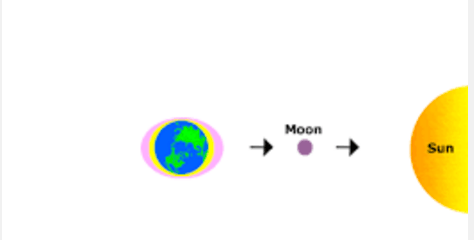
What type of tides would this arrangement of earth-moon-sun create?
a)
neap tide
b)
spring tide
c)
new moon tide
d)
full moon tide
22.
Tides are caused by ___________
a)
wind
b)
gravitational pull of moon
c)
waves gravitation toward land
d)
rain
23.
Wha type of tide would this arrangement of earth-moon-sun create?
a)
full moon tide
b)
new moon tide
c)
neap tide
d)
spring tide
24.
What happens when there is a spring tide
a)
high tides 
b)
really high tides
c)
low tides
25.
The term equinox means....
a)
equal amount of day light and equal amount of night
b)
Equal amount of winter and summer
c)
Equal amounts of hot dogs for everyone
d)
The longest day of the year
26.
What do June 21 and December 21 have in common?
a)
equinox dates
b)
the moon is full
c)
solstice dates
d)
the cold fronts blow in
27.
What is the longest day of the year?
a)
winter solstice
b)
summer solstice
c)
fall equinox
d)
spring equinox
28.

Which season is taking place in the Southern Hemisphere in Position 1?

a)
Winter
b)
Spring
c)
Summer
d)
Fall
29.

Which season is taking place in the Northern Hemisphere in Position 1?

a)
Winter
b)
Spring
c)
Summer
d)
Fall
30.
Which season is taking place in the Northern Hemisphere in Position 4?
a)
Winter
b)
Spring
c)
Summer
d)
Fall
31.
The hemisphere where you live 
a)
equator
b)
southern
c)
northern
d)
eastern
32.

The Arctic Circle receives several days each year where the sun never rises and they are in complete darkness.

a)
True
b)
False
33.
What is the shape of the earth's orbit around the sun?
a)
Circular
b)
Elliptical (slightly oval)
c)
Square to rectangular
d)
Variable and changes with the seasons (no particular shape)
34.

Each day after the summer solstice, the days get longer and longer until the fall equinox.

a)
True
b)
False
35.
One rotation of Earth is equal to
a)
a day.
b)
a year.
36.

In the Rotation movement The Earth turns around

a)

The sun

b)

The imaginary axis

37.

The Revolution movement causes

a)

The day and the night

b)

The seasons

38.

The Rotation movement causes

a)

The day and the night

b)

The seasons

39.

The Rotation movement takes

a)

24 hours

b)

365 days

c)

365 days and 6 hours

40.

In the Revolution movement The Earth turns around

a)

The imaginary axis

b)

The sun

41.
The MOON REVOLVES around the:
a)
Sun
b)
Earth
c)
The Moon doesn't revolve
42.
What type of eclipse occurs when the moon blocks the sun's light and cast a shadow on earth?
a)
solar
b)
lunar
43.

What type of eclipse occurs when the earth's shadow is cast on the moon?

a)

solar

b)

lunar

44.
What moon phase occurs during a solar eclipse?
a)
Full moon
b)
new moon
c)
1st quarter
d)
waxing gibbous
45.
What moon phase occurs during a lunar eclipse?
a)
full moon
b)
new moon
c)
3rd quarter
d)
waxing crescent
46.
What type of eclipse is this?
a)
Solar eclipse
b)
Lunar eclipse
47.
What type of eclipse is this?
a)
Solar Eclipse
b)
Lunar Eclipse
48.

When is a lunar eclipse visible ?

a)

day

b)

night

c)

varies

49.

What time is a solar eclipse visible ?

a)

day

b)

night

c)

varies

50.
How many high tides does a place have each day?
a)
3
b)
4
c)
5
d)
2
51.
What causes tides?
a)
gravity
b)
wind
c)
spring
d)
neap
52.
What type of tide will occur at 9:30 a.m.?
a)
low 
b)
high 
c)
none
d)
high and low
53.
Why does the moon's gravitational pull have more of effect on tides than the sun's gravitational pull?
a)
they are the same
b)
the moon is larger than the sun
c)
tides are not caused by the moon
d)
the moon is closer to the Earth than the sun
54.
A[n] ______________ tide occurs when the sun is at right angles to the line between Earth and the moon. 
a)
high
b)
neap
c)
low
d)
spring
55.
What is a difference between spring and neap tides?
a)
Spring tides occur when the earth and sun are IN LINE with the new or full moon. 
b)
Spring tides occur when moon in 3rd or 1st quarter phases
c)
Spring tides are LOWER than neap tides
d)
Spring tides occur in Spring and neap tides can occur in any season
56.
What do we call tides that have a smaller range that happen when the sun and moon are at right angles to each other?
a)
Neap Tide
b)
Spring Tide
c)
Larger Change
d)
Smaller Change
57.

How much time passes to complete a graph like this?

a)

29.5 days

b)

365 days

c)

1 season

d)

1 rotation

58.

What phase of the moon is represented by position L on the graph?

a)

Full Moon

b)

New Moon

c)

Waxing Crescent

d)

Last Quarter

59.

Which position on the graph represents a FIRST Quarter Moon?

a)

S

b)

A

60.

Which of these phases could be found during the C portion of the graph?

a)
b)
c)
d)
61.

Which of these phases could be found during the P portion of the graph?

a)
b)
c)
d)
62.

What moon phase comes 7 days after the phase at point M?

a)
b)
c)
d)
63.

Use the calendar to predict the moon phase on March 26th.

a)

Waxing Crescent

b)

Waning Crescent

c)

Waning Gibbous

d)

Waxing Gibbous

64.

What moon phase should be between the two shown?

a)

new moon

b)

full moon

c)

first quarter

d)

last quarter