wayground logo

Free Printable Worksheets

NEW

Font size

S
M
L
XL
Worksheets

Units 7 & 8 Review

Total questions: 40

Worksheet time: 46mins

Name
Class
Date
1.

The movement of the tectonic plates is caused by

a)

the rotation of the Earth.

b)

convection currents in the Asthenosphere

c)

the gravity of the iron-nickel core.

d)

the Moho discontinuity.

2.

In some areas of the world, like California and Japan, earthquakes are a common occurrence. How can this best be explained?

a)

The strong ocean currents are undermining both areas causing earthquakes.

b)

Both areas are located near the edge of the Pacific Ocean, the unstable sand causes earthquakes.

c)

Both areas are subjected to strong ocean wind and waves that causes earthquakes.

d)

Both areas are on the boundary of active plates, the motion of the plates causes earthquakes.
3.

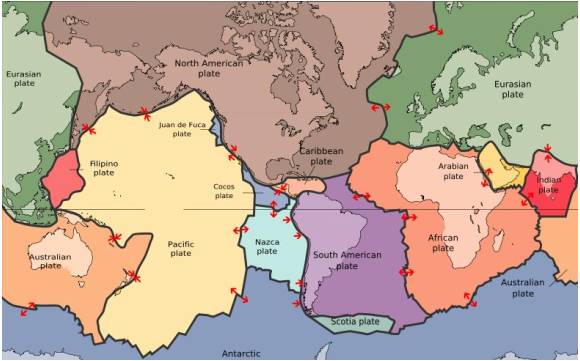
The map in the picture shows tectonic plate boundaries. This map would be useful in predicting the location of future

a)

droughts

b)

hurricanes

c)

earthquakes

d)

tornadoes

4.
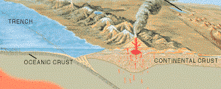
What geological forces might be responsible for this range of mountains?
a)
diverging tectonic plates
b)
erosion of the land by the ocean
c)
converging tectonic plates
d)
deposition of sediments by the ocean
5.

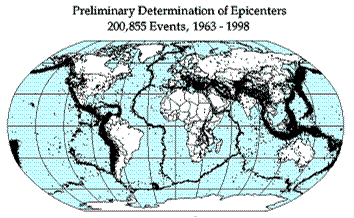
Earthquake epicenters (center of where the earthquakes started) were mapped for a 35 year period in the diagram above. The black dots indicate these epicenters. The black dots appear along what feature on Earth?

a)

hot spots

b)

plate boundaries

c)

rift zones

d)

sea floor spreading

6.
A plate boundary where two plates move away from each other is called
a)
Divergent Boundary
b)
Convergent Boundary
c)
Transform Boundary
d)
Subduction
7.
Scientists hypothesize that a super continent existed 200 million years ago.  This continent is called
a)
America
b)
Super Earth
c)
Pangea
d)
Eurasia
8.
A Plate Boundary where two plates move toward each other is called
a)
Convergent Boundary
b)
Divergent Boundary
c)
Transform Boundary
d)
Subduction
9.
When pressure builds between two tectonic plates, it can suddenly release causing a (an) ______________________
a)
Earthquake
b)
Volcano
c)
Convection Current
d)
Gravitational Pull
10.
The movement of metals within the earth's outer core cause a ____________________________ that is detectable on the earth's surface using a compass
a)
Gravitational Pull
b)
Volcanic Eruption
c)
Magnetic field
d)
Convection Current
11.

Plates slide past each other at _________________ boundaries.

a)

divergent

b)

convergent

c)

transform

d)

universal

12.

A __________ forms where plates diverge on land.

a)

rift valley

b)

mid-ocean ridge

c)

mountain

d)

trench

13.

What is the motion of Earth's plates like?

a)

fast and in stages

b)

slow and in stages

c)

fast and constant

d)

slow and constant

14.

The San Andreas fault is an example of which type of boundary?

a)

transform

b)

divergent

c)

convergent

d)

universal

15.
Identify the Major Plate labeled B
a)
African Plate
b)
Antarctic Plate
c)
Pacific Plate
d)
Eurasian Plate 
16.
Identify the Major Plate labeled I
a)
African Plate
b)
Antarctic Plate
c)
Pacific Plate
d)
Eurasian Plate 
17.
Identify the Major Plate labeled N
a)
African Plate
b)
Antarctic Plate
c)
Pacific Plate
d)
Eurasian Plate 
18.
Identify the Major Plate labeled J
a)
African Plate
b)
Antarctic Plate
c)
Pacific Plate
d)
Eurasian Plate 
19.
Identify the Major Plate labeled D
a)
Indo-Australian Plate
b)
North American Plate
c)
South Americana Plate
d)
Eurasian Plate 
20.
Identify the Major Plate labeled L
a)
Indo-Australian Plate
b)
North American Plate
c)
South Americana Plate
d)
Eurasian Plate 
21.
Identify the Major Plate labeled G
a)
Indo-Australian Plate
b)
North American Plate
c)
South Americana Plate
d)
Eurasian Plate 
22.
Which explains that the continents were once joined together and over time they broke up and then drifted apart?
a)
Plate Tectonic Theory
b)
Continental Drift 
23.
Which of these explains that Earth's outer layer is broken into large slowly moving pieces? 
a)
Plate Tectonic Theory
b)
Continental Drift 
24.
This boundary is described by two plates moving away from eachother along the edges and separating. The resulting gap allows magma to rise and create new crust, forming new lithosphere. 
a)
Convergent Boundary 
b)
Divergent Boundary  
c)
Transform Boundary
25.
This boundary is described as two plates moving past eachother ALONG THE EDGES horizontally.  These boundaries will get stuck or lock against eachother causing earthquakes when they slip and release. 
a)
Convergent Boundary
b)
Divergent Boundary
c)
Transform Boundary
26.
This boundary is described as moving toward one another  When the plates are both continental plates the will crumple up and form a mountains. When they are continental and oceanic plates, subduction occurs  and earthquakes and volcanoes form. 
a)
Convergent Boundary
b)
Divergent Boundary
c)
Transform Boundary
27.
Trenches, deep underwater canyons on the sea floor are created at this type of boundary 
a)
Divergent
b)
Convergent, Subduction Zone
c)
Transform 
28.
The image illustrates what type of boundary?
a)
Divergent
b)
Convergent
c)
Transform
d)
Emergent
29.
The image illustrates what type of boundary?
a)
Divergent
b)
Convergent
c)
Transform
d)
Emergent
30.
The image illustrates what type of boundary?
a)
Divergent
b)
Convergent
c)
Transform
d)
Emergent
31.

An object that orbits the Sun, has a spherical shape, and has mass greater than the mass of other objects near it is a(n)

a)

star

b)

planet

c)

asteroid

d)

comet

32.

What keeps planets in orbit around the Sun?

a)

the Sun's mass

b)

the Sun's period of rotation

c)

the Sun's gravitational force

d)

the Sun's color

33.

All the inner planets

a)

have at least one moon.

b)

have thick atmospheres.

c)

are rocky and have a solid outer layer.

d)

are large.

34.

All the outer planets are made mostly of

a)

water ice.

b)

metal and rock.

c)

gas and liquid around the solid core.

d)

a rocky surface.

35.

Which planet is the solar system's largest?

a)

Jupiter

b)

Saturn

c)

Neptune

d)

Uranus

36.

Which planet has a sideways axis rotation?

a)

Jupiter

b)

Saturn

c)

Uranus

d)

Mercury

37.

Which planet is the hottest?

a)

Mercury

b)

Earth

c)

Jupiter

d)

Venus

38.

As the mass of objects increases, gravity

a)

increases

b)

decreases

c)

stays the same

39.

As the mass of objects decreases, gravity

a)

increases

b)

decreases

c)

stays the same

40.

As the distance between objects increases, gravity

a)

increases

b)

decreases

c)

stays the same