
 Worksheets
Bio ILEARN Practice 1
Total questions: 44
Worksheet time: 58mins
Name
Class
Date
1.
What is the function of the centrioles?
a)
Structure that creates spindle fibers
b)
Structures that contains DNA and directs the cell
c)
Stack of membranes that packages chemicals
d)
Membrane that protects the nucleus
2.
Which organelle is the site of respiration?
a)
Nucleus
b)
Chromosomes
c)
Cytoplasm
d)
Mitochondria
3.

Which structure is common to both plant and animal cells?
a)
Chloroplast
b)
Centriole
c)
Cell wall
d)
Mitochondria
4.

Under a microscope, what kind of cells lack membrane-bound internal organelles?
a)
Prokaryotes
b)
Eukaryotes
c)
Plants
d)
Animals
5.
Which of the following is found in eukaryotic cells but NOT prokaryotic cells?
a)
Cell membrane
b)
Mitochondria
c)
Ribosomes
d)
DNA
6.
The site of photosynthesis
a)
ribosome
b)
mitochondria
c)
chloroplast
d)
nucleus
7.

Which type of cell?
a)
Prokaryote
b)
Eukaryote
8.

Using this image, what organelle is M?
a)
Centrioles
b)
Cell Membrane
c)
Golgi Apparatus
d)
Ribosomes
9.
What are two types of transport that require energy?
a)
osmosis and diffusion
b)
endo and exocytosis
c)
facilitated diffusion and osmosis
d)
active and passive
10.
Osmosis is the movement of _____ across a membrane.
a)
food
b)
energy
c)
oxygen
d)
water
11.
Molecules diffusing with the concentration gradient (from high to low concentration) through a protein channel is...
a)
Passive transport
b)
Exocytosis
c)
Active Transport
d)
Endocytosis
12.

Particles are too large to enter the membrane.
Need help from channel proteins.
No energy
Need help from channel proteins.
No energy
a)
active transport
b)
endocytosis
c)
facilitated diffusion
d)
transport proteins
13.

In this example the water will move _____, the solute _____, and the cell will ______
a)
in, out, swell
b)
in, out, shrink
c)
out, in, swell
d)
out, in, shrink
14.
When comparing two solutions, having a greater amount of solute.
a)
hypertonic
b)
isotonic
c)
hypotonic
15.
When comparing two solutions, having a lesser amount of solute.
a)
hypertonic
b)
isotonic
c)
hypotonic
16.
When comparing two solutions, and both have the same amount of solute
a)
hypertonic
b)
isotonic
c)
hypotonic
17.
What are the products of aerobic respiration?
a)
Glucose and oxygen
b)
Carbon dioxide, water, and energy
c)
Lactic acid and alcohol and energy
d)
Carbon monoxide
18.
The overall equation for cellular respiration is:
a)
C6H12O6 + energy -> 6CO2 + 6H2O + energy
b)
6CO2 + 6H20 + energy -> C6H12O6 + 6O2
c)
C6H12O6 + 6O2 -> 6CO2 + 6H2O + energy
d)
C6H12O6 + 6CO2 -> 6O2 + 6H2O + energy
19.
The main goal of photosynthesis is __________, while the main goal of respiration is to ____________.
a)
produce sugars, turn sugars and other food into ATP energy
b)
turn sugars and other food into ATP energy, produce sugars
20.
Which of the following lists the steps of respiration in order?
a)
Light independent reactions, light dependent reactions
b)
Glycolysis, Krebs cycle, Electron transport
c)
Light dependent reactions, light independent reactions
d)
Krebs cycle, Glycolysis, Electron transport
21.
Yeasts and other micro organisms perform when no oxygen is availible
a)
alcoholic fermentation
b)
lactic acid fermentation
c)
aerobic respiratoin
d)
electron transport chain
22.

Autotroph or heterotroph?
a)
Autotroph
b)
Heterotroph
23.
The amount of energy that usually transfers from one trophic level to the next...
a)
10%
b)
20%
c)
80%
d)
50%
24.
Organisms that feed on both living producers and other consumers.
a)
Carnivores
b)
Omnivores
c)
Herbivores
d)
Detritivores
25.
If the producers in a food chain collect 100 cal of energy, how much is passed all the way to the tertiary consumers?
a)
10 cal
b)
.1 cal
c)
1 cal
d)
.01 cal
26.
What is the name of the process in which DNA (genetic information) is exchanged during meiosis?
a)
crossing under
b)
crossing over
c)
melding
d)
blending
27.
Another name for a sex cell is a:
a)
gamete
b)
embryo
c)
bone cell
d)
muscle cell
28.

Place these cells in order of mitosis.
a)
A, B, C, D, E
b)
B, E, D, A, C
c)
C, E, A, D, B
d)
B, D, A, E, C
29.
Why is the greenhouse effect a good thing?
a)
It supplies CO2 to plants
b)
It cools the earth enough for life to exist
c)
It keeps earth warm enough for life
d)
It is not a good thing
30.

Transcription is a process that in eukaryotic cells takes place in the:
a)
Nucleus
b)
Cytoplasm
c)
Golgi Apparatus
d)
Rough E.R.
31.

Translation is a process in eurkaryotic cells takes place in the:
a)
Cytoplasm
b)
Nucleus
c)
Nucleolus
d)
Golgi Bodies
32.
The process of copying a gene's DNA sequence into a sequence of RNA is called:
a)
Transcription
b)
Translation
c)
Splicing
d)
Protein Synthesis
33.

RNA contains which bases?
a)
adenine, guanine, uracil, cytosine
b)
thymine, guanine, cytosine, uracil
c)
thymine, uracil, cytosine, guanines
d)
adenine, uracil, guanine, thymine
34.
What does Darwin's theory of evolution suggest?
a)
species change over time
b)
extinct species are not related to living species
c)
different species can interbreed
d)
animals that look alike are most closely related
35.
Structures that have the same function but different structures are...
a)
homologous structures
b)
analogous structures
c)
vestigial structures
d)
embryology
36.

Which layer is the oldest
a)
B
b)
A
c)
E
d)
C
37.

Study of embryos of various organisms to show a common ancestor because of similarities in development
a)
natural selection
b)
embryology
c)
speciation
d)
evolution
38.
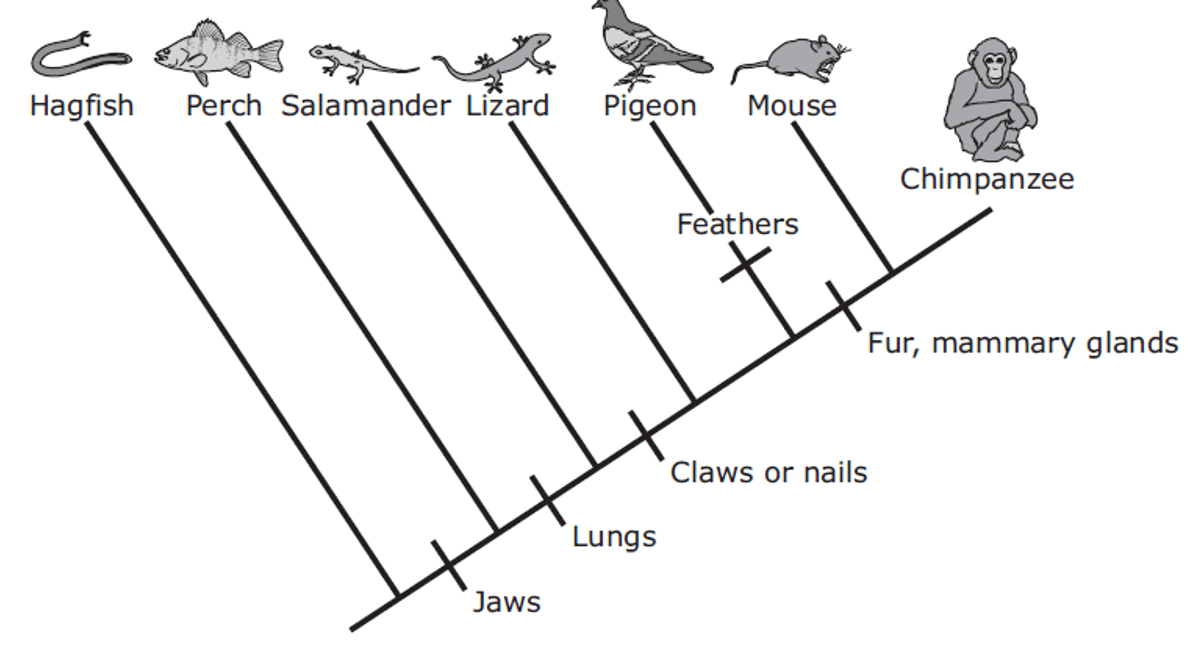
All the animals to the right of the hagfish would have the common characteristic of -
a)
Fur
b)
Claws or nails
c)
Lungs
d)
Jaws
39.

According to this cladogram, birds are LEAST related to -
a)
Amphibians
b)
Sharks
c)
Ray Finned Fish
d)
Crocodiles
40.
The law that states that each trait is passed down separately is called the law of
a)
segregation
b)
crossing over
c)
genetics
d)
independent assortment
41.

Identify the phase of mitosis
a)
prophase
b)
metaphase
c)
anaphase
d)
telophase
42.
The uncondensed/loose DNA found in the nucleus of cells not currently dividing.
a)
nucleus
b)
chromatin
c)
chromatid
d)
chromosome
43.

The number of individuals a habitat can sustain with the resources it has available
a)
Carrying capacity
b)
Limiting factors
c)
Resources
d)
Population
44.
Which of the following key historical figures is not correctly matched to their role?
a)
Charles Darwin - Discovered evolution/natural selection
b)
Gregor Mendel - Father of genetics
c)
Chargaff - X-ray photo of DNA
d)
Watson and Crick - Built a model of DNA
100 %

