wayground logo

Free Printable Worksheets

Font size

S
M
L
XL
Worksheets

Gr. 7/Ch. 3 Genetics Review

Total questions: 71

Worksheet time: 6hrs 55mins

Name
Class
Date
1.

The passing of genetic material from parents to offspring.

a)

heredity

b)

gene

c)

allele

d)

genotype

e)

phenotype

2.

Segments of DNA (Deoxyribonucleic acid) found in chromosomes that give instructions for producing a certain characteristic.

a)

heredity

b)

gene

c)

allele

d)

genotype

e)

phenotype

3.

Different versions of a gene.

a)

heredity

b)

gene

c)

allele

d)

genotype

e)

phenotype

4.

The combination of alleles that you inherited from your parents. This is what you genes look like, the letters. ex. HhGg

a)

heredity

b)

gene

c)

allele

d)

genotype

e)

phenotype

5.

The observable traits. This is what you physically look like, or what gene is expressed. ex. Round Yellow

a)

heredity

b)

gene

c)

allele

d)

genotype

e)

phenotype

6.

An organism with two dominant or two recessive alleles. Or same.

a)

heterozygous

b)

homozygous

7.

An organism with one dominant and one recessive allele. Or different.

a)

heterozygous

b)

homozygous

8.

Each allele in a heterozygous individual influences the phenotype.

a)

dominant

b)

recessive

c)

incomplete dominance

d)

codominance

9.

Both of the alleles in a heterozygous individual contribute to the phenotype, instead of blending, there are usually patches.

a)

dominant

b)

recessive

c)

incomplete dominance

d)

codominance

10.
Which of the following cells is a gamete?
a)
egg
b)
bone
c)
heart
d)
muscle
11.
After meiosis II the daughter cells will contain ____ chromosomes if the original cell contained 78.
a)
78
b)
39
c)
23
d)
46
12.
The fertilized egg is termed a/an _____.
a)
gamete
b)
allele
c)
homolog
d)
zygote
13.
In mitosis cells are genetically _______, but in meiosis cells are genetically ______.
a)
diverse, identical
b)
identical, diverse/different
14.
When does replication of chromosomes occur in animal cell meiosis?
a)
Before Meiosis I and Meiosis II
b)
Before Meiosis II Only
c)
Before Meiosis I Only
d)
During Prophase I and Prophase II
15.
In sexual reproduction, chromosome reduction is necessary to ___.
a)
ensure that all offspring have the correct diploid number of chromosomes
b)
ensure that all offspring have the correct haploid number of chromosomes
c)
ensure that all daughter cells are identical
16.

1n indicates that the cell is ____.

a)

Diploid

b)

Haploid

17.

Is this a normal human karyotype?

a)

YES

b)

NO

18.

Is this karyotype for a male or female?

a)

MALE

b)

FEMALE

19.

Mitosis makes sure that all daughter cells are _____.

a)

genetically identical, diploid

b)

genetically identical, haploid

c)

genetically diverse, diploid

d)

genetically diverse, haploid

20.
I am a single strand.
a)
DNA
b)
RNA
21.
I am arranged as a double helix or "twisted ladder".
a)
DNA
b)
RNA
22.
I include the bases Guanine, Cytosine, Adenine and Thymine.
a)
DNA
b)
RNA
23.
I include the bases Guanine, Cytosine, Adenine and Uracil .
a)
DNA
b)
RNA
24.
I travel outside of the nucleus.
a)
DNA
b)
RNA
25.
Guanine goes with __________
a)
adnine
b)
cytosine
c)
guanine
d)
thymine
26.
I have the sugar ribose.
a)
DNA
b)
RNA
27.
I have the sugar dioxyribose.
a)
DNA
b)
RNA
28.
In DNA the sides of the double helix is made of 
a)
deoxyribose  and phosphates
b)
adenine and guanine
c)
thymine and cytosines
29.
The sugar in DNA is ____________________.
a)
deoxyribose
b)
ribose
30.
The sugar in RNA is ____________________.
a)
deoxyribose
b)
ribose
31.
What is a mutation?
a)
a change in DNA
b)
a person who is bitten by a radioactive spider
32.
The results of mutation are 
a)
can be bad.
b)
can be good. 
c)
cannot show.
d)
 can be good, bad or neutral. 
33.
In RNA, adenine goes with __________.
a)
adnine
b)
cytosine
c)
thymine
d)
uracil
34.
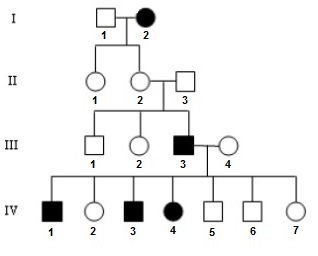
How many generations are shown in this pedigree?
a)
1
b)
2
c)
3
d)
4
35.
How many kids did the mother and father from the first generation have?
a)
2
b)
4
c)
5
d)
6
36.
This pedigree represents the inheritance of hemophilia in this family. How many of the females have the hemophilia trait?
a)
8
b)
5
c)
2
d)
3
37.
What do half colored symbols represent?
a)
The individual is a carrier (heterozygous).
b)
The individual expresses the trait.
c)
The individual has both recessive alleles.
d)
The individual has both dominant alleles.
38.
Is this trait (the shaded individuals) dominant or recessive?
a)
dominant
b)
recessive
39.
What is this?
a)
Pedigree
b)
Karyotype
c)
Venn diagram
d)
Punnett Square
40.
Which gender can be carriers of colorblindness and not have it?
a)
Just males
b)
Just females
c)
Both genders
41.

"transgenic" refers to an animal that:

a)

Has DNA from another organism spliced into its genome

b)

Has undergone DNA modification

c)

Has unique genes for its species

42.

In which ways can genetic engineering can improve crops

a)

Make them pest or drought resistant

b)

Make them more nutritious

c)

Make them larger

d)

All answers are correct

43.
When DNA is manipulated and moved from one source to another it is known as
a)
genetic engineering
b)
electrophoresis
c)
gene therapy
d)
GMO
44.
Making changes in the DNA of an organism is
a)
selective breeding
b)
artificial selection
c)
genetic engineering
d)
genetic transformation
45.
Which term refers to a farmer choosing the best corn from this year to plant next year?
a)
natural selection
b)
selective breeding
c)
genetic engineering
d)
genetic transformation
46.
Dominant or recessive?
tt
a)
Dominant 
b)
Recessive
47.
B = brown fur  b = white fur
In the punnett square, what is the probability for white fur? 
a)
0%
b)
25%
c)
50%
d)
75%
48.
Homozygous or heterozygous?
BB
a)
Homozygous
b)
Heterozygous
49.
Which of the following is a phenotype?
a)
Aa
b)
red hair
c)
heterozygous
d)
DNA
50.

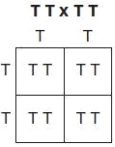
T - tall and t = short

In the Punnett square, what belongs in the missing square?

a)

tt

b)

Tt

c)

TT

51.

In plants, tall (T) is dominant to short (t). Perform the following cross: Tt x Tt. What is the probability of producing a short plant?

a)

0%

b)

25%

c)

50%

d)

75%

52.

What is ratio of the offspring from the cross shown will be homozygous recessive for the trait of tallness? T = tall t = short

a)

0 in 4

b)

1 in 4

c)

2 in 4

d)

4 in 4

53.

Brown eyes are dominant over blue eyes. What is the probability that the offspring will have brown eyes in this cross?

a)

25%

b)

50%

c)

75%

d)

100%

54.

Some flowers are controlled by codominance. Red flowers (RR), blue flowers (BB) and Speckled flowers (RB).


Cross a red flower with a speckled flower. What is the phenotypic ratio?

a)

2 red, 2 speckled

b)

2 red, 2 blue

c)

2 blue, 2 speckled

55.

A calico cat shows both the traits for orange fur and black fur. What kind of allele expression is this?

a)

Incomplete dominance

b)

Codominance

56.

This is an example of ---

a)

Incomplete dominance

b)

Codominance

57.

This is an example of ---

a)

Incomplete dominance

b)

Codominance

58.

A red flowered plant (RR) is crossed with a white flowered plant (WW). The gene for petal color in these plants expresses incomplete dominance. What percentage of the offspring will have red (RR) flowers?

a)

0%

b)

25%

c)

50%

d)

100%

59.

How many pairs of homologous chromosomes are found in each (body) cell?

a)

46

b)

23

c)

72

d)

10

60.

Which chromosomes are shown in the image?

a)

Sex Chromosomes

b)

Autosomes

c)

Trisomy

d)

Monosomy

61.

A karyotype is:

a)

A tool scientists use to analyze chromosomes

b)

A tool scientists use to predict the potential genotypes / phenotypes of offspring

c)

A tool scientist use to identify genes in the human genome

d)

A tool scientists use to identify criminals & find relatives

62.

Identify the tool in the image:

a)

Karyotype

b)

Gel Electrophoresis

c)

DNA Fingerprint

d)

Gene Analysis

63.

XX

a)

Female

b)

Male

64.

XY

a)

Female

b)

Male

65.

This person's sex is:

a)

Female

b)

Male

66.

This person's sex is:

a)

Female

b)

Male

67.

SELECT ALL THAT APPLY: Sex Chromosomes:

a)

Pair #23

b)

Determine whether you're male / female

c)

Pairs #1-22

d)

Every chromosome except sex chromosomes

68.

SELECT ALL THAT APPLY: Autosomes Chromosomes:

a)

Pair #23

b)

Determine whether you're male / female

c)

Pairs #1-22

d)

Every chromosome except sex chromosomes

69.

SELECT ALL THAT APPLY:

a)

Male

b)

Female

c)

No chromosomal abnormalities

d)

Trisomy 21

70.

SELECT ALL THAT APPLY:

a)

Male

b)

Female

c)

No chromosomal abnormalities

d)

Trisomy 21

71.

SELECT ALL THAT APPLY:

a)

Male

b)

Female

c)

No chromosomal abnormalities

d)

Trisomy 18