wayground logo

Free Printable Worksheets

NEW

Font size

S
M
L
XL
Worksheets

Body Movements

Total questions: 23

Worksheet time: 12mins

Name
Class
Date
1.
Turning the hand so that the palm is upward or facing anteriorly (in anatomical position).
a)
supination
b)
pronation
c)
flexion
d)
dorsiflexion
2.
Turning the foot so the plantar surfaces faces medially.
a)
plantar flexion
b)
eversion
c)
inversion
d)
dorsiflexion
3.
Which of the following best describes extension?
a)
The straightening of a joint where the angle of movement increases
b)
The bending of a joint where bones get closer together
c)
The rotation of a joint or spinning of one bone on another
d)
The lateral movement away from the midline
4.

The lateral motion TOWARDS the midline is called ______.

a)

adduction

b)

abduction

c)

circumduction

d)

opposition

5.

Movement AWAY from the mid-line is called _____________.

a)

abduction

b)

adduction

c)

opposition

d)

pronation

6.
Rotation of the forearm until the palm faces DOWN is called __________.
a)
supination
b)
pronation
c)
flexion
d)
dorsiflexion
7.
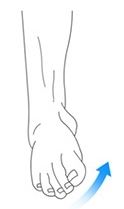
What movement is occurring here?
a)
Eversion
b)
Flexion
c)
Dorsiflexion
d)
Plantarflexion
8.

Mr. Swatter has a fly on his shoulder, the poor thing. He reaches his right hand over to his left shoulder to try and squish the fly. Which movement is occurring at his ELBOW joint?

a)

Extension

b)

Circumduction

c)

Flexion

d)

Supination

9.

Nicole a fitness guru feels compelled to do a few jumping jacks. Which movement is taking place as her hands come together above her head?

a)

Extension

b)

Adduction

c)

Circumdation

d)

Abduction

10.

Noah is very short. He needs to stand on his "tip toe's" to reach the cookie jar on the top shelf of the cupboard. What is the movement of his ankles?

a)

Plantar Flexion

b)

Extension

c)

Dorsiflexion

d)

Rotation

11.
When the outstanding Dustin Martin kicks a football the movement of the knee joint in the back swing, before kicking the ball is......
a)
Abduction
b)
Flexion
c)
Extension
d)
Adduction
12.

Straightening parts at a joint so the angle between them increases is

a)

flexion

b)

dorsiflexion

c)

extension

d)

rotation

13.

Which shoulder motion is illustrated in the picture?

a)

rotation

b)

adduction

c)

flexion

d)

extension

14.

Which movement is shown in the picture?

a)

eversion

b)

rotation

c)

extension

d)

flexion

15.

Turning the hand so the palm is downward is

a)

inversion

b)

supination

c)

pronation

d)

eversion

16.

Identify the joint action being performed.

a)

Circumduction

b)

Lateral Rotation

c)

Medial Rotation

d)

Eversion

17.
Identify the joint action being performed.
a)
Circumduction
b)
Lateral Rotation
c)
Medial Rotation
d)
Eversion
18.
Identify the joint action being performed.
a)
Inversion
b)
Eversion
c)
Plantarflexion
d)
Dorsiflexion
19.
Identify the joint action being performed.
a)
Inversion
b)
Eversion
c)
Plantarflexion
d)
Dorsiflexion
20.
Identify the joint action being performed.
a)
Inversion
b)
Eversion
c)
Plantarflexion
d)
Dorsiflexion
21.

Extension of the parts at a joint beyond anatomical position is

a)

flexion

b)

extension

c)

hyperextension

22.

Turning the foot so that the plantar surface faces laterally is

a)

eversion

b)

inversion

c)

retraction

d)

extension

23.

Which movement is illustrated here?

a)

Rotation

b)

Oppostion

c)

Pronation

d)

Hyperextension