
 Worksheets
Simple Harmonic Motion (AP1)
Total questions: 23
Worksheet time: 23mins
When is the pendulum at maximum velocity
At its lowest point
At its highest point
It moves at a constant velocity
It is at rest
The number of cycles or oscillation made in one second is defined as
time taken
period
frequency
amplitude

The maximum velocity occurs where the ____.
potential energy is a maximum
kinetic energy is a minimum
displacement from equilibrium is equal to
the amplitude of 0.4 𝑚
displacement from equilibrium is equal to
zero
An object of mass 𝑚 is attached to a horizontal spring, stretched to a displacement 𝐴 from equilibrium and released, undergoing harmonic oscillations on a frictionless surface with period 𝑇 . The experiment is then repeated with a mass of 4𝑚. What’s the new period of oscillation?
2T
T
4T
T√2
The variation of the acceleration, a of a particle executing SHM with displacement, x is as shown in figure:


In SHM , at the equilibrium point , the
_________________ is a maximum, and
_________________ a minimum
displacement / velocity
displacement AND acceleration / velocity
velocity / displacement
velocity/ displacement AND acceleration
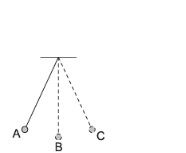
A pendulum oscillates as shown. At which of the following positions is the kinetic energy equal to the total energy?
A
B
C
Not enough information given.
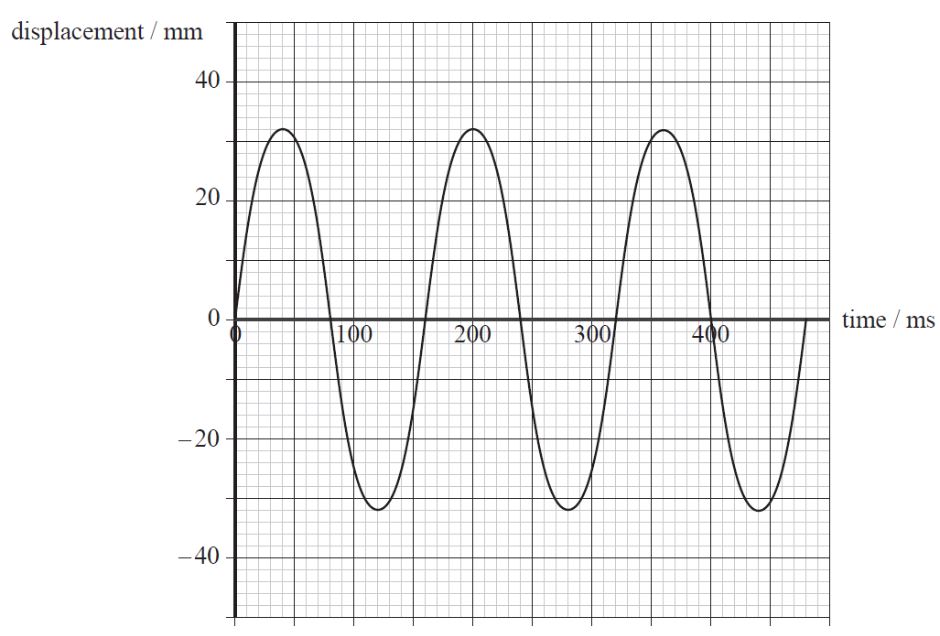
The graph shows the variation with time of the displacement of an object undergoing simple harmonic motion. At which of the following time values is kinetic energy zero?
0 ms
40 ms
80 ms
100 ms

Which of the following graphs correctly represents the total mechanical energy of this spring-mass system? Assume no damping.


What is the period for this waveform?
2 s
1 s
4 s
0.75 s

If you were to increase the gravitational acceleration acting on a pendulum, what would happen to the period of the pendulum?
The period would increase.
The period would decrease.
The period would stay the same.
Cannot determine this information.
If you were to increase the mass of the object on a spring, what would happen to the period of the mass on the spring?
The period would increase.
The period would decrease.
The period would stay the same.
Cannot determine this information.
If you were to increase the spring constant of a spring, what would happen to the period of the mass on the spring?
The period would increase.
The period would decrease.
The period would stay the same.
Cannot determine this information.

The graph shows the variation of displacement d with time t for a particle moving with simple harmonic motion of period T.
Which graph shows the variation of kinetic energy Ek of the particle with time?


For a body performing simple harmonic motion, which one of the following statements is correct?
The maximum kinetic energy is directly proportional to the frequency.
The time for one oscillation is directly proportional to the frequency.
The speed at any instant is directly proportional to the displacement.
The maximum acceleration is directly proportional to the amplitude.

