Font size
 Worksheets
Biology Review
Total questions: 225
Worksheet time: 2hrs 0mins
Which of the following organs belongs to the skeletal system?
Brain
Humerus
Lungs
Heart
List the levels of organization from least complex to most complex.
tissue, organism, cell, organ system, organ
organism, organ system, organ, tissue, cell
tissue, cell, organ, organ system, organism
cell, tissue, organ, organ system, organism
Which scientist was the first to see living cells?
Schwann
Hooke
Virchow
Von Leeuwenhoek
Do scientists consider a virus to be living or non-living?
Living
Non-living
Which pH would be considered a strong base?
2
7
9
13
Which pH would be considered a weak acid?
0
2
6
8
Which pH is considered to be neutral?
5
7
9
11
What is the term used to describe that water is attracted to other materials?
Capillary action
Solute
Mixture
Magnetic
A substance being dissolved is called _____________?
Solution
Solute
Solvent
Capillary action
The attraction between molecules of different substances is called ___________.
Adhesion
Cohesion
Surface tension
High specific heat
What type of tissue lines the interior and exterior body surfaces?
Muscle
Nervous
Connective
Epithelial
What type of tissue can be found in the brain and carries impulses throughout the body?
Muscle
Nervous
Connective
Epithelial
Which scientist performed an experiment with meat and flies in a jar to see if it produced maggots?
Redi
Pasteur
Spallanzani
Needham
Which scientist tried to prove spontaneous generation by heating different broths briefly?
Redi
Needham
Spallanzani
Pasteur
Which characteristic of life is responsible for passing genetic material from parent to offspring?
Evolution
Cells
DNA
Reproduction
Which characteristic of life is responsible for the following situation:
A student walks outside and covers their eyes.
Response to stimulus
Homeostasis
Metabolism
Development
Which type of variable is changed by the scientist?
Control
Independent
Dependent
Which of the following belongs to the Digestive system?
Skin
Esophagus
Lungs
Thyroid
Who discovered that all cells come from pre-existing cells?
Schwann
Hooke
Schleiden
Virchow
Which scientist came up with the term "cells"?
Schwann
Von Leeuwenhoek
Hooke
Schleiden
What type of tissue contracts to allow body movement?
Muscle
Connective
Nervous
Epithelial
Which type of tissue connects, supports, and protects other tissues? Examples include cartilage, bone, blood, ligaments, and tendons.
Epithelial
Nervous
Muscle
Connective
Which scientist performed an experiment with a curved flask and disproved spontaneous generation?
Redi
Needham
Spallanzani
Pasteur
Which characteristic of life explains the body shivering when cold to help maintain the body temperature?
Metabolism
Homeostasis
Reproduction
Growth and Development
Which variable is the one being studied in an experiment?
Independent
Dependent
Control
Which characteristic of life explains how a virus can change over a long period of time?
Development
Metabolism
Homeostasis
Evolution
When a scientist conducts a controlled experiment, what is tested by the experiment?
a single variable
several variables at once
the control group
a previous conclusion
Which characteristic of life describes using chemical reactions to produce energy that helps carry out life functions?
Homeostasis
Metabolism
Response to stimulus
Growth
Who performed an experiment with sealed and unsealed containers of gravy to disprove spontaneous generation?
Pasteur
Redi
Spallanzani
Needham
Which scientist discovered that cells are the basic unit of all living things?
Virchow
Von Leeuwenhoek
Schwann
Hooke
Who discovered that all plants are made of cells?
Virchow
Schwann
Schleiden
Hooke
Which characteristic of life describes the ability to produce offspring?
DNA
Response to stimulus
Cells
Reproduction
Which of the following organs belongs to the Endocrine system?
Thyroid
Stomach
Kidney
Brain
Which reaction puts compounds together and removes water?
Hydrolysis
Synthesis
Condensation
Decomposition
Another name for the term "macromolecule" is ____________.
Micromolecule
Biomolecule
Big Molecule
Small Molecule
What is the material an enzyme acts on is called?
Active site
Substrate
Product
Substance
Which of the following are classified as Saturated fat?
Meat fat
Liquid at room temperature
Fish oil
Butter
Solid at room temperature
Which is a building block of Carbohydrates?
Starch
Fatty acid
Nucleotide
Monosaccharide
Which of the following are classified as Unsaturated fats?
Liquid at room temperature
Butter
Vegetable oil
Lard
Solid at room temperature
In DNA, Adenine pairs with ____________.
Guanine
Thymine
Cytosine
Uracil
Which is NOT a part of an enzyme reaction?
Substance
Enzyme
Product
Active Site
The ____________ is the part of an enzyme that contacts the substrate.
Product
Active site
Reaction
Catalyst
Which reaction breaks organic compounds and adds water?
Hydrolysis
Synthesis
Condensation
Decomposition
In DNA, Cytosine pairs with ____________.
Guanine
Uracil
Thymine
Adenine
Genetic material is made of what type of bases?
Nitrogen
Hydrogen
Oxygen
Carbon
Check all of the following that are describe DNA.
Thymine
Found in the nucleus
Uracil
Double stranded
Single stranded
In RNA, Adenine pairs with _______________.
Thymine
Uracil
Guanine
Cytosine
What are the subunits of Nucleic acids?
Sugars
Fatty acids
Amino acids
Nucleotides
In RNA, Cytosine pairs with _____________.
Thymine
Adenine
Uracil
Guanine
What are the subunits of Lipids?
Sugars
Fatty acids
Amino acids
Nucleotides
Enzymes act as biological catalysts. What does a catalyst do?
Stops a reaction
Reduces a reaction
Speeds up a reaction
Pauses a reaction
What are the subunits of Carbohydrates?
Sugars
Fatty acids
Amino acids
Nucleotides
Check all of the following that describe RNA.
Thymine
Single stranded
Uracil
Found outside the nucleus
Double stranded
Which biomolecule is the primary source of energy for a cell?
Carbohydrate
Lipid
Protein
Nucleic Acid
Which if the following conditions will denature a protein?
High pH
Water in abundance
High Temperatures
Low pH
Alcohol
What are the subunits of Proteins?
Sugars
Fatty acids
Amino acids
Nucleotides
Which biomolecule stores and transmits genetic material?
Carbohydrate
Lipid
Protein
Nucleic Acid
What 3 letter do most enzymes end with?
-ase
-ise
-ose
-ese
Which biomolecule is responsible for enzymes, movement, antibodies, transport, and structure?
Carbohydrates
Lipids
Proteins
Nucleic Acids
What do all organic compounds have in common?
Oxygen
Nitrogen
Carbon
Phosphorus
Hydrogen
What 3 letter do most sugars end with?
-ase
-ise
-ose
-ese
Which of the following elements are found in Lipids?
Carbon
Hydrogen
Oxygen
Nitrogen
Phosphorus
Which of the following elements are found in Carbohydrates?
Carbon
Hydrogen
Oxygen
Nitrogen
Phosphorus
Which biomolecule is responsible for long term energy storage, membrane structure, and acts as a chemical messenger?
Carbohydrates
Lipids
Proteins
Nucleic Acids
Which of the following elements are found in Proteins?
Carbon
Hydrogen
Oxygen
Nitrogen
Phosphorus
_____________ are connected by peptide bonds.
Monosaccharides
Fatty acids
Amino acids
Nucleotides
Which of the following uses information from DNA to produce proteins?
Enzymes
RNA
Catalysts
Amino acids
Which of the following goes with Monosaccharide?
Glucose
Starch
Ribose
Fructose
Sucrose
The following would fall under which category:
Glycogen
Cellulose
Glucose
Carbohydrate
Lipid
Protein
Nucleic Acid
Which of the following elements are found in Nucleic Acids?
Carbon
Hydrogen
Oxygen
Nitrogen
Phosphorus
Which of the following is a Polysaccharide?
Fructose
Sucrose
Ribose
Starch
The following would fall under which category:
Amylase
Keratin
Hemoglobin
Carbohydrate
Lipid
Protein
Nucleic Acid
Which of the following is a Disaccharide?
Fructose
Sucrose
Ribose
Starch
Which is a large molecule formed by joining many simple sugars?
Monosaccharide
Disaccharide
Polysaccharide
The following would fall under which category:
Cholesterol
Wax
Carbohydrate
Lipid
Protein
Nucleic Acid
Which molecule is formed by the joining two simple sugars?
Monosaccharide
Disaccharide
Polysaccharide
Carbohydrates and Lipids have which characteristics in common?
Used for energy
Dissolve in water
Have genetic material
Made of carbon, hydrogen, and oxygen
Made of nitrogen and phosphorus
The movement of molecules (not water) from an area of high concentration to an area of low concentration is called?
Facilitated Diffusion
Simple Diffusion
Osmosis
Active Transport
This organelle controls what comes in and out of the cell and is found in both plant and animal cells.
Cell wall
Cytoplasm
Cell membrane
Chromatin
Which organelle is the rigid outer layer of a plant cell?
Cell wall
Chloroplast
Cell membrane
Cytoplasm
Which type of cell transport requires energy and moves from an area of low concentration to an area of high concentration?
Passive
Active
What is the gel-like fluid where organelles are found?
Vacuole
Nucleus
Lysosomes
Cytoplasm
Which of the following is TRUE about the phosphate portion of the phospholipid?
Non-polar
Polar
Attracts water
Repels water
What is a fungal cell made of?
Peptidoglycans
Chitin
Cellulose
Starch
Plasmolysis is the shrinking of what type of cell?
Plant
Animal
Both
Which of the following can be found in the nucleus?
DNA
Phosphates
Sugars
Nitrogen
The tail-like structure found on bacteria, animal cells, and prokaryotic cells is called?
Cilia
Flagella
Tail
Cytoplasm
Both prokaryotic and eukaryotic cells have DNA present. Where is DNA found in prokaryotic cells?
In the nucleus
In the cytoplasm
In the nucleolus
In the golgi body
The movement of water from an area of high concentration to an area of low concentration across a selectively permeable membrane is called?
Facilitated diffusion
Osmosis
Simple Diffusion
Active transport
Which of the following is TRUE about the lipid portion of the phospholipid?
Non-polar
Polar
Attracts water
Repels water
Which type of cell transport does NOT require energy and moves from an area of high concentration to an area of low concentration?
Active
Passive
Hormones are produced by which organelle?
Smooth ER
Golgi Body
Mitochondria
Rough ER
To find the total magnification of a microscope, you should multiply which 2 magnifications?
Eyepiece and Bodytube
Bodytube and Objective lens
Eyepiece and Objective lens
Both prokaryotic and eukaryotic cells have DNA present. Where is DNA found in eukaryotic cells?
In the nucleus
In the cytoplasm
In the nucleolus
In the golgi body
Which of the following contains genetic material?
DNA
Chromosomes
Chromatin
Ribosomes
Which of the following describes a plant cell?
Centrioles
Cell Wall
Cytoskeleton
Chloroplasts
Which of the following are eukaryotic?
Fungus
Bacteria
Animal
Plant
Which organelle is found inside the cytoplasm and provides support to the cell?
Microtubules
Cell Wall
Ribosomes
Lysosomes
Centrioles are found in what type of cells?
Plant
Animal
Both
When the solute is equal inside and outside the cell.
Isotonic
Hypotonic
Hypertonic
Which process describes when large molecules are released from the cell?
Endocytosis
Molecular Transport
Exocytosis
Passive Transport
Which of the following describes simple diffusion?
Uses energy
Does not use energy
High concentration to Low concentration
Low concentration to High concentration
Moves through phospholipids
Which organelle processes proteins and prepares materials to be secreted from the cell?
Mitochondria
Endoplasmic Reticulum
Lysosome
Golgi Body
Large molecules use protein channels to go in and out of the cell. What are protein channels made of?
Amino acids
Carbohydrates
Cholesterol
Fatty acids
When the solute outside the cell is greater than the solute inside the cell.
Isotonic
Hypotonic
Hypertonic
Which organelle is responsible for producing ATP and sugars through photosynthesis?
Endoplasmic Reticulum
Mitochondria
Nucleus
Chloroplast
Which type of solution would cause a cell to swell and possibly lyse?
Isotonic
Hypotonic
Hypertonic
Particles that are allowed to freely cross the cell membrane must be?
Polar
Non-polar
Which of the following describes facilitated diffusion?
Uses energy
Does not use energy
High concentration to Low concentration
Low concentration to High concentration
Uses membrane proteins
When the solute inside the cell is greater than the solute outside the cell.
Isotonic
Hypotonic
Hypertonic
Which of the following describe prokaryotic cells?
No true nucleus
True nucleus
No organelles
Has organelles
Bacteria
Which of the following is required to transport ions (Cl-, Na+, K+) across the plasma membrane?
Channel
Transport protein
Phospholipid
Nothing is required
Which of the following can cross the plasma membrane without assistance?
Oxygen
Glucose
Cl-
Amylase
Which of the following describe eukaryotic cells?
No true nucleus
True nucleus
No organelles
Has organelles
Plant and Animal cells
Which type of solution would cause a cell to shrivel up or shrink?
Isotonic
Hypotonic
Hypertonic
Which of the following describes active transport?
Uses energy
Does not use energy
High concentration to Low concentration
Low concentration to High concentration
Uses membrane proteins
Both prokaryotic and eukaryotic cells have which of the following?
DNA
Cytoplasm
Mitochondria
Ribosomes
Cell membrane
What does NOT happen during interphase?
Growth
DNA replication
Cell division
Organelle replication
Cytokinesis is a phase of mitosis.
True
False
Cells spend the majority of their lives in ____________________.
Interphase
Synthesis
Mitosis
Gap 0
In what phase of mitosis does DNA condense into visible chromosomes?
Telophase
Prophase
Anaphase
Metaphase
Cells of organisms must replicate in order to _______________.
Grow
Replace dying cells
Repair damaged cells
All of the above
Sister chromatids are pulled apart during which phase of Mitosis?
Interphase
Prophase
Metaphase
Anaphase
Telophase
What are the phases of Mitosis IN ORDER?
Metaphase, Anaphase, Prophase, Telophase
Prophase, Metaphase, Telophase, Anaphase
Prophase, Metaphase, Anaphase, Telophase
Telophase, Anaphase, Prophase, Metaphase
Programmed cell death refers to ________________.
Apoptosis
Karyokinesis
Interkinesis
Meiosis
Chromatin refers to DNA that is ___________________
Old and needs to be dissolved.
Tightly bound into chromosome-like structures.
Completely unwound and ready for replication.
relaxed like a bowl of spaghetti.
DNA is replicated during which phase of the cell cycle?
Gap 1
Synthesis
Gap 2
Mitosis

What is the formation of somatic cells called?
Meiosis
Interphase
Mitosis
Cytokinesis
At which stage during mitosis does the nuclear envelope break up?
Prophase
Metaphase
Anaphase
Telophase
A chromosome that has been duplicated means that...
there will be 1 copy and 1 original.
there will only be 1 original.
The ______________ holds the replicated sister chromatids together.
Centriole
Centromere
Chromosome
Chromatid
Egg and sperm are haploid cells. This means each cell has how many chromosomes in humans?
23
32
46
64
What is cytokinesis?
This is when two cells merge together to make one giant cell.
The stage of the cell cycle where the rest of the cell divides after mitosis is complete.
The stage where chromosomes migrate to opposite ends of the cell.
The stage in which DNA condenses into chromosomes.

Prophase
Interphase
Anaphase
Telophase
During what phase of mitosis do the chromosomes line up in the middle of the cell?
Prophase
Metaphase
Anaphase
Telophase
What is the formation of sex cells called?
Meiosis
Mitosis
Sperm
Oogenesis
When is the cleavage furrow visible during the cell cycle?
Prophase
Metaphase
Anaphase
Telophase
The process of crossing over occurs in which phase of meiosis?
Anaphase 1
Prophase 2
Anaphase 2
Prophase 1
The correct order of phases of mitosis and meiosis could be abbreviated as ________.
MAPT
PMAT
TPAM
PAMT
The union of sperm and egg forms a _____________.
Oocyte
Zygote
Gamete
Spermatogenesis
If a human cell is diploid, this means it has _____ chromosomes.
23
32
46
64
What do you call 2 chromosomes paired together? Hint: 4 chromatids
Synapsis
Tetrad
Chromosome
Couple
What is the difference between unicellular organisms and multicellular organisms?
Unicellular can not excrete waste.
Multicellular can only reproduce via mitosis.
Unicellular can not reproduce.
Multicellular can change forms.

During telophase in a plant cell, what starts to form to make 2 new cells?
Cleavage furrow
Cell wall
Cell Plate
Spindle fibers
DNA replicates (doubles) during which phase of the cell cycle?
G1
S
G2
Mitosis
Which is the process of nuclear division?
Mitosis
Meiosis
Interphase
What is the exchange of genetic material between different organisms to produce offspring?
Genetic recombination
Interkinesis
Reproduction
Mapping
Which type of asexual reproduction happens when a parent cell develops a new individual that can detach or remain attached to the parent?
Binary fission
Budding
Vegetative Propagation
Fragmentation/Regeneration
When cancer forms in the body, something has gone wrong during mitosis. Which best describes what is happening?
The body stops the cell cycle early.
The cells are not responding to internal regulators.
The cell membrane does not split.
The nuclear membrane does not break down.

Which type of asexual reproduction happens when an organism's body breaks up into several parts and each part develops into a new individual?
Binary fission
Budding
Vegetative propagation
Fragmentation/Regeneration
In mitosis, the two resulting cells are
different from the starting cell and identical to each other.
different from the starting cell and different from each other.
identical to the starting cell and different from each other.
identical to the starting cell and identical to each other.
Name the growth phase of the cell cycle for both Mitosis and Meiosis.
Metaphase
Telophase
Interphase
Anaphase
Stem cells are
undifferentiated or unspecialized cells in the body.
differentiated or specialized cells in the body.
only found in the inner mass cells of blastocyst.
only found in a fetus.

A cell spends more time preparing for mitosis than in mitosis. What phase is the cell in?
Prophase
Interphase
Anaphase
Metaphase
Check all that apply:
Which of the following are products of meiosis?
Sperm cells
Gametes
Nerve cells
Egg cells


The diagram shows homologous chromosomes during prophase I of meiosis. Which of the following correctly describes the process being illustrated?
Segregation of sister chromatids
Mutation in which the DNA content of the gene is altered
Crossing over in which genetic material is exchanged
Condensation and segregation of alleles

Determine the sex of the individual whose karyotype is displayed in the image.
female
male
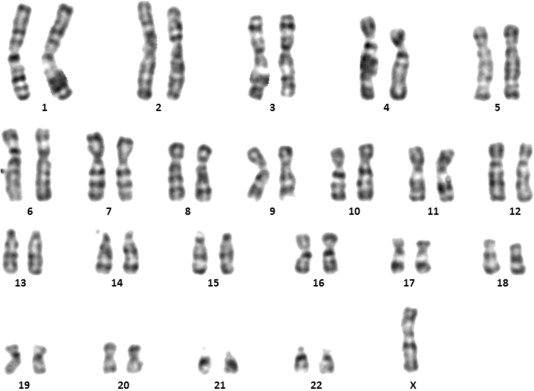
This is called Turners syndrome, can you notice the mutation in the chromosomes?
Both chromosomes 1 are bent
There are too many chromosomes
There are too many of chromosome 3
It is missing the second sex chromosome
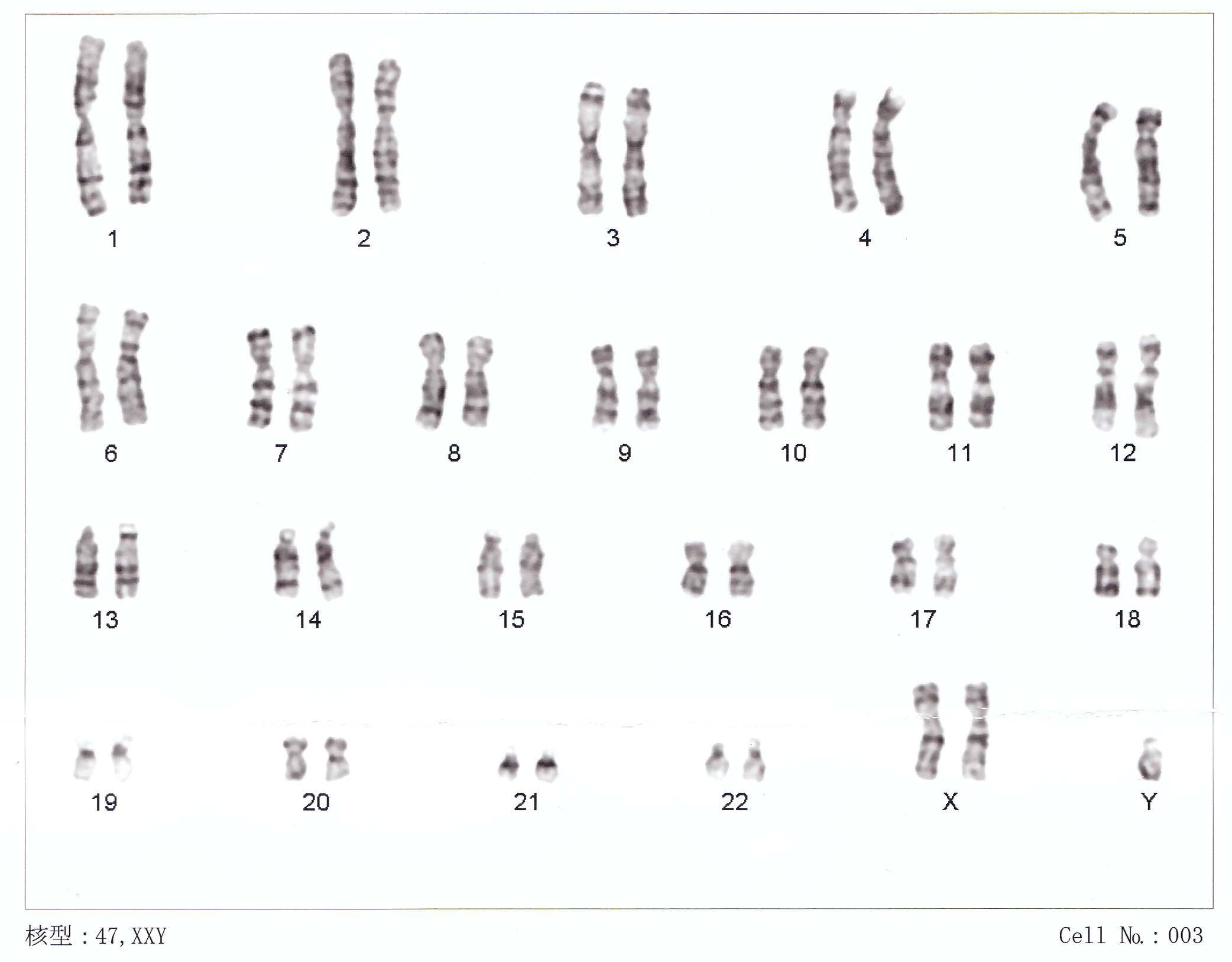
These are the chromosomes of someone with Kleinfelters syndrome. What is different about their chromosomes?
There is only one Y chromosome
One of the 5th chromosomes is too curved
There is an extra X chromosome
There are too few chromosomes
Passing traits from parents to their offspring
Genetics
Heredity
Punnett square
Monohybrid cross
The physical characteristics of an organism
Genotype
Heredity
Trait
Phenotype
Feature that a living thing can pass to its offspring
Trait
Phenotype
Genetics
Heredity
Two of the same dominant genes for one trait
Homozygous recessive
Heterozygous
Homozygous dominant
Two of the same recessive genes for one trait
Homozygous recessive
Heterozygous
Homozygous dominant
Study of heredity
Heredity
Genetics
Trait
Phenotype
Crossing involving one pair of contrasting traits
Monohybrid cross
Dihybrid cross
Trihybrid cross
A chart showing all of the possible gene combinations among the offspring of a genetic cross.
Trait
Monohybrid cross
Heredity
Punnett square
The genetic makeup of an organism
Genotype
Trait
Phenotype
Genetics
Two different genes for one trait
Homozygous recessive
Heterozygous
Homozygous dominant
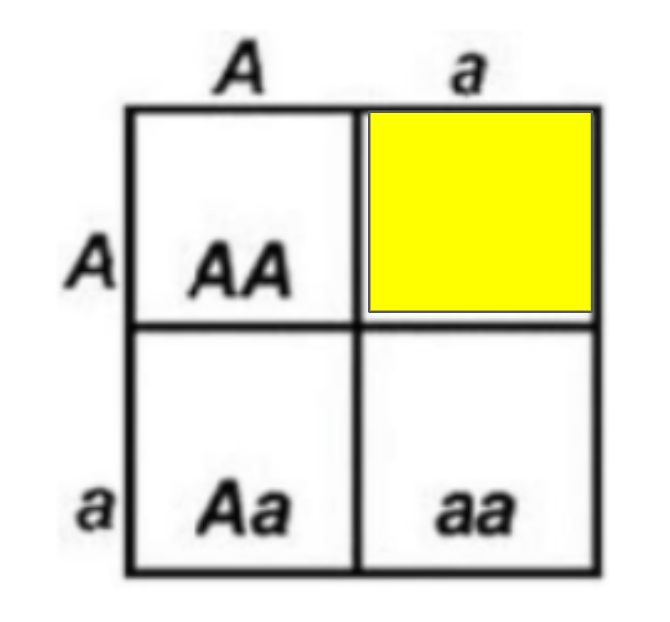
Fill in the Yellow Box
AA
Aa
aa
What is the probability that an offspring born from this cross will have a homozygous dominant genotype?
25%
50%
75%
100%
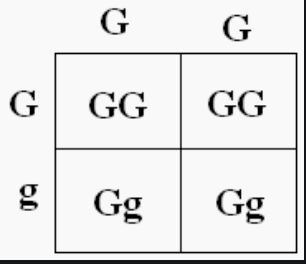
The punnett square is used to tell the color of a frogs skin. "G" means green skin and "g" means brown skin. What is the chance the baby frogs will have brown skin?
0%
25%
50%
100%
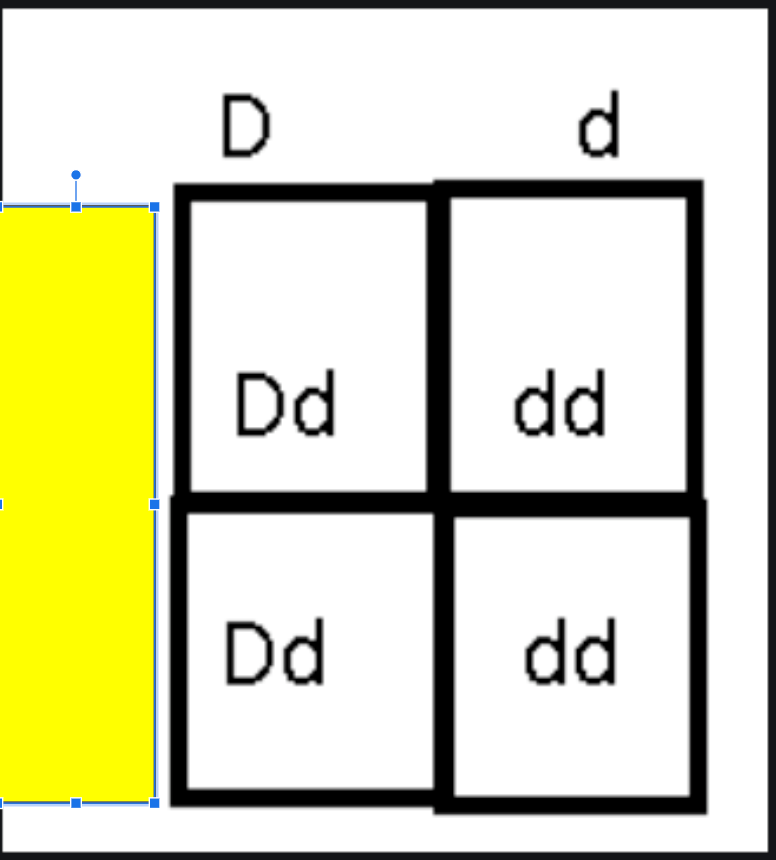
What is the mother's genotype?
DD
Dd
dd

Brown eyes are dominant over blue eyes. What is the probability that the offspring will have brown eyes in this cross?
25%
50%
75%
100%
TRANSCRIBE this DNA sequence: TACGTTACT
AUGCAAUGA
ATGCAATGA
AUGGATUGA
TACGTTACT
Which of the following are differences in the structure between RNA and DNA
DNA uses deoxyribose sugar, RNA uses sugar ribose
DNA pairs Adenine with Uracil, RNA pairs Adenine with Thymine
DNA is a double helix, RNA is a single helix
DNA pairs Adenine with Thymine, RNA pairs Adenine with Uracil