
 Worksheets
Electricity and Magnetism
Total questions: 41
Worksheet time: 1hrs 1mins
Protons have a ____________ charge and Electrons have a _______________ charge.
Positive, Positive
Positive, Negative
Negative, Positive
Negative, Negative

These magnets would....
Repel
Attract

What are the invisible lines called around this model?
Electric Field Lines
Magnetic Field Lines
Lettuce Seeds

As the magnets get farther apart, the strength of the fields get.....
Weaker
Stronger
Stay the same
If you cut a bar magnet in half, each half would...
lose it's magnetic field
have it's own north and south poles
repel plastic objects
if electrons transfer from a wool square to a pvc wand, the wool becomes ______________ and the wand becomes_____________.
Positive, Positive
Positive, Negative
Negative, Positive
Negative, Negative
Which statement is true about both magnetic and electric fields?
Like charges repel each other
Like charges attract each other
Like poles attract each other
If you have both the balloon and pvc wand with a build up of negative charges. How can you decrease the potential energy of the balloon?
Bring them closer together
Bring them farther apart
Rub both with wool more vigorous

The Affect of Electric fields surrounding particles become stronger the _______________ they are from each other.
Farther
Closer

Like charges in electric fields.....
Attract
Repel
Transfer Electrons

Opposite charges in electric fields....
Attract
Repel
Transfer Electrons
You can cause a permanent magnet to lose its magnetic field if
You forcefully vibrate the object, causing its domains to fall out of alignment.
By rubbing an iron object with a permanent magnet in the same direction repeatedly.
You freeze the object.
You connect the north and south poles of two magnets.
Magnetic fields are strongest
between the poles
at the north pole
at the south pole
at both poles

Looking at the field lines in this picture, these two magnets are ________
Attracting
Repelling
Attracting and Repelling
Doing nothing
Cameron and Morgan are each holding a bar magnet with opposite poles facing each other. They walk in opposite directions until they stop feeling their magnet pull towards the other one. What can they conclude about the distance between them when they stop feeling their magnets pull?
They are outside the magnetic field of their magnets.
The distance made the magnets' force stronger.
The magnetic fields are far enough apart to change direction.
The magnetic field was weaker when they were close.
A student claims that Earth has a magnetic field. Which evidence would best support the student's claim?
The student creates a working circuit that illuminates a bulb using wire and a battery.
The student turns in all directions with a compass and the needle always points north.
The student receives a shock after walking across the carpet and touching a doorknob.
The student rolls a ball down a large hill and the ball comes to a complete stop at the bottom
Ivan has a magnet and four different objects. He places the magnet near each of the objects and records whether each object attracts, repels, or has no reaction. Which question is Ivan's experiment designed to answer?
Which type of magnet will apply force on an object?
How can magnetic force affect an object's shape?
Which objects will respond to a magnetic force?
How does an object's gravity affect a magnet?
If Earth had twice the mass it has now, how would the gravitational force between it and the Sun change?
The gravitational force would be twice as much as it is now.
The gravitational force would be four times as much as it is now.
The gravitational force would be half as much as it is now.
The gravitational force would be the same as it is now.
If two charges attract to each other, then which of the following is true?
Both charges must be positive.
Both charges must be negative
Both charges must be different.
Both charges must be equal in value.
A magnet can hold a piece of paper to the door of a refrigerator. How does the magnet stick without touching the door?
Gravity attracts the magnet to the door.
The magnet induces a magnetic field in the paper.
The magnetic force of the magnet can act at a distance.
Atoms from the magnet pass through the paper and touch the door.

A student claims that the magnetic fields are not the same across the magnet. Using the picture, what evidence best supports the claim?
The magnetic fields of the magnet are strongest at both poles.
The magnetic fields of the magnet are strongest at the north pole.
The magnetic fields of the magnet are strongest at the south pole.
The magnetic fields of the magnet are strongest at the middle
What two forces are required for generators and electric motors to work?
magnetism and thermal
electricity and thermal
electricity and magnetism
magnetism and radiant
In a _______ a spinning turbine moves magnets which generates an electric current.
Motor
Generator
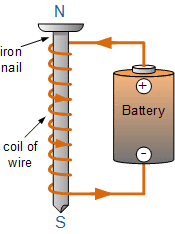
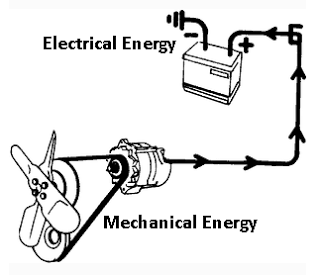
What is the transfer of energy when you plug in a motor and it spins?
chemical to mechanical
electrical to mechanical
mechanical to electrical
physical to potential
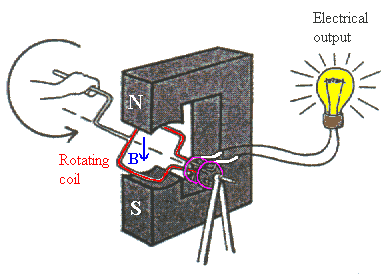
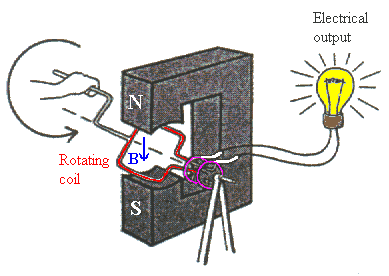
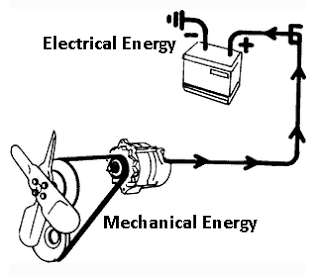
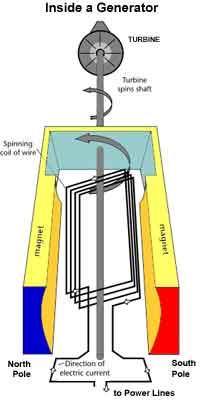
true or false- motors and generators are opposites
true
false
A generator is
a device that spins when exposed to wind
a device that conducts electrical current through a wire
a device that converts mechanical motion into electricity
When an electric current runs through a wire, a magnetic field is induced
under the wire
above the wire
around the wire
through the wire

