wayground logo

Free Printable Worksheets

Font size

S
M
L
XL
Worksheets

Relative & Absolute Dating

Total questions: 25

Worksheet time: 37mins
Name
Class
Date
1.
States that younger rocks lie above older rocks if the layers have not been disturbed
a)
Law of crosscutting
b)
Law of superposition
c)
Relative Dating
d)
Unconformity
2.
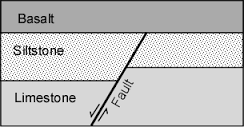
How does the law of crosscutting explain the age of a fault?
a)
The fault is younger than the rocks above it.
b)
The fault is younger than the rocks it cuts through.
c)
The fault is older than the rocks above it.
d)
The fault is older than the rocks it cuts through.
3.
What are the relative ages of the features in order from oldest to youngest?
a)
Limestone, Basalt, Fault, Siltstone
b)
Siltstone, Fault, Basalt, Limestone
c)
Limestone, Fault, Basalt, Siltstone
d)
Limestone, Siltstone, Fault, Basalt
4.
Which of the following is the oldest?
a)
Layer L
b)
Intrusion D
c)
Intrusion H
d)
Layer E
5.
Which of the following correctly lists the layers in order from oldest to youngest?
a)
A, B, C, D, E
b)
E, B, C, D, A
c)
E, D, C, B, A
d)
C, B, A, D, E
6.
Used to determine whether an object is older or younger than other objects
a)
Superposition
b)
Relative Dating
c)
Fossil
d)
Unconformity
7.
How does sedimentary rock usually form?
a)
Vertically
b)
Diagonally
c)
Folding
d)
Horizontally
8.
A break in the geologic record that is made when rock layers are eroded over a long period of time
a)
Law of Superposition
b)
Law of Crosscutting
c)
Relative Dating
d)
Unconformity
9.

Uses radioactive elements near the fossils to determine the actual age of the fossils.

a)

Relative Dating

b)

Absolute Dating

10.
How does absolute age differ from relative age?
a)
only absolute dating indicates which rock is older than another
b)
only absolute dating finds the age in years
c)
only relative dating finds the age in years
11.

Above what layer is there an unconformity?

a)

H

b)

M

c)

R

d)

F

12.
A is older than layer C
a)
TRUE
b)
FALSE
13.

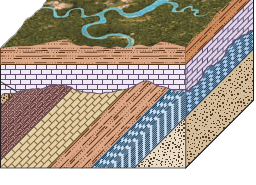
What type of unconformity is shown here?

a)

Non-conformity

b)

Disconformity

c)

Angular unconformity

14.

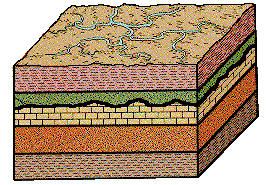
What type of unconformity is shown here?

a)

Non-conformity

b)

Disconformity

c)

Angular unconformity

15.

What is the correct order of the rock layers from oldest to youngest?

a)

F, E, C, B, A, D

b)

F, E, D, C, B, A

c)

A, B, C, D, E, F

d)

D, F, E, C, B, A

16.
The length of time required for half of the radioactive atoms in a sample to decay is its...
a)
era
b)
age
c)
half-life
d)
eon
17.
Radiometric dating is possible because the rates of decay of radioactive isotopes _____.
a)
change over time
b)
change from place to place
c)
are constant
d)
vary widely
18.
If the half-life of a radioactive group of atoms is 100 years, then how old is the rock if there have been two half-lives?
a)
25 years
b)
200 years
c)
400 years
d)
800 years
19.
The original element that undergoes radioactive decay is known as the...
a)
daughter element
b)
half-life
c)
parent element
d)
carbon-14
20.
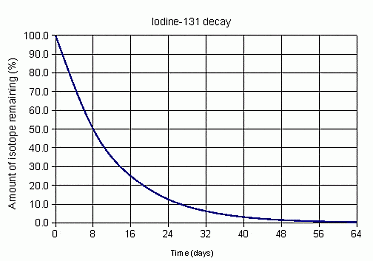
What is the half-life of iodine-131?
a)
32 days
b)
8 days
c)
16 days
d)
24 days
21.

The % of the parent isotope remaining after 2 Half Lives.

a)

50%

b)

25%

c)

12.5%

d)

6.25%

22.
An element that has broken down and released particles and energy is said to be _______________.
a)
radioactive
b)
subatomic
23.

The element that is the product of radioactive decay is known as the...

a)

daughter element

b)

half-life

c)

parent element

d)

carbon-14

24.
Radiometric dating is possible because the rates of decay of radioactive isotopes _____.
a)
change over time
b)
change from place to place
c)
are constant
d)
vary widely
25.

If the half-life of a radioactive group of atoms is 300 years, then how old is the rock if there have been three half-lives?

a)

37.5 years

b)

100 years

c)

600 years

d)

900 years