
 Worksheets
Lenses and Mirrors
Total questions: 21
Worksheet time: 1hrs 3mins


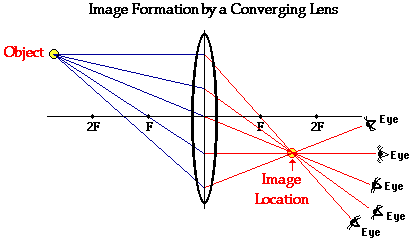

The concave spherical mirror of radius r shown above has focal point F and center of curvature C. An object is placed at a distance 2r from the mirror. Where will the image be formed?
Between C and the object
To the right of the object
Between F and the mirror
To the left of the mirror
Between F and C
A physics student places an object 6.0 cm from a converging lens of focal length 9.0 cm. What is the magnitude of the magnification of the image produced?
0.6
2.0
3.6
3.0
1.5
An object is placed in front of a converging thin lens at a distance from the center of the lens equal to half the focal length. Compared to the object, the image is
upright and smaller
inverted and smaller
upright and larger
inverted and the same size
inverted and larger

A group of students collected data using a lens. They varied the distance so of an object from the lens and measured the image distance si. The figure above is their graph of the inverse of the image distance as a function of the inverse of the object distance. The focal length of the lens is approximately
2.0 m
1.0
4.0
1.5

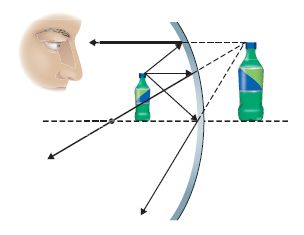
Which of the rays shown above is correct for this diverging mirror?
1
2
3
4

A student uses a convex lens to create images and collects the data shown above. The focal length of the lens is in which of the following ranges?
0–5 cm
5-10 cm
10-15 cm
15-25 cm

This image is
real.
virtual.

A student is conducting an experiment with four different types of mirrors. Which mirror in the experiment is a convex mirror?
mirror 1
mirror 2
mirror 3
mirror 4
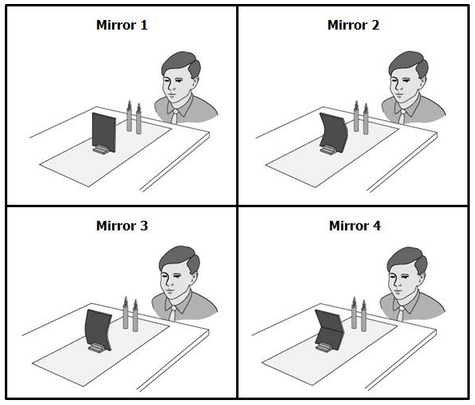
A student is conducting an experiment with four different types of mirrors. Which mirror in the experiment converges light and UP CLOSE, produces an upright, magnified image of the candles? (hint: no two mirrors are the same)
mirror 1
mirror 2
mirror 3
mirror 4
Which lens represents the path light takes through a diverging lens?


A student draws three rays of light from point P through a converging lens. Each point labelled F is a principal focus of the lens. Which of the rays are drawn correctly?
ray Y only
ray Z only
ray X and ray Y
ray X and ray Z
A shopkeeper wants to keep an eye on his store in order to prevent shoplifting. What could the shopkeeper hang on the wall in order to see a wider image of his store and his customers?
a convex mirror
a concave mirror
a convex lens
a concave lens
A dentist uses a small dental mirror to help magnify teeth in your mouth. What type of mirror is this?
a convex mirror
a concave mirror
a convex lens
a concave lens

If an object's distance from a convex lens were increased, the image would become which of the following?
Same size
Magnified
Diminished
Magnified and diminished
The principle on which mirrors work is
Refraction.
Polarization.
Dispersion.
Reflection.
The process of blending of light as it passes from air into glass and vice versa is called
Reflection of light.
Deflection of light.
Defraction of light.
Refraction of light.

