wayground logo

Free Printable Worksheets

NEW

Font size

S
M
L
XL
Worksheets

Natural Selection (7)

Total questions: 25

Worksheet time: 43mins

Name
Class
Date
1.

The phrase "Survival of the Fittest" would best describe

a)

Natural Selection

b)

Artificial Selection

c)

Selective Breeding

d)

None of the Above

2.

Which is not true about natural selection?

a)

There must be diversity in the population.

b)

It is driven by natural processes like predators or weather conditions.

c)

Humans are involved and can select the most desirable organisms.

d)

Predators, geological activity, and weather can all have an impact on organisms.

3.

What is one problem with artificial selection?

a)

It takes thousands of years.

b)

It removes diversity and bad traits can surface.

c)

It promotes biodiversity of the species.

d)

It can only happen once a year.

4.

Children that inherit traits from their parents are called

a)

Offspring

b)

Babies

c)

Species

d)

Biodiversity

5.

Humans play a role in artificial selection.

a)

True

b)

False

6.

_____________ is a trait or behavior that happens over time that helps an organism survive and function better in their environment.

a)

Offspring

b)

Diversity

c)

Adaptation

d)

Mutation

7.

Artificial Selection relies on diversity in population, so the fittest members will survive.

a)

True

b)

False

8.

Both natural selection and artificial selection create change in plants and animals.

a)

True

b)

False

9.

The term "survival of the fittest" refers to

a)

Artificial Selection

b)

Selective Breeding

c)

Diversity

d)

Natural Selection

10.
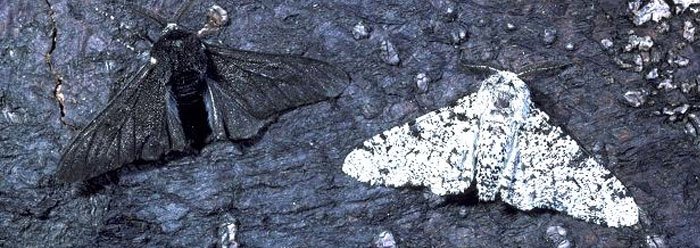
The trees these moths used to live on were white, but have been covered in soot from coal factories. Which moth will be more successful in this environment?
a)
Dark moth
b)
Light moth
c)
Both will be equally successful
d)
Neither will be successful
11.
Since the 1800s humans have stopped burning coal, and the trees have returned to their original color. Which moth will be more successful in this environment?
a)
Dark moth
b)
Light moth
c)
Both will be equally successful
d)
Neither will be successful
12.

Natural selection is where ___________ decide(s) which traits should be passed on

a)

Animals

b)

Humans

c)

Nature

d)

All of the above

13.

In a situation where shrubs and lower leaves on trees disappeared and both long neck and short neck giraffes depended on this for a food resource - would the short neck giraffes grow longer necks to adapt?

a)

Yes, that's the only way they can survive.

b)

No, more than likely they will die out because organisms can't change their traits.

c)

Yes, the short neck giraffe would be able to stretch to reach higher places and over time pass that on to it's offspring.

d)

No, the short neck giraffe would just have the long neck giraffe get leaves from higher places for them.

14.

Which of the following is true about Natural Selection?

a)

It takes place over a relatively short period of time.

b)

Humans have a decision in the outcome of the offspring.

c)

The process happens due to environmental activity.

d)

Organisms are able to quickly adapt to the changes in their environment.

15.

Which of the following is true about Selective Breeding?

a)

It can also be called Artificial Selection

b)

It can have negative impacts on the species and biodiversity.

c)

It takes place over a relatively short period of time.

d)

All of the above are true.

16.
How do adaptations help animals?
a)
to hide from predators
b)
to hunt for food
c)
to survive in their habitats
d)
All of these are correct
17.
An animal's color or pattern that helps it blend into its surroundings
a)
Environment 
b)
Mimicry
c)
Camouflage
d)
Habitat
18.
A scientist puts 100 houseflies in a sealed container; then sprays an insecticide into the container.  Ninety-six of the flies die.  Four survive.  The scientist lets the survivors mate and produce offspring, then repeats the experiment with 100 offspring.  Fifty-six of them survive the spray.  This experimental result is evidence of – 
a)

artificial selection

b)

selective breeding

c)
natural selection
19.
Which statement does not accurately describe natural selection?
a)
Individual organisms change their genes to adapt to their environment
b)
The genetic composition of a population changes from one generation to the next
c)
More advantageous traits become more common in population
d)
Beneficial and useful traits are inheritable
20.
Survival of the Fittest and Evolution were proposed by what scientist?
a)
Steven Hawking
b)
Albert Einstein
c)
Charles Darwin
d)
Isaac Newton
21.
Predict which moth would increase in population
a)
light 
b)
dark
22.
Why are advantageous traits more likely to be passed onto offspring?
a)
Because they are more likely to survive and reproduce.
b)
Because they come from dominant alleles.
c)
Because they come from recessive alleles.
d)
Because the trait is an acquired phenotype.
23.
Do organisms "decide" to evolve and change?
a)
Yes, they know they need to change to survive 
b)
No, they change because of natural selection
24.
Why did the population of peppered moths in England change from light to dark after the Industrial Revolution?
a)
Light moths were easy to see against sooty trees and were eaten
b)
Light moths were killed by soot
c)
The birds that ate the dark moths were killed by soot
d)
Dark moths were produced by industrial processes
25.
The example of the peppered (brown) moths living near English industrial cities demonstrates that
a)
A change in an environment can result in the evolution of species living there
b)
Evolution occurs so slowly that is it not possible to determine that it has happened in less than a million years
c)
The environment near these cities has always favored dark colored moths