
 Worksheets
AP Vietnam to Reagan
Total questions: 45
Worksheet time: 25mins
LBJ's plan for increased domestic spending on anti-poverty & anti-racism programs
New Deal
New Frontier
Great Society
Welfare for All
Southern Strategy
Which of the following was NOT a factor in the rise of conservatism before 1980?
Backlash against the counterculture
Backlash against the Civil Rights Movement
Backlash against the Rights Revolution
Backlash against the hawks of the Vietnam era
What effect did the Pentagon Papers have on society?
It increased the Credibility Gap(distrust in the government)
It exposed government corruption
It increased the pressure on Nixon to resign
It created the public know about government plans
Which of the following lead to Carter's downfall as a president?
Stagflation
Watergate
Iran-Contra
Bay of Pigs
By "any means necessary". Malcom X was advocating the possible use of which of the following?
The initiatives of LBJ his Great Society were most similar to the goals of which President?
Lincoln
Wilson
Franklin Roosevelt
Ronald Reagn
The overall strategy of the US during the Cold War
Truman Doctrine
Containment
Marshall Plan
Domino Theory
“…Why is it acceptable for women to be secretaries, librarians, and teachers, but totally
unacceptable for them to be managers, administrators, doctors, lawyers, and Members of
Congress? The unspoken assumption is that women are different. They do not have executive
ability, orderly minds, stability, leadership skills, and they are too emotional. It has been
observed before, that society for a long time discriminated against another minority, the blacks,
on the same basis—that they were different and inferior. … the truth is that in the political world
I have been far oftener discriminated against because I am a woman than because I am
black…laws will not change such deep-seated problems overnight But they can be used to
provide protection for those who are most abused, and to begin the process of evolutionary
change … I wish to introduce today a proposal …the equal rights amendment.”
--Shirley Chisolm, Address to the U.S. House of Representatives, Washington, D.C., 1969
Which of the following was a significant effect of passage of the Equal Rights Amendment by the House and Senate?
the establishment of the National Women’s Party
the construction of restrooms that were open to people of either gender
the mounting of a grassroots campaign that successfully prevented its ratification by the states
the addition of potential women soldiers to the military draft pool
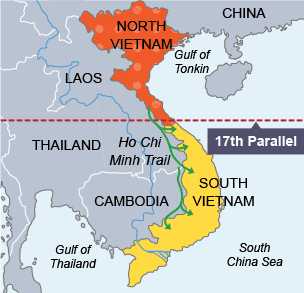
“In January I could only conclude that the precipitate withdrawal of American forces from
Vietnam would be a disaster not only for South Vietnam but for the United States and for the
cause of peace…A nation cannot remain great if it betrays its allies and lets down its friends …
Let me briefly explain what has been described as the Nixon doctrine—a policy which not only
will help end the war in Vietnam but which is an essential element of our program to prevent
future Vietnams…in cases involving other types of aggression, we shall furnish military and
economic assistance when requested in accordance with our treaty commitments. But we shall
look to the nation directly threatened to assume the primary responsibility of providing the
manpower for its defense…In the previous administration we Americanized the war in Vietnam.
In this administration we are Vietnamizing the search for peace…”
--Richard Nixon, Address to the Nation on the War in Vietnam, 1969
Which of the following developments supported Nixon’s Vietnamization policy?
The Nixon administration greatly reduced the bombing of North Vietnam.
The Nixon administration stopped bombing North Vietnamese supply routes in Cambodia.
The United States removed advisors and stopped aid to South Vietnam.
The number of American combat troops sent to Vietnam was decreased.
“In January I could only conclude that the precipitate withdrawal of American forces from
Vietnam would be a disaster not only for South Vietnam but for the United States and for the
cause of peace…A nation cannot remain great if it betrays its allies and lets down its friends …
Let me briefly explain what has been described as the Nixon doctrine—a policy which not only
will help end the war in Vietnam but which is an essential element of our program to prevent
future Vietnams…in cases involving other types of aggression, we shall furnish military and
economic assistance when requested in accordance with our treaty commitments. But we shall
look to the nation directly threatened to assume the primary responsibility of providing the
manpower for its defense…In the previous administration we Americanized the war in Vietnam.
In this administration we are Vietnamizing the search for peace…”
--Richard Nixon, Address to the Nation on the War in Vietnam, 1969
The excerpt from Nixon’s address on Vietnamization most directly reflects which of the following?
the belief that America could not win in Vietnam without the use of nuclear weapons
the difference between Nixon’s practical politics and hardline hawks’ ideologically-based
views
the division between the pro-war and antiwar elements in American society
the belief that the United States needed to force the South Vietnamese to assume responsibility for their own defense

One significant result of the Voting Rights Act was
increased integration of educational institutions in the South.
the acceleration of the migration of African Americans to industrial cities in the North.
the expansion of federal power through the Department of Justice, which was authorized to monitor voting activity.
the decrease in white voting throughout the South.
“…I found myself obliged by conscience … to take a public stand against my country’s war in
Vietnam… when I first made public my opposition to my government’s policy, many persons
have questioned me about the wisdom of my decision. “Why you?” they have said. “Peace and
civil rights don’t mix. Aren’t you hurting the cause of your people?”… There is at the outset a
very obvious and almost facile connection between the war in Vietnam and the struggle I and
others have been waging in America. A few years ago there was a shining moment in that
struggle. It seemed as if there was a real promise of hope for the poor, both black and white,
through the poverty program… Then came the buildup in Vietnam, and I watched the program
broken and eviscerated as if it were some idle political plaything of a society gone mad on
war…”
--Martin Luther King, Jr., “Conscience and the Vietnam War,” 1967
According to King, how did many Americans respond to his increasing criticism of the war in Vietnam?
They thought he was actively working to strengthen the United States’s moral leadership.
They questioned his right to criticize the war.
They embraced his action and gave new support to the civil rights movement.
They believed he was out of step with younger civil rights leaders.
“…I found myself obliged by conscience … to take a public stand against my country’s war in
Vietnam… when I first made public my opposition to my government’s policy, many persons
have questioned me about the wisdom of my decision. “Why you?” they have said. “Peace and
civil rights don’t mix. Aren’t you hurting the cause of your people?”… There is at the outset a
very obvious and almost facile connection between the war in Vietnam and the struggle I and
others have been waging in America. A few years ago there was a shining moment in that
struggle. It seemed as if there was a real promise of hope for the poor, both black and white,
through the poverty program… Then came the buildup in Vietnam, and I watched the program
broken and eviscerated as if it were some idle political plaything of a society gone mad on
war…”
--Martin Luther King, Jr., “Conscience and the Vietnam War,” 1967
In this excerpt, King’s denunciation of American involvement in Vietnam has the most in common with which of the following?
the belief that the U.S. must act to contain the global spread of Communism
the perception that Vietnam was not a winnable war
the idea that American involvement overseas was interfering with Johnson’s Great Society
Ho Chi Minh’s assertions of the principles inherent in the Declaration of Independence
“We affirm the philosophical or religious ideal of nonviolence as the foundation of our purpose,
the presupposition of our faith, and the manner of our action. Nonviolence as it grows from
Judaic-Christian tradition seeks a social order of justice permeated by love. Integration of human
endeavor represents the crucial first step toward such a society. Through nonviolence, courage
displaces fear; love transforms hate. Acceptance dissipates prejudice; hope ends despair. Peace
dominates war; faith reconciles doubt. …The redemptive community supersedes systems of
gross social immorality. Love is the central motif of nonviolence. Love is the force by which
God binds man to Himself and man to man. Such love goes to the extreme; it remains loving and
forgiving even in the midst of hostility… By appealing to conscience and standing on the moral
nature of human existence, nonviolence nurtures the atmosphere in which reconciliation and
justice become actual possibilities.”
--“Statement Submitted by the Student Non-violent Coordinating Committee to the Platform
Committee of the National Democratic Convention, June 7, 1960, Los Angeles, CA,” 1960
The sentiments expressed in the excerpt highlight the:
tensions between college-educated civil rights workers and those in the rank-and-file.
tensions between older civil rights leaders and the movement’s more impatient younger participants.
tensions between whites and blacks in the civil rights movement.
the influence of Martin Luther King’s philosophy in the early 1960s.
“‘All men are created equal. They are endowed by their Creator with certain inalienable rights;
among these are Life, Liberty, and the pursuit of Happiness.’ This immortal statement was made
in the Declaration of Independence of the United States of America in 1776… the French
imperialists, abusing the standard of Liberty, Equality, and Fraternity, have violated our
Fatherland and oppressed our fellow-citizens. They have acted contrary to the ideals of humanity
and justice. In the field of politics, they have deprived our people of every democratic liberty.
…We are convinced that the Allied nations which at Tehran and San Francisco have
acknowledged the principles of self-determination and equality of nations, will not refuse to
acknowledge the independence of Vietnam…For these reasons, we, members of the Provisional
Government of the Democratic Republic of Vietnam, solemnly declare to the world that Vietnam
has the right to be a free and independent country…”
--Ho Chi Minh , speech in Ba Dinh Square, Hanoi, Vietnam, 1945
Which of the following best reflects Ho Chi Minh’s assessment of Vietnam’s right to exist as
an independent nation?
The French had forfeited their right to Vietnam because of mismanagement before the outbreak of World War II.
The American Declaration of Independence outlined fundamental rights of self- determination.
The Vietnamese people had achieved the right because of their fight against the Japanese and their protection of the French.
Vietnam could decide on its status after free elections were held.
The court case that ended segregation in public schools
Brown v. Board
Plessy v. Ferguson
Miranda v. Arizona
Engel v. Vitale
Tinker v. DesMoines
The Civil Rights process of registering black voters in Mississippi in 1964.
Freedom Summer
Freedom Rides
Sit-Ins
March on Selma
This Civil Rights Legislation outlawed Housing Segregation
Civil Rights Act of 1964
Civil Rights Act of 1968
Civil Rights Act of 1965
Civil Rights Act of 1967

•Conservative activist •Founder of Eagle Forum – opposes modern feminism •Campaigned against Equal Rights Amendment

•Arrested for refusing to give up her seat on a bus to a white person
•Her actions led to Montgomery Bus Boycott (1955-56) which led to integrated buses and thrust her into the national spotlight

•Leader in Women’s Liberation Movement •Helped form NOW (National Organization of Women) •Became central voice of Women’s Movement •Wrote The Feminine Mystique, a book that challenged the traditional role of women
•Clergyman, activist & leader in the Civil Rights Movement •Used nonviolent civil disobedience (influenced by Gandhi) •Montgomery Bus Boycott (1955) •Letter from Birmingham Jail (1963) •March on Washington (1963)


__________ occurs in the economy when unemployment and inflation are both high.
Hyperinflation
Disinflation
Deflation
Stagflation
Which of these is NOT a reason the US got involved in Iran in 1953?
US was allies of the British
US was allies of the Soviet Union
Nationalizing oil is a socialist move, and the coup was during the Cold War
The Shah was a firm ally of the United Staes
A political organization established by evangelist Jerry Falwell in 1979 to mobilize conservative Christian voters on behalf of Ronald Reagan’s campaign for president.
Moral Majority
Family Values
Religious Right
Evangelical Christian Republicans
What did Title XI (9) ban?
gender discrimination in the work place
gender discrimination in higher education
racial discrimination in higher education
racial discrimination in the work place
What did Roe vs. Wade establish?
voting rights for all 18 year olds
schools must be de-segregated
illegal immigrants have voting rights
women could legally have an abortion

Which of these is NOT a core principal of conservatism in the 1960s and 1970s
Cutting taxes on the Wealthy
Deregulating Business
A belief America looked weak internationally
Progressive views on Integration and women's rights

