Wayground logo

Free Printable Worksheets

Font size

S
M
L
XL
Worksheets

Ecology Check In

Total questions: 25

Worksheet time: 26mins

Name
Class
Date
1.
What are the traits that make an organism better to survive in its environment called?
a)
adaptations
b)
evolution
c)
niche
d)
population
2.

What do the arrows in the diagram represent?

a)

flow of energy

b)

life cycle stages

c)

ecological succession

d)

renewable resource deletion

3.

grass --> grasshopper --> sparrow --> hawk

In the food chain above, which organism would be found on level B of the energy pyramid shown?

a)

grass

b)

grasshopper

c)

sparrow

d)

hawk

4.

What is the correct order for this food chain?

a)

Owl, Mouse, Grasshopper, Grass

b)

Grass, Mouse, Owl, Grasshopper

c)

Grass, Owl, Grasshopper, Mouse

d)

Grass, Grasshopper, Mouse, Owl

5.

What do herbivores eat?

a)

Animals

b)

Plants and Animals

c)

Plants

d)

Dead Animals

6.

What do omnivores eat?

a)

Animals

b)

Plants and Animals

c)

Plants

d)

Dead Animals

7.

How much energy is transferred between trophic levels?

a)

25%

b)

20%

c)

10%

d)

90%

8.

All of the biotic and abiotic factors.

a)

community

b)

ecosystem

c)

population

9.

Members of a species in a certain area

a)
Ecosystem
b)
community
c)
biodiversity
d)
population
10.
What may happen if the snowshoe hare was removed from the food web pictured?
a)
The insects in the habitat would increase.
b)
The shrew population would decrease due to being only hawk food source.
c)
The willow tree population would decrease.
d)
Foxes would dies due to no food source. 
11.
If the number of births in a population is the same as the number of deaths in a population, what will happen to the growth of the population?
a)
It will increase.
b)
It will decrease.
c)
It will stay the same.
d)
It will fluctuate.
12.
Largest number of individuals of a population that the environment can support...  
a)
carrying capacity
b)
population crash
c)
lag phase
d)
mutualism
13.
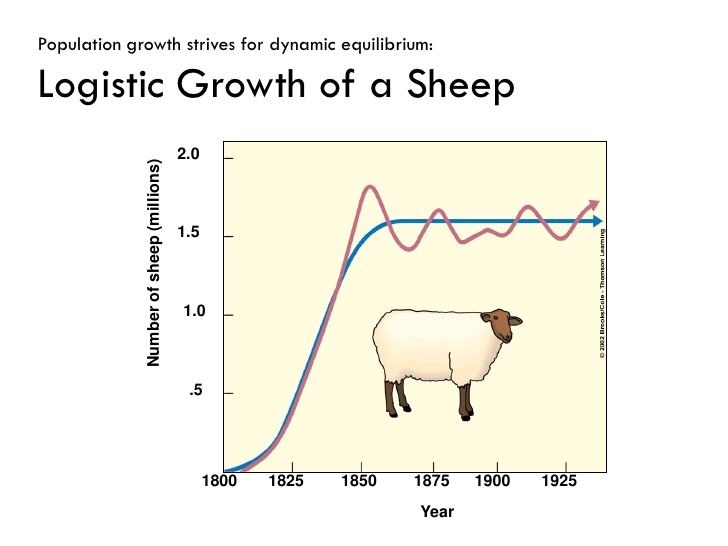
What is the carrying capacity for this sheep population?
a)
1.8 million
b)
1.25 million
c)
1.6 million
d)
1.o million
14.
When a population grows past the ecosystem's carrying capacity, what happens to the population?
a)
Continues to grow
b)
The population starts to die off to return to carrying capcity
c)
The population will go extinct due to lack of resources
d)
The population grows then finds a new carrying capacity
15.
Food, water, sunlight, shelter, and space are resources that are often __________.
a)
limiting factors
b)
wet
c)
messy
d)
found in rocks
16.
Any thing or organism that regulates the size of a population of another organism is known as __________.
a)
a limiting measure
b)
a limiting factor
c)
factorization
d)
materialization of precipitation
17.
Which kind of growth does the human population follow? It is described as a J-shaped curve.
a)
Exponential Growth
b)
Logistic Growth
c)
Outstanding Growth
d)
Minimal Growth
18.
What type of growth is represented behind?
a)
exponential
b)
logistics
c)
a good kind
d)
representative
19.

Which of the following are density dependent factors? (there are 3!)

a)

competition for resources

b)

predation

c)

disease

d)

natural disasters

20.

Which of the following are examples of a density independent factors? (there are 3!)

a)

forest fire

b)

seasonal cycles

c)

storms

d)

disease

21.

This graph shows ....

a)

When one population increases, the other decreases.

b)

When one population decreases, the other increases.

c)

When one population increases, the other increases instantly.

d)

When one population increases, it causes the other to increases shortly after.

22.
What factor describes when populations increase because animals are moving into a population?
a)
Emigration
b)
Limiting Factors
c)
Immigration
d)
Exponential Growth
23.
What factor describes when populations decrease because animals are moving out of a population?
a)
Emigration
b)
Limiting Factors
c)
Immigration
d)
Exponential Growth
24.
What would most likely happen if an ecosystem no longer received sunlight?
a)
The number of herbivores would increase
b)
The number of plants would increase
c)
all organisms would adapt
d)
All living organisms would eventually die
25.
If there is 1000 Kcal available in the producers in trophic level 1, how much energy is available in the herbivores in trophic level 2?
a)
10 Kcal
b)
1 Kcal
c)
100 Kcal
d)
1000 Kcal