
Font size
 Worksheets
Heating & Cooling Curves
Total questions: 33
Worksheet time: 48mins


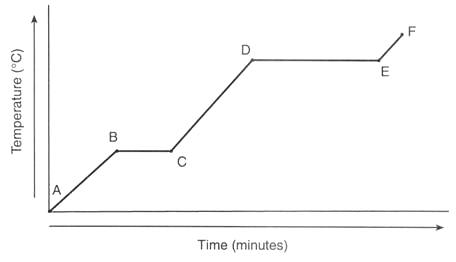

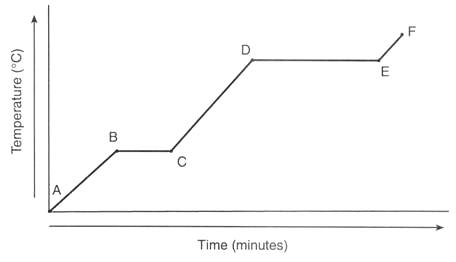


Which equation do you use to solve for the energy of segment D-E?
q= mCΔT
q= Hv*m
PV=nRT
q= Hf*m

Which equation do you use to solve for segment B-C?
q=mCΔT
q= Hv*m
q= Hf*m
PV=nRT

The energy of which segments can be found using the equation q=mCΔT?
A-B, D-E, E-F
B-C, D-E ,E-F
B-C, C-D, E-F
A-B, C-D, E-F

Which equation do you use to solve for the energy of segment C-D?
q=mCΔT
q= Hv*m
q= Hf*m
PV=nRT
Which equation would you use to solve the following: Calculate the heat necessary to change 10 g of ice(s) at 0°C to 10 g of water(l) at 0°C.
q=mCΔT
q= Hv*m
q= Hf*m
PV=nRT
Which equation would you use to solve the following: Calculate the heat necessary to change 10 g of H2O(l) at 0 °C to 10 g of H2O(l) at 100°C.
q=mCΔT
q=Hv*m
q= Hf*m
PV=nRT
What equation would you use to solve the following:
How much heat is absorbed by 20g granite boulder as energy from the sun causes its temperature to change from 10°C to 29°C?
q=mCΔT
q=Hv*m
q= Hf*m
PV=nRT
What equation would you use to solve the following:
Calculate the heat necessary to change 10 g of H2O(l) at 100°C to 10 g of H2O(g) at 100°C.
q=mCΔT
q=Hv*m
q=Hf*m
PV=nRT

The melting point of the sample is
-60 ºC
20 ºC
60 ºC
100 ºC

Which letter indicates where water is in both the solid and liquid phase at the same time?
A
B
C
D
E
A measure of the average kinetic energy of the particles in an object is called
Heat
Temperature
Kinetic energy
Enthalpy

In which region(s) does temperature increase?
Region C only
Regions B and D
Regions A, C, and E
Regions A and B

In which region(s) of the heating curve would water be a liquid and a gas at the same time?
A
B
C
D
E
In a heating curve, diagonal lines indicate temperature is __________, while flat lines indicate temperature is __________.
Constant, changing
Changing, constant

NaCl was heated starting at an initial temperature of 0°C. The heating curve is shown in the picture. What is the melting point of this substance?
0°C
801°C
1000°C
1465°C
If 20 g of water undergoes a temperature change from 25° C to 30° C, how much heat energy moves from the surroundings into the water?
Cw= 4.18 J/(g°C)
418 J
209 J
83 J
4.18 J
If you are melting 10 grams of ice that has been stored at -20 °C, what amount of heat must the water absorb to make the water drinkable at 5 °C. (Cice= 2.03 J/(g°C); Cw= 4.18 J/(g°C); ΔHfus= 334 J/g)
406 J
6670 J
209 J
7284 J
1045 J

The graph represents the temperature of a substance while it is cooled.
At what interval is the substance a liquid and a solid?
AB
BC
CD
DE
EF
The graph represents the temperature of a substance while it is cooled.
At what interval(s) is the internal kinetic energy decreasing?
AB
BC
CD
DE
EF
The graph represents the temperature of a substance while it is cooled.
At what interval(s) is the internal potential energy decreasing?
AB
BC
CD
DE
The graph represents the temperature of a substance while it is cooled.
At what temperature did condensation took place?
200 °C
150 °C
100 °C
20 °C
What equation would you use to solve the following:
Calculate the heat necessary to change 10 g of H2O(l) at 100°C to 10 g of H2O(g) at 100°C.
q=mCΔT
q=Hv*m
q=Hf*m
PV=nRT

