
 Worksheets
Unit 10 Equilibrium Practice - Chemistry
Total questions: 71
Worksheet time: 2hrs 34mins

At what time (in seconds) is equilibrium established?
0 seconds
1 second
5 seconds
10 seconds
2 NO(g) + O2(g) ⇌ 2 NO2(g)
When the following reaction reached equilibrium,
SO2 (g) + NO2 (g) <=> SO3 (g) + NO (g)
it was found to contain:
0.40 M SO3 , and 0.30 M NO,
0.15 M NO2 , and 0.20 M SO2.
Calculate the equilibrium constant for this reaction.
4.0
0.42
0.25
1.0
Which is true for a system at equilibrium?
Forward reaction rate is faster than the reverse and concentrations are equal
Forward and reverse reaction rates are equal and concentrations are constant
Forward and reverse reaction rates are equal and concentrations are equal
Forward reaction rate is faster than the reverse and concentrations are constant
What is the correct equilibrium expression for the following reaction:
2H2O2 (aq) ↔ 2H2O (l) + O2 (g)
[H2O]2[O2] / [H2O2]2
[H2O2]2 / [H2O]2[O2]
[O2] / [H2O2]2
[H2O]2 / [H2O2]2

When the system X + 2 Y ↔ Z has reached equilibrium, which of the following is TRUE?


What is the equilibrium expression for: Fe3O4(s) + 4H2(g) ↔ 3Fe(s) + 4H2O(g) Kc =

2SO2(g)+O2(g) ↔ 2SO3(g)
Removing O2(g) will
shift equilibrium right
shift equilibrium left
increase pressure
have no change
2SO2(g)+O2(g) ↔ 2SO3(g) Increasing volume of container will
2SO2(g) + O2(g) ↔ 2SO3(g) Decreasing volume of container will
2SO2(g) + O2(g) ↔ 2SO3(g) Using a catalyst
2SO2(g) + O2(g) ↔ 2SO3(g) + Heat
Increasing the temperature will...
shift equilibrium right
shift equilibrium left
increase pressure
have no change

CoCI42- +6H2O ↔ Co(H2O)62+ + 4CI-.
What would happen when H2O is added?
Position of equilibrium will shift to left (and become more blue)
Position of equilibrium will shift to right (and become more pink)
Keq will increase as H2O is added
Position of equilibrium will shift to left to reduce the added H2O
N2(g) + 3H2(g) ↔ 2NH3(g)
When the pressure on the system is increased, the equilibrium position shifts to the right. Why?
To increase the amount of products
To reduce the pressure, as the right side has fewer molecules of gas
Keq will increase when it is shifted to the right
To increase the pressure, as the right side has more molecules of gas
CoCI42- +6H2O ↔ Co(H2O)62+ + 4CI-
What will happen when CI- ions are added?
Position of equilibrium will shift to left and become more pink
Color of system will turn to all pink
Concentration of reactants and products remain unchanged
Position of equilibrium will shift to left to reduce the added CI- ions
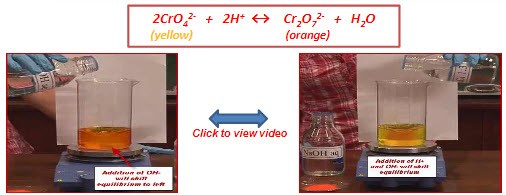
2CrO42- + 2H+ ↔ Cr2O72- + H2O
What will happen when H+ ions are added to the system?
Position of equilibrium will shift to left and become more yellow
Color of system will turn all yellow
Color of system will turn all orange
Equilibrium will shift to right and become more orange

Heat + 1 N2O4 ↔ 2 NO2
What will happen when the temperature is increased?
Position of equilibrium will shift to left and become lighter in color
Position of equilibrium will shift to right and become more brown
No change in position of equilibrium
Position of equilibrium will shift to right and become lighter in color

CoCI42- +6H2O ↔ Co(H2O)62+ + 4CI- + Heat
What will happen when the temperature is increased?
Position of equilibrium will shift to left and become more blue
Position of equilibrium will shift to right and become more pink
No change in position of equilibrium
Position of equilibrium will shift to left and become more pink
inhibitor
Smaller particle size allows for a _________ surface area to be exposed for the reaction.
larger
smaller
rectangular
spherical
Increasing the ____ causes the particles (atoms
or molecules) of the reactants to move more quickly so that
they collide with each other more frequently and with more
energy.
Catalyst
Surface Area
Temperature
Concentration
________ is the measure of how much area of an
object is exposed.
Surface Area
Catalyst
Temperature
Concentration
Grains of sugar have a greater _______ than a solid cube of
sugar of the same mass, and therefore will dissolve quicker in water.
Surface Area
Catalyst
Temperature
Concentratrion
Pick the TWO (2) options that will INCREASE the rate of a reaction.
Reducing Heat
Adding Catalyst
Adding Heat
Removing Catalyst
Which of the following will lower the rate
of reaction?
adding an enzyme to the reaction
decreasing the temperature from 40°C to
10°C
breaking a chunk of calcium up into
smaller pieces
increasing the amount of solute
dissolved in a solution
Which factors affect the rate of a reaction? (select all that apply)
temperature
concentration
size
pressure
catalyst
Increase in temperature causes the particles to
slow down
move faster
stay apart from each other
move in the correct order
Why does a higher concentration increase the rate of reaction?
it increases the amount of reactants
it lowers the activation energy
it increases the energy of reactant particles
it increases the frequency of collision
Why does a higher temperature increase the rate of a reaction?
It increases both the frequency collision and energy of reactant particles
It only increases the frequency of collision
It only increases the energy of reactant particles
It reduces the activation energy of the reaction
Grinding an effervescent tablet into powder increases the rate of reaction due to increase of
concentration
total surface area
temperature
size
Increasing pressure causes the reacting particles
to bond together
to repel from each other
gain more kinetic energy
to move closer together
Increasing the temperature gives particles more __________.
time
energy
space
frequency
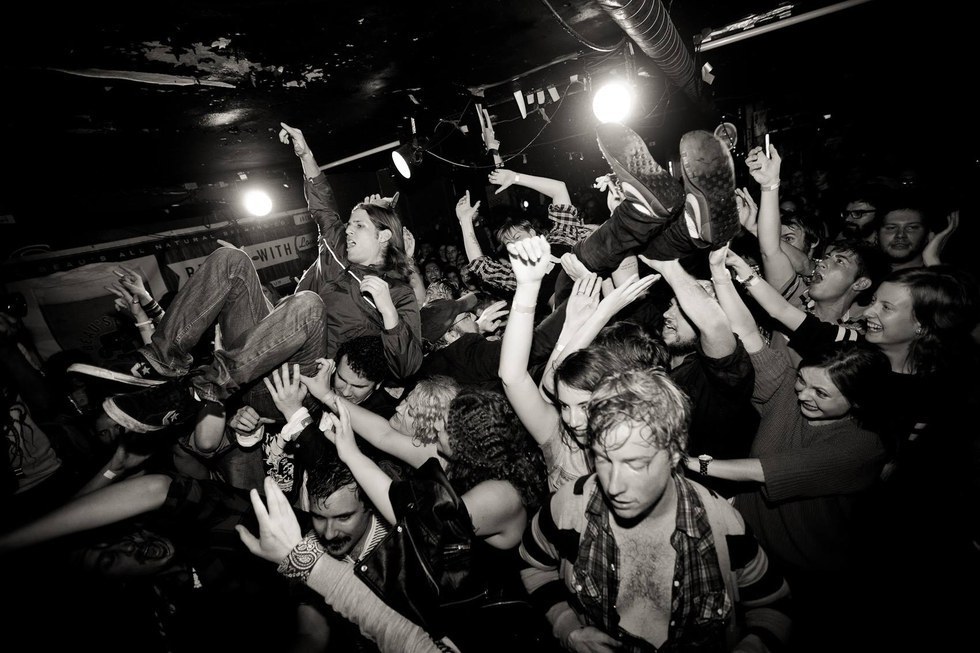
You add more bodies into a "mosh pit" to hope for more collisions. You have increased
temperature
concentration
pressure
catalyst
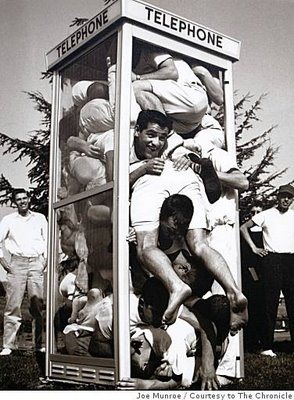
You make a space much smaller by increasing the ________________ hoping to increase the reaction rates.
temperature
concentration
catalyst
pressure
What is the name given to a catalyst in the human body?
Inhibitor
Catalyst
Chemical
Enzyme
_______ refers to how much solute is dissolved in
a solution.
Surface Area
Catalyst
Temperature
Concentration
What is the value of the Keq of the reaction: CO(g) + 2H2(g) ↔ CH3OH(g) if the equilibrium concentrations of the reactants and product are: CO=0.17M, H2=0.34M, and CH3OH= 0.17M?
0.085
8.7
0.12
2.9
If K of a reaction is larger than one, the ___ reaction was favored, if K is smaller than one, the ___ reaction was favored.
forward, reverse
reverse, forward
neither reaction was favored in either reaction at equilibrium
Consider the following equation H2 (g) + I2 (g) ↔ 2 HI(g) Calculate Keq if at equilibrium the concentrations are [H2] = 0.40 M , [I2] = 0.45 M , [HI] = 0.30 M
The following equilibrium was established in a container at 393 K.
heat + M2(g) + R(g) ⇌ RM2(g)
Which change would increase the yield of RM2? (select all the apply)
Remove some R(g) from reaction vessel
change the temperature to 293 K
remove RM2 as it is formed
Continually add more M2(g) + R(g)
Increase the temperature to 493 K
2SO2(g) + O2(g) ⇌ 2SO3(g) is an exothermic reaction. An increase temperature will...
Avagadro's Law
heat + N2 + O2 <−> 2NO
If O2 is removed, the concentration of N2 will _______.
heat + N2 + O2 <−> 2NO
If the heat is removed from the chemical system, the concentration of N2 will _______.
Given: 2A(g) <-> 2B(g) + C(g).
Raising the pressure by lowering the volume of the container will...
cause [A] to increase
cause [B] to increase
have no effect
cannot be determined
The forward reaction forms the substance __________.

If the equilibrium constant is less than 1, it means that
Products are favored
Reactants are favored
The value of Keq tells us...
if the formation of reactant or product is favored
how fast a reaction will occur
how much of each reactant should be added
if the reaction is exothermic or endothermic
What are [C] and [D]?
concentration of reactants
concentration of products
energy of reactants
energy of products
Which of the following systems would NOT be shifted by a change in the volume of the system at constant temperature?
CO (g) + NO (g) ↔ CO2 (g) + ½N2 (g)
N2 (g) + 3H2 (g) ↔ 2NH3 (g)
N2 (g) + 2O2 (g) ↔ 2 NO2 (g)
NO(g) + O3 (g) ↔ NO2 (g) + O2 (g)

