Worksheets
Ecology Unit Test Review
Total questions: 41
Worksheet time: 25mins

What is the relationship between the snake and the mouse in this food web?
The snake is a primary producer and the grasshopper is a tertiary consumer
The snake is a predator and the mouse is its prey
The mouse is a parasite and the snake is the host
The snake is a tertiary consumer and the mouse is a primary consumer

What is the relationship between the Polar Bear and the Orca in this food web?
They are producers
They are decomposers
They are competitors
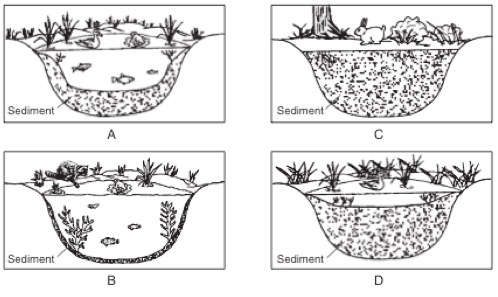
Excess nitrogen fertilizers sometimes drain into waterways that flow into the Galveston Bay. This nitrogen may cause algae blooms, which reduce dissolved oxygen in the water. How does nitrogen negatively affect the Galveston Bay?
fish births increase
fish populations decrease
sediment on the bottom of the bay
Organisms that make their own food are called __________________.
producers
consumers
decomposers
Where does all the energy originate from in a food web?
All energy comes from the Sun.
All energy comes from the Moon.
All energy comes from your Face.
All energy comes from the Plants.
Blue whales live in oceans. What type of factors do they rely on for their existence?
Only biotic factors
Only abiotic factors
Both biotic and abiotic factors
Neither biotic nor abiotic factors
A certain type of mite is a parasite of honeybees. Which statement best describes the relationship between the mites and the bees?
The mites harm the bees by feeding on their blood.
The mites get honey in return for helping the bees stay healthy.
The mites help the bees find food but get nothing in return.
The mites live in the hive of the bees but do not interact with the bees.
What is the process of combining nitrogen gas with other elements to make nitrogen into usable compounds?
nitrogen composition
nitrogen fixation
ammonia
denitrification
Why are decomposers important in maintaining stability in an ecosystem?
Decomposers photosynthesize and make the energy for the ecosystem
Decomposers recycle nutrients needed by producers (plants)
Decomposers keep the herbivores in check in an ecosystem
How much energy is transferred from one trophic level of a food chain to the next?
100%
50%
30%
10%
Why is it important to have diversity in an ecosystem?
The more biodiversity in an ecosystem the more climate change can occur
The more biodiversity in an ecosystem the more poaching can benefit humans
The more biodiversity in an ecosystem the more people can live their
The more biodiversity in an ecosystem the more stability there is in that ecosystem.
What organisms are able to occupy more than one trophic level?
herbivores
carnivores
omnivores
producers
What is primary succession?
primary succession is the changes that occur in a brand new ecosystem.
primary succession is the changes that occur in an ecosystem that has been disturbed either by humans or by a natural disaster.
What process occurs when dead plant and animal matter decomposes and nitrogen is released back into the atmosphere?
Assimilation
Fixation
Ammonification
Denitrification
What is a pioneer species?
The first plant species to inhabit new land
The established plants and animals in an ecosystem
The first humans to inhabit new land
The first plants and animals that settled in the west
A symbiotic relationship in which one organism benefits while the other is not affected.
Mutualism
Parasitism
Commensalism
A symbiotic relationship in which both organisms benefit from the relationship.
Mutualism
Parasitism
Commensalism
A symbiotic relationship where one organism benefits, and the other is harmed.
Mutualism
Parasitism
Commensalism
Consumers...
Make their own food
Go through photosynthesis
Eat other organisms
Breathe in carbon dioxide
What is the producer in this food chain?
phytoplankton → krill → fish → shark
Phytoplankton
Krill
Fish
Shark
Arrows in a food web show the flow of
energy
protein
nutrients
glucose

What are the two REACTANTS in photosynthesis?
Carbon dioxide and oxygen
Water and sunlight
Water and carbon dioxide
Glucose and sunlight

What are the PRODUCTS in photosynthesis?
Sunlight and water
Carbon dioxide and water
Glucose and carbon dioxide
Glucose and oxygen

Which group is not represented in the food web?
producers
primary consumers
secondary consumers
decomposers

In this energy pyramid, which organism would most likely be in level 2?
bird
fox
caterpillar
tree

The picture provided shows an ocean bay food chain. Sea otters move into the ocean bay. They eat all of the sea urchins. This change will cause the
kelp to have less food.
crabs to have more food.
sea ducks to have less food.
arctic foxes to have more food.
Which of these organisms would most likely be found at the top of an energy pyramid?
clams
sardines
sharks
kelp (seaweed)


The least amount of available energy is found at level--
4
3
2
1

DTR: Leech sucking blood
Mutualism
Commensalism
Parasitism
Predation
DTR: Barnacles live on a whale and get nutrients that float nearby. The whale does not receive a benefit and doesn't get hurt from this relationship
Mutualism
Commensalism
Parasitism
Predation

Which organism has the most available energy?
Snakes
Insects
Grasses
Rabbits