wayground logo

Free Printable Worksheets

Font size

S
M
L
XL
Worksheets

Quizizz #6: Chemical Reactions

Total questions: 54

Worksheet time: 2hrs 0mins

Name
Class
Date
1.

What is a chemical reaction?

a)

a change in matter when the molecules rearrange to make new molecules

b)

a change in matter when matter changes its form or appearance

c)

a change in matter when the physical appearance changes

d)

a very boring change in matter

2.

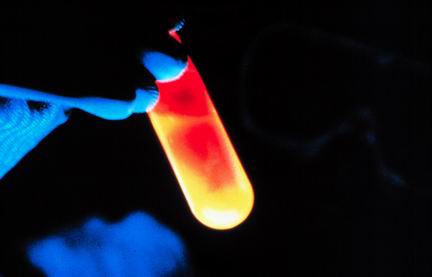
This image shows a

a)

chemical reaction

b)

physical change

c)

musical change

d)

all of these answers are correct

3.

When energy like heat and light are given off in a chemical reaction it is called

a)

exothermic

b)

endothermic

c)

eccentric

d)

ectomorphic

4.

When energy is absorbed and taken in during a chemical reaction it is called

a)

exothermic

b)

endothermic

c)

eccentric

d)

ectomorphic

5.

When the matter in a chemical reaction gets colder it is called

a)

exothermic

b)

endothermic

c)

eccentric

d)

endomorphic

6.

When the matter in a chemical reaction gets warmer it is called

a)

exothermic

b)

endothermic

c)

eccentric

d)

endomorphic

7.
Breaking down a substance into simpler substances
a)
Displacement
b)
Synthesis
c)
Decomposition
d)
Oxidation
8.
What type of reaction is the equation C + O→ CO2?
a)
Synthesis Reaction
b)
Decomposition Reaction
c)
Single Displacement Reaction
d)
Double Displacement Reaction
9.
What type of reaction is the equation 2NaCl →2Na +Cl2?
a)
Synthesis Reaction
b)
Decomposition Reaction
c)
Single Displacement Reaction
d)
Double Displacement Reaction
10.
Cu + 2Ag(NO3) → 2Ag + Cu(NO3)
a)
Synthesis Reaction
b)
Decomposition Reaction
c)
Single Displacement Reaction
d)
Double Displacement Reaction
11.
Ca3(PO4)2 + 3 H2SO4 + 3 CaSO4 + 2 H3(PO4)
a)
Synthesis Reaction
b)
Decomposition Reaction
c)
Single Displacement Reaction
d)
Double Displacement Reaction
12.
Consider the chemical equation CH4 + 2 O2 → CO2 + 2 H2O. In this equation, CH4 is a
a)
product
b)
reactant
c)
displacement
13.
Consider the equation 4 Fe+3 O2 → 2 Fe2O3 . In this equation, 3 O2 is a
a)
product
b)
reactant
c)
compound
14.
Which generalized equation represents a decomposition reaction?
a)
A + BC → AC+ B
b)
A + B → AB
c)
AB → A + B
15.
Which generalized equation represents a single displacement reaction?
a)
A + BC → AC+ B
b)
A + B → AB
c)
AB → A + B
16.

What type of reaction involves the breaking down of a substance into simpler substances?

a)

Single Replacement Reaction

b)

Double Replacement Reaction

c)

Synthesis Reaction

d)

Decomposition Reaction

17.

What type of reaction involves 2 substances combining to form 1 new compound?

a)

Decomposition Reaction

b)

Single Replacement Reaction

c)

Double Replacement Reaction

d)

Synthesis Reaction

18.

What type of reaction involves the breaking down of a substance into simpler substances?

a)

Single Replacement Reaction

b)

Double Replacement Reaction

c)

Synthesis Reaction

d)

Decomposition Reaction

19.

What type of reaction involves one element replacing another element in a compound?

a)

Single Replacement Reaction

b)

Double Replacement Reaction

c)

Synthesis Reaction

d)

Decomposition Reaction

20.

What type of reaction involves ions from 2 compounds exchanging places to form 2 completely new compounds?

a)

Single Replacement Reaction

b)

Double Replacement Reaction

c)

Synthesis Reaction

d)

Decomposition Reaction

21.

What type of chemical reaction is this one?

CUO + CO2 --> CuCO3

a)

Decomposition

b)

Combustion

c)

Synthesis

d)

Single Replacement

22.

What type of chemical reaction is this one?

Ca + MgCl2 --> CaCl2 + Mg

a)

Decomposition

b)

Combustion

c)

Synthesis

d)

Single Replacement

23.

3KOH + H3PO4 --> K3PO4 + 3H2O

a)

Combination

b)

Decomposition

c)

Single replacement

d)

Double replacement

24.
CxHy +O--> H2O + CO2
a)
Decomposition
b)
Double replacement
c)
Combustion
d)
Single Replacement
25.

Combustion reactions will always involve

a)

Oxygen and a solid

b)

Liquid nitrogen and heat

c)

Oxygen and heat/energy

d)

CO and H2O

26.

Balancing this reaction:

____ CH4 + ____ O2 ---> ___ CO2 + ____ H2O

a)

2,1,3,1

b)

1,2,1,2

c)

1,2,2,1

d)

2,1,1,2

27.

Balance this reaction:

____ Na3PO4 + ____ KOH ---> ____ NaOH + ____ K3PO4

a)

1,3,3,1

b)

1,3,2,1

c)

2,3,3,1

d)

1,1,3,1

28.

Balance this reaction:

____ NaF + ____ Br2 ---> ___ NaBr + ____ F2

a)

3,1,2,1

b)

1,2,3,4

c)

2,1,2,1

d)

1,2,1,2

29.
The red numbers in the image below represent ________
a)
subscripts
b)
coefficients
c)
I don't know, and don't want to try
d)
None of the answers are correct
30.
The blue numbers in the image below represent ________
a)
I don't know, and don't want to try
b)
coefficients
c)
subscripts
d)
none of the answers are correct
31.
What kind of reaction is this:
Fe + CuSO4 -> Cu + FeSO4
a)
Double Replacement
b)
Decompostion
c)
Single Replacement
d)
Combustion
32.
in a reaction, aqueous barium chloride reacts with aqueous potassium carbonate to produce solid barium carbonate and aqueous potassium chloride. what is the correct balanced equation.
a)
Ba2Cl(aq) + KCO3(aq) --> BaCO3(s) + KCl(aq)
b)
BaCl2(aq) + K2CO3(aq) --> BaCO3(s) + 2KCl(aq)
c)
BaCl(aq) + K2CO3(aq) --> BaCO3(s) + K2Cl(aq)
d)
Ba2Cl2(aq) + KCO3(aq) --> Ba2CO3(s) + KCl2(aq)
33.

Which chemical reaction always starts with a hydrocarbon that reacts with oxygen and produces carbon dioxide and water?

a)

Decomposition

b)

Synthesis

c)

Combustion

d)

Single Replacement

34.

The reactants are on the left side of the chemical equation.

a)

True

b)

False

35.

What type of chemical reaction is this one?

CUO + CO2 --> CuCO3

a)

Decomposition

b)

Combustion

c)

Synthesis

d)

Single Replacement

36.

The right side of the equation below is called the

a)

products

b)

reactants

37.

What type of chemical reaction is this one?

C2H2 + O2 --> CO2 + H2O

a)

Decomposition

b)

Combustion

c)

Synthesis

d)

Single Replacement

38.

Evidence of a chemical reaction include:

a)

Phase change

b)

No new substance

c)

Bubbles forming

d)

Shape change

39.
A neutralization reaction will (almost) always produce...
a)
water & salt
b)
water
c)
salt
d)
water & carbon
40.

A type of chemical that forms solutions that taste sour, due to high concentrations of positive hydrogen ions

a)

acid

b)

base

c)

salt

d)

pH

41.
In a ____ reaction, an acid and a base produce a salt and a water. 
a)
concentrated
b)
decomposition
c)
dilute
d)
neutralization
42.
What type of reaction is displayed below?
HCl + NaOH → NaCl + H2O
a)
Neutralization
b)
Combustion
c)
Double Replacement
d)
Decomposition
43.
In a neutralization reaction, what are the products of a reaction between an acid and a base?
a)
Another acid and base
b)
Carbon dioxide and a salt
c)
Water and a salt
d)
Either two acids or two bases
44.
What is the range of pH values in an acidic solution?
a)
0-7
b)
7-14
c)
15-239058204958
d)
pH = 7
45.
What is the range of pH values in a basic solution?
a)
0-7
b)
7-14
c)
7
46.
The products of a neutralization reaction are acids and bases
a)
True
b)
False
47.
The reactants of a neutralization reaction are acids and bases
a)
True
b)
False
48.
Forms hydroxide ions (OH-) in water
a)
Acids
b)
Bases
c)
All
49.
If there is excess hydroxide ions, the solution will be...
a)
acidic
b)
basic
50.
Which of the following examples shows that a chemical reaction has occurred? 
a)
A rock breaks into smaller pieces when it is struck with a hammer.
b)
Rust forms on a hammer that has been left outside to long. 
c)
A cup of water turns pink when a few drops of red food coloring are added. 
d)
A solid is formed when heat is removed from a sample of water. 
51.
Four students performed four different investigations by combining different substances. Their results are shown in the table provided. In which experiment are new substances being formed?
a)
Experiment 1
b)
Experiment 2
c)
Experiment 3
d)
Experiment 4
52.
Which of the following is an example that includes evidence of a chemical reaction?
a)
A sample of zinc is placed in water and it settles to the bottom
b)
A solid block of ice is heated and it completely melts into a liquid. 
c)
Sugar that is burned gives off an odor and turns brown and then black.
d)
A tomato is placed into a blender and chopped up into smaller pieces.
53.
Which of the following is NOT evidence that that a chemical reaction has occurred?
a)
produces light/heat
b)
production of a gas
c)
formation of a precipitate
d)
melting
54.
For an investigation a student poured a blue solution of CuSO4 into a beaker. The student placed a shiny, silver-colored strip of zinc metal in the solution and observed the changes.
The student inferred that a chemical reaction occurred. What evidence supports this inference?
a)
A dark solid formed on the zinc metal.
b)

The zinc metal remained silver-colored and shiny

c)
The CuSO4 solution turned blue when the zinc metal was added.
d)
None of these