
Font size
 Worksheets
FINAL EXAM REVIEW
Total questions: 50
Worksheet time: 30mins
What element is found in all four areas of the earth (lithosphere or solid earth), biosphere (all living matter on earth), hydrosphere (all water on earth), and atmosphere (the sphere of gases surrounding our earth)?
Sodium (Na)
Oxygen (O)
Carbon (C)
Nitrogen (N)
The Earth, living matter, oceans, and atmosphere are composed of-
so many different elements that they cannot all be listed.
all of the elements on the Periodic Table equally.
a limited number of known elements.
no elements at all.
Which element is the second most abundant in Earth's crust?
Oxygen
Calcium
Sodium
Silicon
Two elements that occur in the earth's atmosphere are _____ and _______.
Silicon and Argon
Argon and Aluminum
Nitrogen and Oxygen
Helium and Nitrogen
What does the prefix "geo" mean?
ground
life
water
air
What does the prefix "bio" mean?
ground
water
life
air
What does the prefix "atmo" mean?
water
air
ground
life
What does the prefix "hydro" mean?
ground
life
water
air
In what sphere do the elements rocks and minerals belong?
Geosphere
Bioshpere
Hydrosphere
Atmosphere
The elements oxygen, carbon dioxide, and nitrogen belong to what sphere?
Geosphere
Biosphere
Hydrosphere
Atmosphere
Animals, plants, and humans are part of the ______________.
Geosphere
Biosphere
Hydrosphere
Atmosphere
Lakes, oceans, rivers, and streams are part of the _____________.
Geosphere
Biosphere
Hydrosphere
Atmosphere
All living things are part of the _______________.
Geoshphere
Biosphere
Hydrosphere
Atmosphere
In what sphere does the mantle, core, and crust belong?
Geosphere
Biosphere
Hydrosphere
Atmosphere
Match the sphere to it's element: Vapor
Geosphere
Biosphere
Hydrosphere
Atmosphere

Which two spheres are interacting?
Geosphere
Biosphere
Hydrosphere
Atmosphere

Which spheres are interacting? (Hint: think about what the plant is producing)
Geosphere
Biosphere
Hydrosphere
Atmosphere

Which two spheres are interacting?
Geosphere
Biosphere
Hydrosphere
Atmosphere
What is the only sphere that contains solid, liquid, and gas?
Hydrosphere
Geosphere
Atmosphere
Biosphere

Look at the data table. Which graph below best represents the most abundant elements in the Earth's crust?


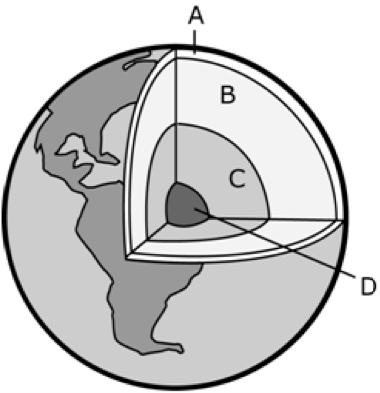
Which letter in the diagram identifies the layer of Earth made up of solid nickel and iron?
layer A
layer B
layer C
layer D


As you go deeper into the Earth select the three things below you would expect to increase.
Temperature
Density
Pressure
Volume

Which Earth system is pictured?
Atmosphere
Biosphere
Geosphere
Hydrosphere
The satellite of the earth is the...
star
lun
moon
sun

protect against magnetic particles.

The graph shows the composition of the atmosphere for planet
Venus
Mars
Earth
Mercury

Which of the following data tables most likely matches the graph?


Approximately how much more Nitrogen is there on Earth than on Mars?
76%
2%
19%
18%

Which of the following gases do Mars and Venus have in large concentrations compared to Earth?
Oxygen
Nitrogen
Carbon Dioxide
Hydrogen

What are Earth's layers?
skin
crust
mantle
core
pit
A limited number of elements comprise the largest portion of Earth's mantle. Pick the top 4.
oxygen
nickle
iron
magnesium
silicon
Movement in the outer core creates Earth's ______________.
tropical islands
atmosphere
ocean waves
magnetic field

Three factors combine to set convection currents in motion, what are they?
heat
magnetism
density
gravity
rock samples from volcanoes

Choose the description that would match "A".
Temperature: hotter
Density: less dense
The rock: rises
Temperature: colder
Density: less dense
The rock: rises
Temperature: hotter
Density: more dense
The rock: sinks
Temperature: colder
Density: more dense
The rock: sinks
Choose the description that would match "B".
Temperature: hotter
Density: less dense
The rock: rises
Temperature: colder
Density: less dense
The rock: rises
Temperature: hotter
Density: more dense
The rock: sinks
Temperature: colder
Density: more dense
The rock: sinks


How many planets are in our solar system?
9
8
6
What is The force that pulls objects down towards the center of the Earth.
force
gravity
motion
What is Newton's 2nd law?
for every action there is an equal and opposite reaction
an object in motion stays in motion and an object at rest stays at rest, unless acted upon by another FORCE
FORCE = mass x acceleration
The formula to find the speed is:
speed=disttime
speed=timedist
speed=Acceldist
speed=dist2

