
 Worksheets
Optics
Total questions: 45
Worksheet time: 4hrs 45mins
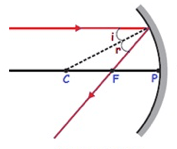
This ray diagram is for which mirror?
concave
convex
plane
window
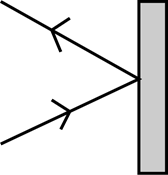
In the illustration, the light ray striking the object is-
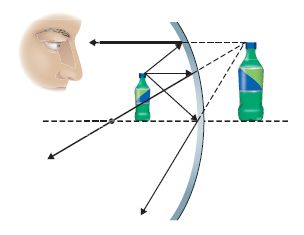

In the diagram, which letter represents the angle of incidence?
A
B
C
D

Which diagram represents specular reflection?
A
B

Which diagram represents diffuse reflection?
A
B
C
D

bends due to traveling at a different speed when it passes through water
flint glass n=1.70
barium glass n=1.60
crown glass n=1.523
water n=1.33
diamond n=2.45


What direction will this light ray bend after it is refracted?


The image as seen through this convex lens will be ...
real and larger
real and smaller
virtual and larger
virtual and smaller

When light goes from glass into water, the speed of the light...
slows down
stays the same
speeds up

What direction will this light ray refract?


The image will ...
be upright and real
be upright and virtual
not exist
be upside down and real

What type of lens is being used here?
convex
concave
You need a lens for a movie project. Its best to use a _____ lens because only a ______ image will project on the screen.
convex, real
convex, virtual
concave, real
concave, virtual

What material could the upper layer be?
Water
Boron Nitrate
Cubic Zirconia
Diamond

What material could the lower layer be?
air
water
Boron Nitrate
Diamond
The color you see is the color that is ___________
reflected
absorbed
The wavelength from red to violet is __________________.
decreasing
increasing
the same
If a material absorbs all frequencies of light waves EXCEPT green, what color will be perceived by the observer?
Black
Green
White
Yellow
Which has the greatest energy among the colors in a rainbow?
green
orange
red
violet
Why does white light separate into different colors as it passes through a prism?
The colors are changed by addition.
This is an example of color by subtraction.
Different colored light has different wavelengths.
The side part of a prism only let certain colors of light pass through.
Which of the following is true about the relationship between frequency and energy?
The frequency of the color of light and energy are not related.
As the frequency of the color of light increases, its energy decreases.
As the frequency of the color of light decreases, the energy increases.
As the frequency of the color of light increases, the energy also increases.
The sky is blue because...
blue is the color most scattered or reflected by our atmosphere.
red is the color most scattered or reflected by our atmosphere.
blue is the color most absorbed by our atmosphere.
blue is complimentary to orange.
What does "c" stand for in the equation for a wave?
The speed of an electron
The crest
The speed of light
The frequency
Photoelectric effect provides the evidence for the ______ nature of radiation.
dual
wave
particle
electromagnetic
Which of the following colors of light have the highest energy
red
orange
green
purple
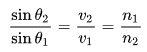
If light travels from a higher to a lower index of refraction medium the light will
bend away from the vertical axis or may not refract
bend closer to the vertical axis
not bend
answer is not here
Light travels from air (n = 1.000) into an optical fiber. If the angles of incidence and refraction are 22oand 15º respectively. what is the index of refraction inside the fiber? Round off your values to 3 sig. figs.
HINT: n1sinθ1=n2sinθ2
1.45
1.44
0.69
0.70
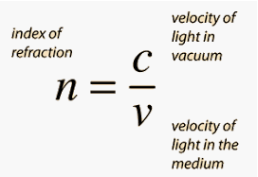
The index of refraction, is defined as the ratio of the speed of light in a vacuum (c = 3x10^8 m/s) to the speed of light in a medium. What is the index of refraction of a medium where the speed of light is 0.7c ? Round off your values to 3 sig. figs.
1.42
1.43
1.28
1.29

Light travels from air (n = 1.00) into a second material. The incident ray of light hits the surface at angle of 64o and the refracted ray enters the second material at an angle of 32o. What is the index of refraction of the second material? n1sin(Θ1) = n2sin(Θ2)
1.4
0.90
0.53
1.7


A tree 20 m high is located 40 m from the converging lens of focal length 0.08 m.Calculate the distance from the lens to the image.
0.08 m
0.01 m
0.10 m
0.20 m
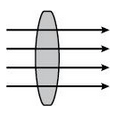
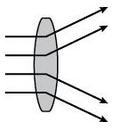
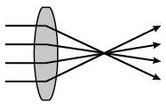
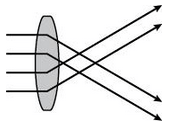
Which lens represents the path light takes through a diverging lens?


Which figure represents the path light takes through a converging lens?

You place an object 20 cm in front of a convex mirror with a –15 cm focal length. Calculate the image position
HINT. Use the mirror equation: f1=di1+do1
9.45 cm
5.34 cm
-4.35 cm
-8.57 cm

If the flame on the candle is 2 cm tall, how tall is the flame of the image?
1
2
4
8
A concave mirror has a radius of curvature of 24 cm. A 6.4 cm tall object is held 26cm from the mirror. Calculate the distance between the image and the mirror.
HINTS. use: f=2C di=do−ffdo do1+di1=f1
22.3 cm
23.2 cm
32.2 cm
23.3 cm

