
Font size
 Worksheets
Moon and Universe Quick Check
Total questions: 55
Worksheet time: 49mins

Which star stage is generally the COOLEST?
Supergiant
Giant
Main Sequence
White Dwarf
Which of the following is TRUE about comets?
They are composed of dust, rock, and ice.
They are old stars that had fallen out of its orbit
They give bad omens of an impending war, famine, and pestilence.
They are big chunks of rocks that are found between Mars and Jupiter
Which of the following statements correctly compares a comet and an asteroid?
Comet exhibits a tail awhile an asteroid does not.
Comet and asteroid are both from the Kuiper Belt.
Comet is faster to complete its orbital period than an asteroid.
Comet and asteroid are both made up of solid piece of dirty ice.
A Group of stars, and or star systems, star clusters, dust and gas held together by gravity is known as:
Universe
Galaxy
Solar System
Planet
What Galaxy is Earth located?
Andromeda
Milky Way
Sagittarius
Snickers
A galaxy which is either spherical (ball like) or a flattened disk is a ___ galaxy.
elliptical
humanoid
irregular
spiral
Stars form from huge clouds of gas and dust in space called :
supernova
nebula
the Kuiper Belt
the Oort Cloud
The universe has many parts. These parts vary greatly in size. Which list shows us the largest to the smallest parts of our universe?
Galaxies, Planets, Nebula, Stars
Planets, Stars, Nebula, Galaxies
Nebula, Stars, Galaxies, Planets
Galaxies, Nebula, Stars, Planets
What are the four types of stars that can be found on the HR Diagram?
main sequence, giant, supergiant, white dwarf
main sequence, giant, supernova, white dwarf
main sequence, nebula, supergiant, black hole
main sequence, giant, neutron star, black dwarf

Where would the main sequence stars be located?
A
B
C
D

The category that contains the most stars is...
Main Sequence
Supergiants
Giants
White Dwarfs


What moon phase is at location A?
new moon
full moon
waxing crescent
waning crescent
waxing gibbous
if February 1st has a Neap tide, when can we expect the next Spring tide?
Feb 12
Feb 26
Feb 8
Feb 17

How many days after the first quarter moon would you observe the next new moon?
7 days
14 days
21 days
28 days

True or False: The moon is always half lit by the sun.
True
False

Which moon phase is represented by moon #2?
Waxing Gibbous
Waning Gibbous
Waxing Crescent
Waning Crescent
First Quarter
Which moon phase is represented by moon #6?
Waxing Gibbous
Waning Gibbous
Waxing Crescent
Waning Crescent
First Quarter

When we see the term "Waxing" what is happening to the light on the moon?
it is growing, (more and more light)
it is decreasing (less and less light)

The lunar cycle is how the moon’s appearance from the Earth change over a predictable amount of time in a predictable pattern. How can we explain what causes the lunar cycle?
The moon’s revolution
The moon’s rotation
The sun’s revolution
The earth’s rotation


If you look up at the sky and see this, you are witnessing a....
solar eclipse
total eclipse
lunar eclipse
jupiter


towards the Earth


Which of the following has the shortest wavelength?
microwaves
UV rays
Infrared
the color blue

Which of the following has the most energy?
Red
Blue
Green
Violet

Which of the following has the most energy?
X-rays
The color green
Microwaves
ultraviolet

Which of the following has the longest wavelength?
Infrared
The color Indigo
gamma rays
TV

Which of the following has the least amount of energy?
UV rays
The color yellow
infrared
Gamma rays
How might a high mass star's life cycle end? (check all that apply)
white dwarf
neutron star
black hole
red giant
You are standing on the side of the road when a police car races past you with its siren on. After the police car passes you, what happens to the pitch of the siren?
It increases
It decreases
It turns red
An astronomer looks at a star in the night sky. Based on his calculations the star's light is shifting towards the color blue. What does this mean about the star?
It's moving towards the astronomer
It's moving away from the astronomer
It's not moving at all
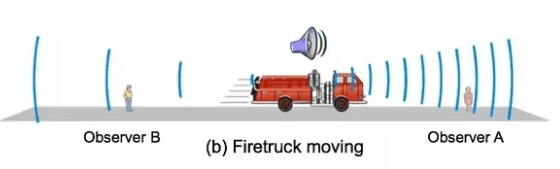
Look at the picture. Who is experiencing a higher pitched sound?
Observer A
Observer B
There's no difference
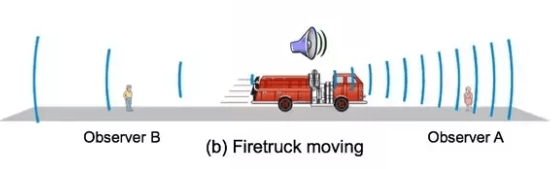
Look at the picture. Who is experiencing a lower pitched sound?
Observer A
Observer B
There is no difference

What is the Doppler Effect?
A change in frequency due to the relative motion of a wave source and an observer
When a wave overlaps with another wave
When a wave bounces off of another object
When a wave bends due to traveling through a different medium

