wayground logo

Free Printable Worksheets

Font size

S
M
L
XL
Worksheets

5th Grade Science Review

Total questions: 188

Worksheet time: 3hrs 36mins

Name
Class
Date
1.

Which of the following definitions apply to the word mass?

a)

A measure of how close atoms or molecules are packed together.

b)

The amount of matter in a substance.

c)

Anything that has mass and occupies space.

d)

The space occupied by matter.

2.

Which of the following definitions apply to the word density?

a)

A measure of how close atoms or molecules are packed together.

b)

The amount of matter in a substance.

c)

Anything that has mass and occupies space.

d)

The space occupied by matter.

3.

Which of the following definitions apply to the word matter?

a)

A measure of how close atoms or molecules are packed together.

b)

The amount of matter in a substance.

c)

Anything that has mass and occupies space.

d)

The space occupied by matter.

4.

Which of the following definitions apply to the word volume?

a)

A measure of how close atoms or molecules are packed together.

b)

The amount of matter in a substance.

c)

Anything that has mass and occupies space.

d)

The space occupied by matter.

5.

Density is determined by:

a)

weight and size

b)

color and hardness

c)

gravity and mass

d)

mass and volume

6.

Which of the following is not a mixture?

a)

sand and water

b)

water

c)

dirt and rocks

d)

salt water

7.

The mass of an object will ____________ when it changes location.

a)

decrease

b)

change

c)

increase

d)

remain the same

8.

All of the following objects are attracted to magnets EXCEPT _________.

a)

Iron nail

b)

Plastic button

c)

Steel scissors

d)

Iron screw

9.

The same quantity of sugar and sand are added to a glass of water and stirred. After some time the sugar particles cannot be seen while sand particles settle down. Based on the observations, which of the following statements is TRUE?

a)

Sugar is soluble in water while sand is not.

b)

Sand is soluble in water while sugar is not.

c)

Both sugar and sand are soluble in water.

d)

Both sugar and sand are not soluble in water.

10.

Which of these objects is an insulator?

a)

Copper Wire

b)

Oven Mitt

c)

Paper Clip

d)

Soda Can

11.

Identify which item below best completes the table.

a)

Glass Window

b)

Gold Ring

c)

Paper Bag

d)

Styrofoam Cup

12.

A magnet would be attracted to which item?

a)

Plastic bottle sprayer

b)

Refrigerator

c)

Wooden table

d)

Aluminum bat

13.

A student completes an investigation, where sand and water are mixed together. The student needs to separate the sand from the water. Which of the following procedures should the student follow?

a)

Pour the mixture through a funnel to separate the sand from the water.

b)

Pour the mixture through a paper filter to separate the sand, and allow the water to flow through to another container.

c)

Pour the mixture into a glass, and use your hand to separate the sand from the water.

d)

Pour the mixture into a bowl, and dip all the water out with a spoon.

14.

A student mixes together iron filings, sand, salt, gravel, and water. Which ingredients will keep all their physical properties after being mixed?

a)

Iron filings, sand, and gravel

b)

Iron filings, sand, and salt

c)

Sand, gravel, and salt

d)

Sand, salt, and water

15.

A teacher mixes 50 grams of sugar with 100 mL of water in a beaker until the sugar dissolves. The teacher then puts the beaker on a hotplate and evaporates the water. How much sugar will be left after all the water evaporates?

a)

0 grams

b)

10 grams

c)

50 grams

d)

100 grams

16.

A class completes an experiment where they mix together salt, sand, and water. Which three tools will they need to separate the mixture?

a)

Stove, Spoon, Beaker

b)

Stove, Filter, Beaker

c)

Filter, Funnel, Beaker

d)

Filter, Spoon, Beaker

17.

Which of these is NOT a mixture?

a)

Hamburger

b)

Kool-Aid

c)

Fruit Salad

d)

Taco

18.

What would be the best way to separate the trail mix?

a)

Put the trail mix in a container and pour water on it.

b)

Drag a magnet over the trail mix to take apart the items.

c)

Place the trail mix in a pan and place it in the Sun.

d)

Use a utensil to physically separate the trail mix.

19.

What would be the best way to separate the trail mix?

a)

Put the trail mix in a container and pour water on it.

b)

Drag a magnet over the trail mix to take apart the items.

c)

Place the trail mix in a pan and place it in the Sun.

d)

Use a utensil to physically separate the trail mix.

20.

All of the following are solutions except?

a)

Pepper and Water

b)

Peppermint Candy and Water

c)

Sugar and Water

d)

Salt and Water

21.
The amount of matter in an object is a measure of the object's ________________.
a)
volume
b)
density
c)
mass
d)
solubility
22.
Which of the following units provides the best measure for the amount of space that matter occupies?
a)
mL
b)
grams
c)
cm3
d)
Both mL and cm3
23.
Which statement is true?
a)
Oil is the most dense substance.
b)
Corn syrup is less dense than water.
c)
Oil is less dense than water.
d)
Oil and corn syrup have the same density but different masses.
24.
In which state does matter completely fill its closed container?
a)
Gas
b)
Liquid
c)
Solid
d)
Ice
25.
Which state of matter has a fixed shape and volume and it's molecules move very slowly?
a)
Liquid
b)
Gas
c)
Solid
d)
Plasma
26.
The boiling point of water is ______________.
a)
0° C
b)
50° C
c)
200° C
d)
100° C
27.
The volume of water in a beaker was 215 mL. After 5 days, the volume of the water was 200 mL. What best explains the change in volume?
a)
Some of the water absorbed the air. 
b)
Some of the water evaporated and escaped into the air as water vapor.
c)
Some of the water disappeared.
d)
Some of the water was released due to condensation.
28.
When a gas turns into a liquid, it is called ___________________.
a)
Condensation
b)
Evaporation
c)
Melting
d)
Freezing
29.
5 grams of salt was mixed with 50 mL of water to form a solution. In the solution, the water was which of the following?
a)
Solvent
b)
Saturate
c)
Solute
d)
Transparent
30.
Allows little to no light through.
a)
Transparent
b)
Translucent
c)
Opal
d)
Opaque
31.
The bending of waves as they pass from one substance into another.
a)
Reaction
b)
Reflection
c)
Refraction
d)
Repost
32.
The distance between one peak and the next in a wave
a)
Transpartent
b)
Scattering
c)
Wavelength
d)
Waste Pro
33.
The term for any wave that hits a surface and bounces off
a)
Transparent
b)
Translucent
c)
Refraction
d)
Reflection
34.
Blurs light as it passes through
a)
Transparent
b)
Translucent
c)
Opaque
d)
Refraction
35.
Transfer of energy when a wave disappears into a surface
a)
Transparent
b)
Refraction
c)
Reflection
d)
Absorption
36.
Allows most light through
a)
eflection
b)
Refraction
c)
Translucent
d)
Transparent
37.
The number of vibrations a wave makes in a given amount of time is a 
a)
Absorption
b)
Medium
c)
Frequency
d)
Photon
38.
Light travels on straight lines.
a)
Light Bulb
b)
Sunshine
c)
Light Rays
d)
Frequency
39.
wood is a _____?
a)
conductor
b)
insulator
40.
water is a______?
a)
conductor
b)
insulator
41.
What kind of circuit is this?
a)
series
b)
parallel
42.
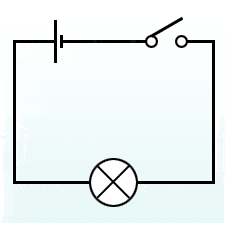
this circuit is .....?
a)
open
b)
parallel
c)
closed
d)
The cutest little circuit evah!
43.
When all parts of the circuit are connected it is a ______ circuit. 
a)
open
b)
closed
44.
When you flip a light switch on and off you are closing and opening a circuit.
a)
true
b)
false
45.
What type of circuit is show in the image?
a)
Series Circuit
b)
Parallel Circuit
46.

What does KINETIC mean?

4 lines
47.

What does TRANSFORM mean?

4 lines
48.

What is ENERGY?

4 lines
49.

JOULE is a measurement of

a)

Work

b)

Energy

c)

Heat

d)

Electricity

e)

Force

50.

NEWTON is a measurement of

a)

Work

b)

Energy

c)

Heat

d)

Electricity

e)

Force

51.

The amount of force needed to move an object is called

a)

Work

b)

Energy

c)

Heat

d)

Electricity

e)

Force

52.

The Law of Conservation of Energy states: energy cannot be cr________ or de__________

4 lines
53.

What does 'Therm' mean in Greek?

4 lines
54.

Which of the following energies travel in waves? (Select 2)

a)

Mechanical

b)

Electrical

c)

Light

d)

Thermal

e)

Sound

55.

We receive ________ and heat energy from the Sun.

a)

sound

b)

mechanical

c)

light

d)

kinetic

56.

Vibrations produce _______ energy.

a)

chemical

b)

sound

c)

potential

d)

light

57.

Food

a)

kinetic

b)

chemical

c)

light

d)

sound

58.

Fuel

a)

radiant

b)

chemical

c)

potential

d)

kinetic

e)

sound

59.

batteries

a)

Kinetic

b)

Thermal

c)

Sound

d)

Chemical

60.

energy from water

a)

Hydraulic

b)

Sound

c)

Wind

d)

Thermal

61.

What type of energy do these appliances use?

a)

Solar

b)

Wind

c)

Electric

d)

Sound

62.
What is energy?
a)
The ability to cause a change
b)
A force
c)
Electricity
d)
The ability to transform work
63.

This type of energy is the energy stored in objects by tension. When the tension is released, motion occurs.

a)

Thermal Energy

b)

Nuclear Energy

c)

Mechanical Energy

d)

Chemical Energy

64.

A spring that is pressed down has this type of energy

a)

Mechanical Energy

b)

Nuclear Energy

c)

Radiant Energy

d)

Thermal Energy

65.

Another name for Thermal Energy is...

a)

Heat energy

b)

Solar energy

c)

Thermal Energy

d)

Cold energy

66.

This type of energy comes from tiny charged particles

a)

Thermal Energy

b)

Electrical Energy

c)

Solar Energy

d)

Nuclear Energy

67.

What percentage of Earth's fresh water that is not frozen

a)

97%

b)

1%

c)

100%

d)

3%

68.

Which of the following are types of freshwater that can be used by people?


Select all that are true.

a)

groundwater

b)

ice caps and glaciers

c)

oceans

d)

rivers

e)

lakes

69.

What happens once groundwater reaches a layer of rock in the ground that it cannot pass through?

a)

it is soaked up by that layer of rock and dirt

b)

it creates an aquifer

c)

it creates a reservoir

d)

it evaporates

70.

People get fresh water from

a)

reservoirs

b)

lakes and rivers

c)

pumping groundwater up from aquifers using wells

d)

all of the above

71.

Why does groundwater usually require less treatment than surface water?

a)

The layers of Earth protect groundwater from pollutants.

b)

As groundwater sinks into the ground, the layers of rock act like a natural filter and remove pollutants from the water.

c)

Surface water has more exposure to pollutants in runoff and the atmosphere.

d)

all of the above

72.

What is the energy source for the water cycle?

a)

sun

b)

wind

c)

rain

d)

oceans

73.

What are clouds made of?

a)

dry air

b)

water

74.

What are the main components of the water cycle?

a)

runoff

b)

transpiration

c)

evaporation

d)

condensation

e)

precipitation

75.

What type of precipitation will fall if the temperature is 0 degrees celsius, but the precipitation freezes along the way to Earth's surface?

a)

rain

b)

snow

c)

sleet

d)

hail

76.

Which statement correctly describes how clouds are formed?

a)

Clouds form when a large block of ice is frozen in the sky.

b)

Clouds form when a solid changes directly to a gas through sublimation.

c)

Clouds form when water vapor condenses around tiny specks of dirt in the air.

d)

Clouds form when water vapor evaporates from a lake, river, puddle, or ocean.

77.

This landform is formed by

a)

water erosion

b)

wind erosion

c)

deposition

d)

glaciers

78.

What is this landform?

a)

delta

b)

canyon

c)

valley

d)

sand dune

79.

This landform is formed by

a)

water erosion

b)

weathering

c)

deposition of sediments

d)

glaciers

80.

Glaciers are masses of ice that move slowly on land. Which of these features was most likely formed by a glacier?

a)

A wide valley

b)

A deep ocean

c)

A lava flow

d)

A mountain range

81.

A triangular landform where a river empties into another body of water.

a)

Landform

b)

Canyon

c)

Delta

d)

Valley

82.

A deep gorge in the surface of Earth formed by the erosion of moving water and sediment.

a)

Valley

b)

Delta

c)

Canyon

d)

Landform

83.

Hills formed by wind blowing, moving and depositing sand.

a)

Valley

b)

Dune

c)

Delta

d)

Canyon

84.

The build up of land by the settlement of sediments and soil in a new location.

a)

Weathering

b)

Erosion

c)

Deposition

d)

River

85.

The movement of sediment down a fast-moving river.

a)

Weathering

b)

Erosion

c)

Deposition

d)

River

86.
A large, flat area of land at the mouth of a river formed by the deposition of sediments.
a)
Canyon
b)
Erosion
c)
Landslide
d)
Delta
87.

does the process of photosynthesis only occur in plants? true or false

a)

true

b)

false

88.

where in plants do carbon dioxide and oxygen enter/exit?

a)

roots

b)

stomata of leaves

c)

stem

d)

flower

89.

where in plants does most photosynthesis occur?

a)

roots

b)

leaves

c)

flowers

d)

stems

90.

What color is chlorophyll?

a)

green

b)

yellow

c)

pink

d)

blue

91.

What is the compound that plants use to absorb the energy from light?

a)

water

b)

carbon dioxide

c)

clorophyll

d)

coffee

92.

If plants breathe in carbon dioxide, what do they breathe out?

a)

nitrogen

b)

oxygen

c)

carbon

d)

helium

93.

What are the three elements needed by the plant in the process of photosynthesis?

a)

air, sunlight, carbon dioxide

b)

carbon dioxide, soil, water

c)

carbon dioxide, water, sugar

d)

water, carbon dioxide, sunlight

94.

The original source of energy for a food web is...

a)

plants

b)

sun

c)

producers

d)

decomposers

95.

Decomposers get energy from...

a)

the sun

b)

eating plants

c)

eating animals

d)

dead things and waste

96.

Producers are ...

a)

plants

b)

able to do photosynthesis

c)

also called autotrophs

d)

all of these are true

97.

Arrows in a food web represent...

a)

eating

b)

sunlight

c)

energy

d)

matter

98.

Photosynthesis is important because...

a)

it makes carbon dioxide

b)

it makes food for the food webs

c)

it makes water

d)

it's not important

99.

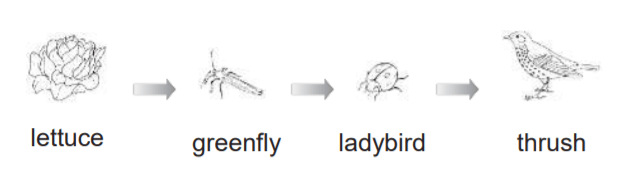
Who is the producer?

a)

lettuce

b)

greenfly

c)

ladybird

d)

thrush

100.

What is a producer?

a)

an organism that gets energy from eating other organisms

b)

an organisms that uses sunlight to make its own food

c)

an organism that gets energy from eating dead organisms, non-living material or waste

101.

An animal that hunts other animals for food is a ___________

a)

herbivore

b)

predator

c)

prey

d)

omnivore

102.

What is a herbivore?

a)

an animal that gets energy from eating other animals

b)

an organism that gets energy from eating only plants

c)

an animal that gets energy by eating both plants and other animals

103.

An organism that gets energy from eating other organisms is a ______________

a)

producer

b)

consumer

c)

decomposer

104.

A connection of food chains with many food energy paths in an ecosystem is a ____________

a)

ecosystem

b)

food web

c)

environment

105.

An animal that is hunted and eaten for food is a

a)

predator

b)

prey

106.

What is a carnivore?

a)

an animal that gets energy by eating other animals

b)

An animal that gets energy by eating only plants

c)

an animal that gets energy by eating both plants and animals

107.

An animal that gets energy from eating both plants and animals is a(n)

a)

herbivore

b)

carnivore

c)

omnivore

108.

Which of the following is NOT a consumer

a)

grass

b)

dog

c)

shark

d)

fish

109.

Which of the following is a living part of the ecosystem?

a)

Air

b)

Sunlight

c)

Mushroom

d)

Soil

110.
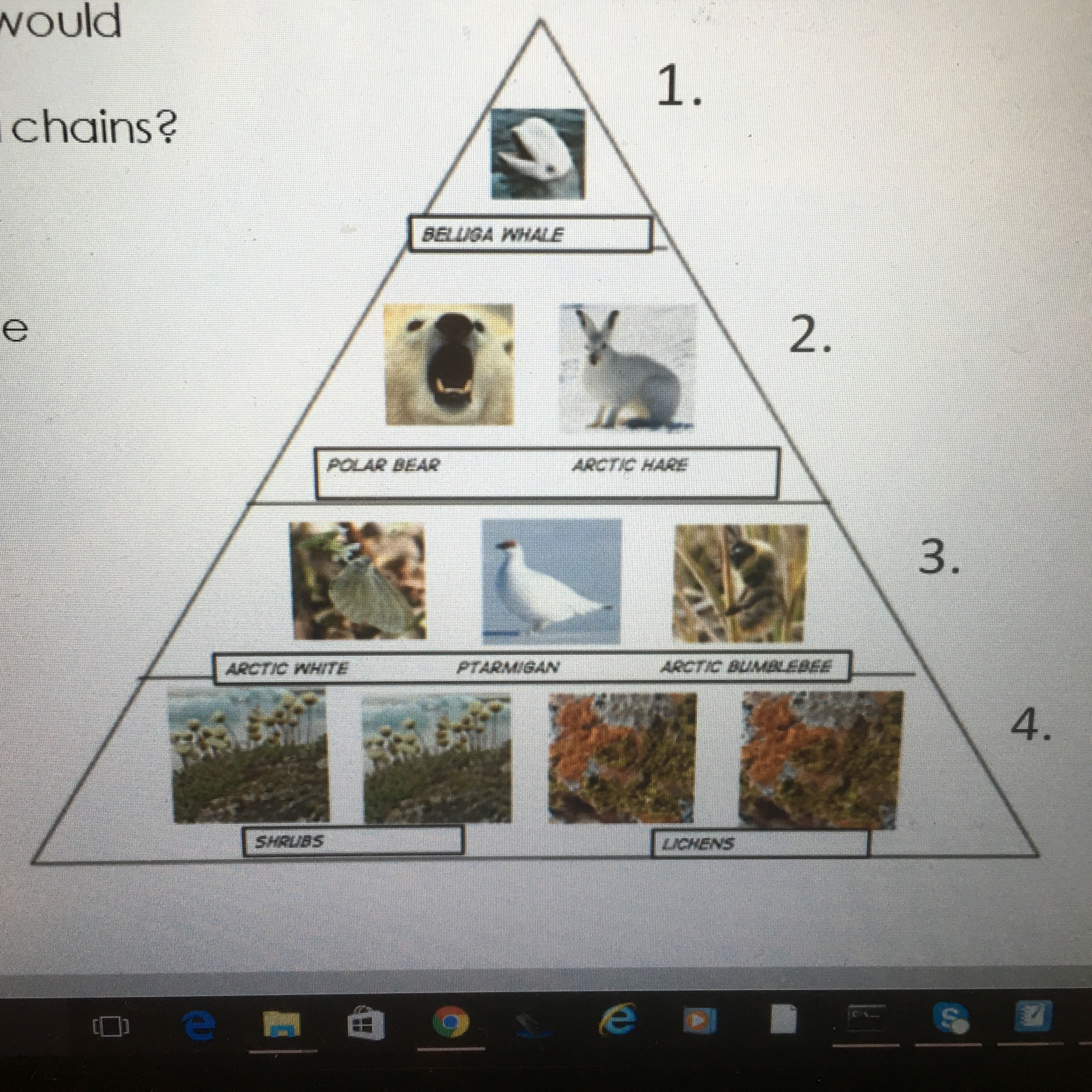
Which group are the producers? 
a)
1 and 2
b)
3 and 4
c)
4
d)
3
111.
The diagram represents a pyramid of energy in an ecosystem.  Which level would most likely contain members of the plant kingdom?
a)
A
b)
B
c)
C
d)
D
112.
Which of this energy roles is always located at the bottom of an energy pyramid?
a)
Producer
b)
Second-Level Carnivores
c)
Herbivores.
d)
First-Level Consumers.
113.
The largest group of organisms found in a food web would be:
a)
Primary Consumers
b)
Producers
c)
Decomposers
d)
Tertiary Consumers
114.
Which organism recieves the least amount of energy from the producer?
a)
Owl
b)
Grasshopper
c)
Lilypad
d)
Mouse
115.
If these organisms were arranged in a food pyramid, which organism would have the least amount of total energy available?
a)
coyote
b)
insect
c)
lizard
d)
shrub
116.
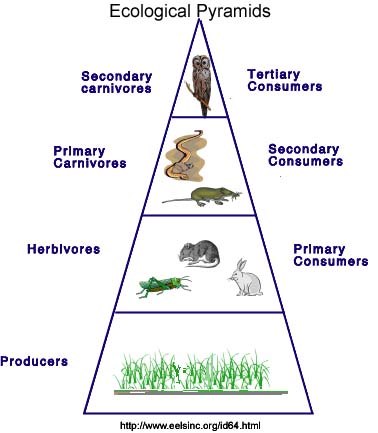
In the energy pyramid here, how much of the energy in the producers gets passed to the herbivores?
a)
10%
b)
20%
c)
80%
d)
90%
117.
In the energy pyramid here, which organisms have the most energy available?
a)
Producers
b)
Carnivores
c)
Herbivores
d)
Top Predator
118.
In the energy pyramid below, which organism has the least amount of energy available?
a)
Producers
b)
Herbivores
c)
Carnivores
d)
Top Predator
119.
A behavior that is developed by observing others or by being taught is a 
a)
learned behavior 
b)
inherited trait
c)
adaptation 
d)
function
120.
Characteristics passed from parents to their offspring.
a)
behavior
b)
learned trait
c)
inherited trait
d)
function
121.
Which of these is not an inherited trait?
a)
a bird building a nest
b)
a turtle burying its eggs
c)
a bear hibernating in winter
d)
a horse pulling a plow
122.
Which characteristic would most likely be inherited by a baby?
a)
brown hair
b)
crying a lot
c)
ability to jump high
d)
his ability to talk
123.
A dog rolls over and receives a treat. The dog rolls over again. This is an example of...
a)
learned behavior
b)
adaptive behavior
c)
inherited behavior
d)
instinctive behavior
124.
Which characteristic is inherited?
a)
hair color
b)
sleeping late
c)
enjoying hiking
d)
loving to read
125.
Which best describes an inherited trait?
a)
a characteristic one chooses to express
b)
a characteristic one receives from the food one eats
c)
a characteristic that is passed on from one's parents
d)
a characteristic that is influenced by one's surroundings
126.

A behavior animals are born knowing how to do is an __________.

a)

example

b)

animal

c)

option

d)

instinct

127.
What is an instinct?
a)
Characteristics passed from parents to offspring.
b)
A natural behavior that an organism inherits.
c)
A behavior that an organism obtains from experiences.
128.
Instinct, inherited trait, or learned behavior?Curly hair
a)
Instinct
b)
Inherited trait
c)
Learned behavior
129.
Instinct, inherited trait, or learned behavior?
Bears go into hibernation.
a)
Instinct
b)
Inherited trait
c)
Learned behavior
130.
Instinct, inherited trait, or learned behavior?
Anna has a southern accent.
a)
Instinct
b)
Inherited trait
c)
Learned behavior
131.
Instinct, inherited trait, or learned behavior?
Jamal is very tall.
a)
Instinct
b)
Inherited trait
c)
Learned behavior
132.
Instinct, inherited trait, or learned behavior?
A rabbit digs a burrow.
a)
Instinct
b)
Inherited trait
c)
Learned behavior
133.
A girl observes her brother and records some behaviors she saw.
Which is a learned behavior?
a)
blinking
b)
reading
c)
sleeping
d)
swallowing
134.

A woman is a great cook. Why are her children likely to become good cooks?

a)

They will learn to cook from instinct.

b)

They will learn to cook from watching her.

c)

They will inherit her cooking skills

d)

Cooking is inherited

135.

Which animal observation would be considered an instinct?

a)

a dog jumps 6 ft into the air to catch a Frisbee.

b)

a dog barks when its owner tells it to speak

c)

a dog barks when a stranger approaches it

d)

a dog sits upright and appears to beg for a treat

136.

Which trait below is NOT one that is inherited in puppies?

a)

number of whiskers

b)

length of tail

c)

injured paw

d)

eye color

137.
Structures or behaviors that help an
organism survive in its surroundings
a)
adaptations
b)
inherited traits
c)
learned behaviors
d)
structural behaviors
138.
Something that an organism does or the
way that an organism behaves or reacts
a)
traits
b)
structures
c)
behavior
d)
functions
139.
The way that parts are organized or put
together
a)
function
b)
structure
c)
trait
d)
logical
140.
The “job” that a body part does in an
organism
a)
function
b)
trait
c)
logical
d)
structure
141.
Occurring in the night
a)
logical
b)
structural
c)
function
d)
nocturnal
142.
New organisms that come from parent
organisms
a)
adaptations
b)
offspring
c)
behaviors
d)
function
143.
Things that an organism knows or senses
without having to be taught
a)
structural behaviors
b)
structural adaptations
c)
instincts
d)
non-instinctive behaviors
144.
Characteristics of an organism
a)
adaptations
b)
traits
c)
functions
d)
instincts
145.
Behaviors that an animal develops by
observing other animals or by being
taught
a)
learned behaviors
b)
structural behaviors
c)
inherited behaviors
d)
no behaviors
146.
Characteristics that are passed from
parents to their offspring
a)
broken leg
b)
structures
c)
behaviors
d)
inherited traits
147.
Behaviors that an animal inherits from
its parents
a)
instinctive behaviors
b)
traits
c)
offspring
d)
functions
148.
Something that makes sense
a)
practical
b)
expensive
c)
logical
d)
conductors & insulators
149.
A series of steps used by scientists to solve a problem or answer a question. 
a)
scientific method
b)
recipe
c)
data collection
d)
metric system
150.
A testable explanation to a problem that has not yet been tested. 
a)
data
b)
theory
c)
hypothesis
d)
fact
151.
This variable in an experiment is the one being changed by the scientist. 
a)
dependent variable
b)
independent variable
c)
data
d)
control group
152.
Testing a hypothesis often involves a(n):
a)
answer
b)
experiment
c)
problem
d)
safety check
153.
The summary at the end of an experiment that explains the results. 
a)
conclusion
b)
procedures
c)
materials
d)
responding variable
154.
The name of the information that you get from your experiment (you organize it into charts and graphs).
a)
observations
conclusion
b)
data
c)
variables
d)
hypothesis
155.
Dependent variable means
a)
the scientist controls what to test
b)
educated guess
c)
ask a question
d)
what is being measured
156.
If you increase the amount of spinach you eat, then you will increase the iron in your blood. 
What's the dependent variable?
a)
increase the amount of iron in your blood
b)
spinach you eat
157.
If I ride my bike to school instead of walking, then I will get to school faster. What is the dependent variable?
a)
True
b)
How fast you get to school
c)
Riding a bike or walking
d)
False
158.
Will a construction paper air plane fly faster than an airplane made from notebook paper? Choose the best hypothesis.
a)
If I make a paper airplane from notebook paper, then it will fly faster than construction paper.
b)
Yes.
c)
No.
d)
I think the construction paper air plane will fly faster.
159.
Which side of a penny will hold more drops of water? Choose the best hypothesis.
a)
If I use the heads side of a penny, then it will hold more drops of water than tails.
b)
Heads
c)
Tails
d)
Tails will hold more drops of water.
160.
If I study for my scientific method test, then I will have a better test score. What is the dependent variable?
a)
Scientific Method
b)
Studying
c)
Independent variable
d)
Test score
161.
If I listen to Mr. Castro's instructions, then I will have less accidents in the lab. What is the independent variable?
a)
Yes
b)
Maybe
c)
Listening or not listening to instructions
d)
Likelihood of having an accident in lab 
162.
If I read this question carefully, then I will answer it correctly. What is the independent variable?
a)
I hope so
b)
Yes
c)
Reading or not reading carefully
d)
Likelihood of a correct answer
163.
Which of the following would be considered quantitative data?
a)
Color
b)
Smell
c)
6.84 cm
d)
texture
164.
Explaining the color of a chemical would be what kind of observation?
a)
Qualitative 
b)
Quanitative
165.
What is the part of the experiment that is left alone or “natural", and is used to compare back to?
a)
Independent Variable
b)
Dependent Variable
c)
Control Group
d)
Experimental Group 
166.
You will want your experiment to have ____ independent variable(s) in it for the experiment to be valid.
a)
1
b)
2
c)
3
d)
4
167.
What is a factor that the experimenter has full control over and changes to see what happens?
a)
Dependent Variable
b)
Independent Variable
c)
Control group 
d)
Hypothesis
168.
What is a factor that changes because of what the experimenter does?
a)
Dependent Variable
b)
Independent Variable
c)
Control Group
d)
Hypothesis
169.
A series of steps used by scientists to solve a problem or answer a question. 
a)
scientific method
b)
recipe
c)
data collection
d)
metric system
170.
A testable explanation to a problem that has not yet been tested. 
a)
data
b)
theory
c)
hypothesis
d)
fact
171.
This variable in an experiment is the one being changed by the scientist. 
a)
dependent variable
b)
independent variable
c)
data
d)
control group
172.
Testing a hypothesis often involves a(n):
a)
answer
b)
experiment
c)
problem
d)
safety check
173.
The summary at the end of an experiment that explains the results. 
a)
conclusion
b)
procedures
c)
materials
d)
responding variable
174.
The name of the information that you get from your experiment (you organize it into charts and graphs).
a)
observations
conclusion
b)
data
c)
variables
d)
hypothesis
175.
Dependent variable means
a)
the scientist controls what to test
b)
educated guess
c)
ask a question
d)
what is being measured
176.
If you increase the amount of spinach you eat, then you will increase the iron in your blood. 
What's the dependent variable?
a)
increase the amount of iron in your blood
b)
spinach you eat
177.
If I ride my bike to school instead of walking, then I will get to school faster. What is the dependent variable?
a)
True
b)
How fast you get to school
c)
Riding a bike or walking
d)
False
178.
Will a construction paper air plane fly faster than an airplane made from notebook paper? Choose the best hypothesis.
a)
If I make a paper airplane from notebook paper, then it will fly faster than construction paper.
b)
Yes.
c)
No.
d)
I think the construction paper air plane will fly faster.
179.
Which side of a penny will hold more drops of water? Choose the best hypothesis.
a)
If I use the heads side of a penny, then it will hold more drops of water than tails.
b)
Heads
c)
Tails
d)
Tails will hold more drops of water.
180.
If I study for my scientific method test, then I will have a better test score. What is the dependent variable?
a)
Scientific Method
b)
Studying
c)
Independent variable
d)
Test score
181.
If I listen to Mr. Castro's instructions, then I will have less accidents in the lab. What is the independent variable?
a)
Yes
b)
Maybe
c)
Listening or not listening to instructions
d)
Likelihood of having an accident in lab 
182.
If I read this question carefully, then I will answer it correctly. What is the independent variable?
a)
I hope so
b)
Yes
c)
Reading or not reading carefully
d)
Likelihood of a correct answer
183.
Which of the following would be considered quantitative data?
a)
Color
b)
Smell
c)
6.84 cm
d)
texture
184.
Explaining the color of a chemical would be what kind of observation?
a)
Qualitative 
b)
Quanitative
185.
What is the part of the experiment that is left alone or “natural", and is used to compare back to?
a)
Independent Variable
b)
Dependent Variable
c)
Control Group
d)
Experimental Group 
186.
You will want your experiment to have ____ independent variable(s) in it for the experiment to be valid.
a)
1
b)
2
c)
3
d)
4
187.
What is a factor that the experimenter has full control over and changes to see what happens?
a)
Dependent Variable
b)
Independent Variable
c)
Control group 
d)
Hypothesis
188.
What is a factor that changes because of what the experimenter does?
a)
Dependent Variable
b)
Independent Variable
c)
Control Group
d)
Hypothesis